
Two Recipes · 40 Minutes · One Very Good Lunch
Tomato Soup With Grilled Cheese (The Cozy Classic, Done Properly)
A silky fire-roasted soup that needs no straining, and a sandwich built around a three-cheese blend that actually pulls.
- Soup in 35 minutes
- Sandwich in 10
- Freezer friendly
- Feeds a crowd
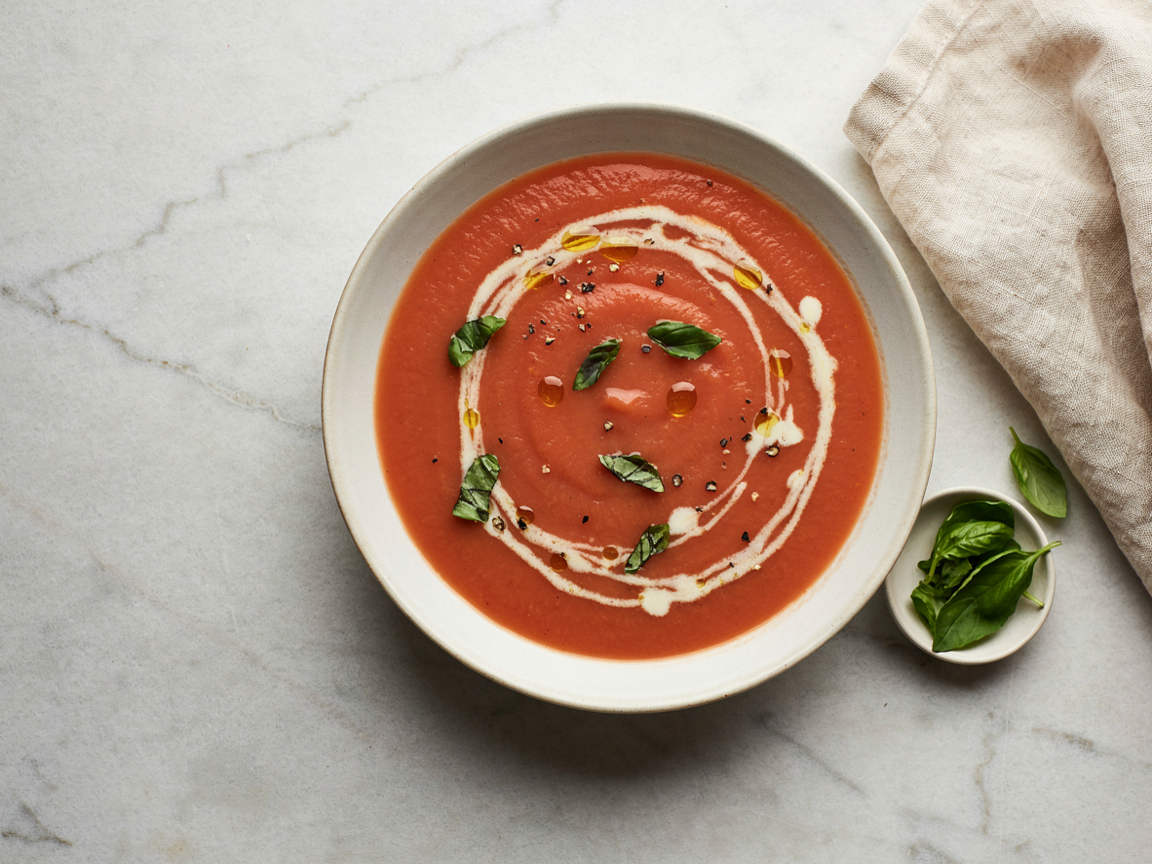
The sandwich leans on the rim rather than sitting in the soup. That detail is the difference between crisp and soggy.
Tomato soup with grilled cheese is the one pairing almost everybody has an opinion about, and almost nobody makes properly. The soup comes out of a can and the sandwich comes out of a pan too hot, so you end up with something thin and sweet next to bread that is burnt outside and cold in the middle.
Both halves are fixable in about forty minutes. The soup needs fire-roasted tomatoes and a blender, not cream by the cupful. The sandwich needs low heat and three cheeses, not one. Neither is difficult — they are just done in a hurry by most people, and it shows.
Save the pin so both recipes are one tap away when the weather turns.
Why Tomato Soup With Grilled Cheese Works So Well
This is not just nostalgia. The pairing is genuinely well engineered, and understanding why tells you what to fix when it disappoints.
Acid against fat
Tomatoes are sharp and bright. Melted cheese is rich and coating. Each one resets your palate for the other, which is why you can eat far more of both together than separately.
Smooth against crunch
A blended soup has no texture at all by design. The crisp crust of the sandwich supplies every bit of it, which is why a soggy grilled cheese ruins the whole plate.
Bread is the spoon
The sandwich is structural. It has to be sturdy enough to dunk and lift without collapsing, which rules out soft sandwich bread no matter how good it tastes toasted.
Both scale easily
The soup doubles without any adjustment and freezes well. Sandwiches can be made in batches in the oven. Together they are one of the easiest things to feed eight people.
The one thing most recipes get wrong: they fix a thin, sharp soup by pouring in more cream. That flattens the tomato flavour instead of balancing it. The real fix is tomato paste cooked until it darkens and a teaspoon of sugar — which is in the recipe below.
The Soup
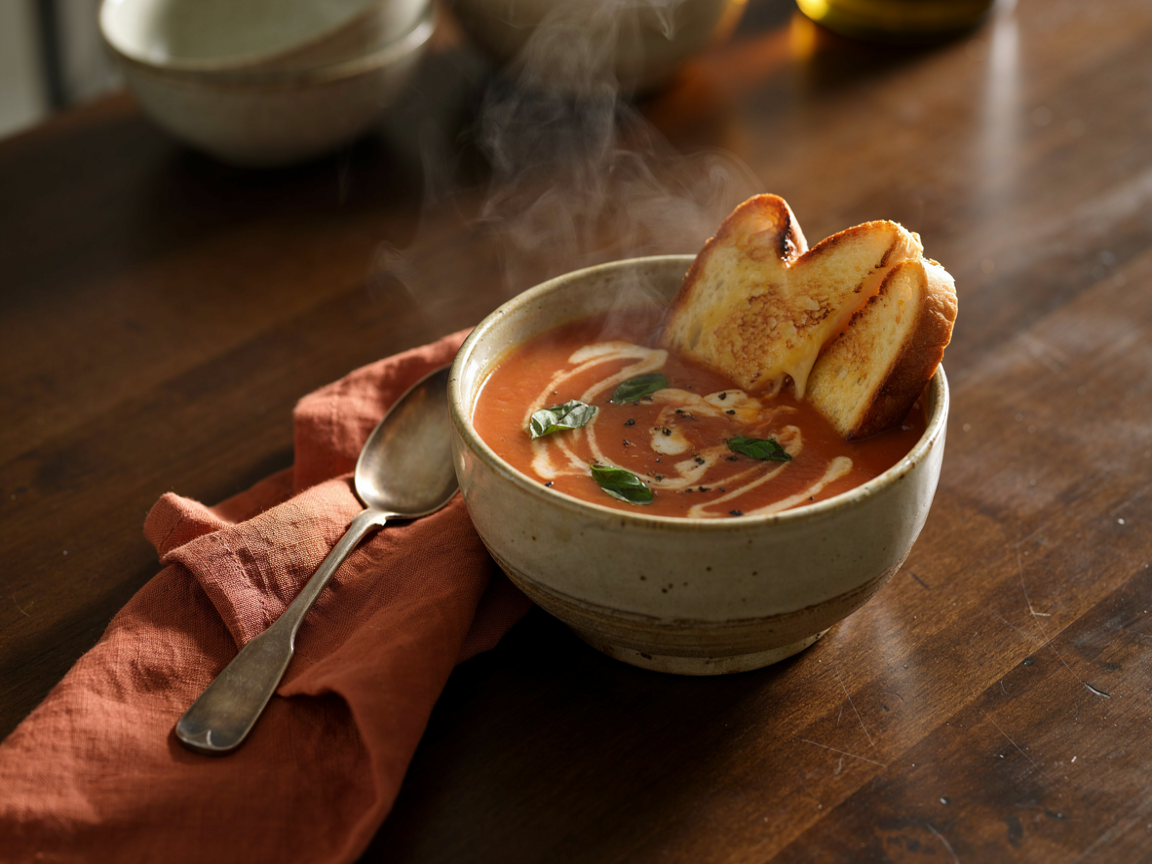
Blended properly, it needs no straining. That velvet texture comes from the blender, not from cream.
Creamy Fire-Roasted Tomato Soup
Onion and garlic softened in butter, tomato paste cooked dark, fire-roasted tomatoes simmered and blended silky, cream stirred in off the heat.
How many bowls?
Ingredients
- 1 tbsp butter + 1½ tsp oil2 tbsp butter + 1 tbsp oil3 tbsp butter + 1½ tbsp oil¼ cup butter + 2 tbsp oil unsalted butter and olive oil
- ½ medium1 medium1 large2 medium yellow onion, diced small
- 2 cloves4 cloves6 cloves8 cloves garlic, sliced thin
- 1 tbsp2 tbsp3 tbsp¼ cup tomato paste
- 1 can (14.5 oz)1 can (28 oz)1 can (28 oz) + 1 can (14.5 oz)2 cans (28 oz) fire-roasted crushed or whole tomatoes
- 1 cup2 cups3 cups4 cups chicken or vegetable stock
- ¼ cup½ cup¾ cup1 cup heavy cream, plus more to swirl
- ½ tsp1 tsp1½ tsp2 tsp sugar, to balance the acid
- ½ tsp salt, ¼ tsp pepper¾ tsp salt, ½ tsp pepper1 tsp salt, ¾ tsp pepper1½ tsp salt, 1 tsp pepper fine salt and black pepper, plus more to taste
- To finish torn fresh basil and a drizzle of olive oil
Instructions
Soften the onion properly
Melt the butter with the olive oil over medium-low heat, add the onion and a pinch of salt, and cook gently for 8 to 10 minutes until completely soft and translucent. Do not rush this — undercooked onion stays sharp all the way through the finished soup.
Add the garlic
Stir in the sliced garlic and cook for 1 minute more, just until it smells sweet. Garlic burns in about 90 seconds at this heat and burnt garlic is bitter right through a blended soup.
Cook the tomato paste until it darkens
Add the tomato paste and stir constantly for 2 to 3 minutes until it turns from bright red to a deep brick colour and starts sticking to the pan. This step is where most of the soup’s depth comes from.
Simmer
Pour in the tomatoes and the stock, add the sugar, salt and pepper, and scrape the bottom of the pan clean. Bring to a gentle simmer and cook uncovered for 20 to 25 minutes, stirring occasionally.
Blend until genuinely silky
Blend with an immersion blender for a full 2 minutes, or in a countertop blender in batches with the lid vented. Longer than feels necessary is the point — this is what makes straining unnecessary.
Cream in off the heat
Take the pot off the burner, wait 30 seconds, then stir in the cream. Adding cream to a boiling acidic soup is what makes it curdle into grainy specks.
Taste and finish
Taste and adjust: more salt if it tastes flat, a pinch more sugar if it tastes sharp. Serve with torn basil, a swirl of cream and a drizzle of olive oil.
Roughly, per serving
Soup calculated from the 4-serving quantities divided four ways. The sandwich figure assumes two slices of sourdough, 2 oz of the cheese blend and 1 tbsp of butter.
These are estimates, not a lab analysis. Bread weight varies enormously between loaves and is the single biggest variable here. Using milk instead of cream drops the soup to roughly 200 calories a bowl.
The Grilled Cheese
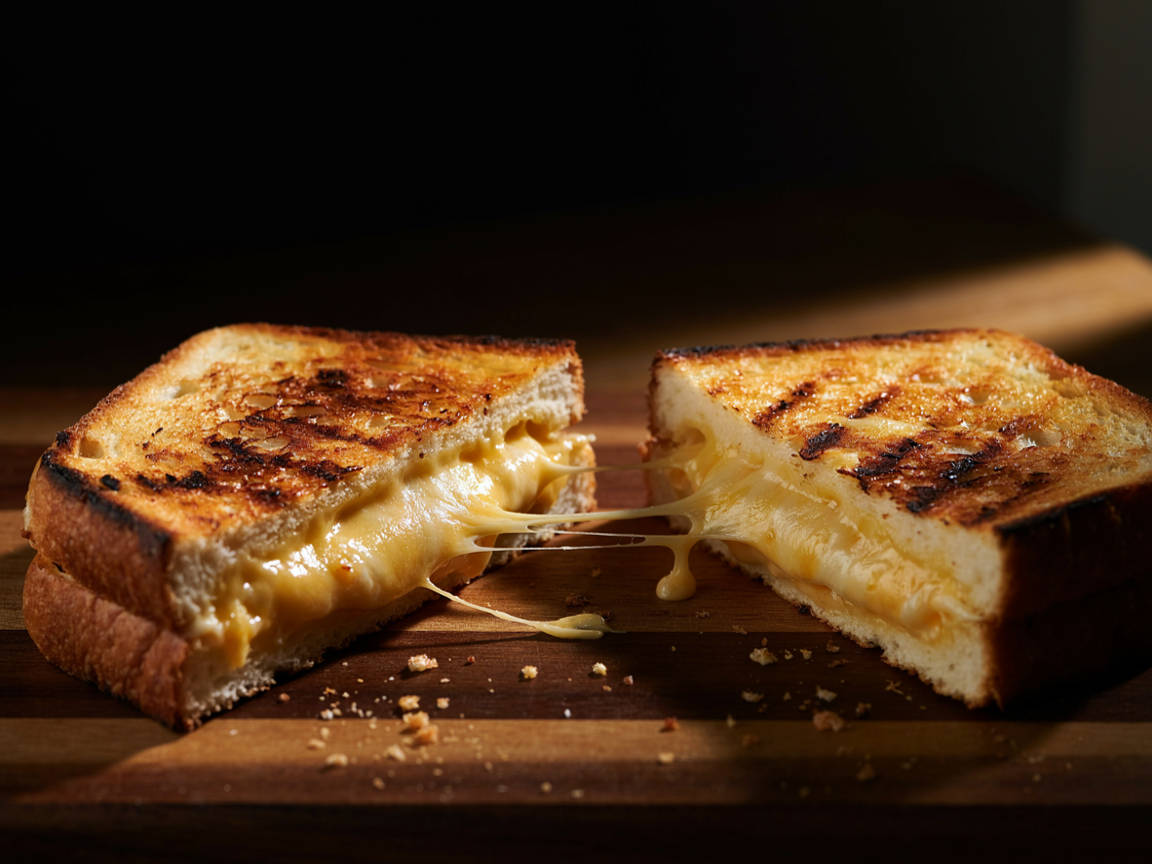
That pull comes from low-moisture mozzarella in the blend. Cheddar alone will not do it.
Three-Cheese Grilled Cheese
Sharp cheddar for flavour, gruyère for the melt, low-moisture mozzarella for the pull — cooked low and slow under a lid.
How many sandwiches?
Ingredients
- 2 slices4 slices8 slices12 slices sturdy sourdough or country white, about ½ inch thick
- 1 oz2 oz4 oz6 oz sharp cheddar, grated
- ½ oz1 oz2 oz3 oz gruyère, grated
- ½ oz1 oz2 oz3 oz low-moisture mozzarella, grated
- 1 tbsp2 tbsp¼ cup6 tbsp softened butter, or mayonnaise for the outsides
Instructions
Grate everything yourself
Grate all three cheeses on the coarse side of a box grater and toss them together in a bowl. Pre-shredded cheese is coated in starch to stop it clumping and it melts into a greasy, separated mess.
Butter the outsides, not the pan
Spread softened butter or a thin layer of mayonnaise right to the edges of one side of each slice. Edge-to-edge coverage is what gives you an evenly golden crust instead of a pale rim.
Build it
Place one slice butter-side down, pile the cheese mix on evenly all the way to the corners, and top with the second slice butter-side up. Corners with no cheese are the most disappointing bite in the sandwich.
Cook low and covered
Into a cold non-stick or cast iron pan, then set the heat to medium-low. Cover with a lid for the first 3 to 4 minutes — the trapped heat melts the middle while the outside is still browning.
Flip once, press lightly
When the underside is deep golden, flip and cook uncovered for another 3 to 4 minutes, pressing gently once with a spatula. Pressing hard squeezes the cheese out of the sides.
Rest a minute, then cut
Let it sit for a full minute on a board before cutting. Cut immediately and the molten cheese runs out; rest it briefly and it sets just enough to stretch instead.
Pick Your Cheese Blend
All four use the same 4 oz total per two sandwiches. Tap one to see the ratio.
Classic cheddar — pure nostalgia
One cheese, strong flavour, the version most people picture. It is also the trickiest to melt well.
- 4 oz sharp or extra-sharp cheddar, grated
- Aged cheddar has less moisture and separates more easily — keep the heat genuinely low
- Mild cheddar melts more smoothly but tastes of very little against the soup
Best melt — the house blend
The balance used in the recipe above, and the one to make if you are making it once.
- 2 oz sharp cheddar for flavour
- 1 oz gruyère for a smooth, nutty, even melt
- 1 oz low-moisture mozzarella for stretch
Maximum pull — for the photo
Weighted towards stretch. Slightly milder, considerably more dramatic.
- 2 oz low-moisture mozzarella
- 1½ oz sharp cheddar
- ½ oz provolone
- Slice the mozzarella rather than grating it for even longer strands
Spicy — cuts the richness
Heat plays extremely well against a sweet tomato soup, and it stops the whole plate feeling heavy.
- 2 oz pepper jack
- 2 oz sharp cheddar
- Add a thin smear of chipotle paste or hot honey inside one slice
- A few pickled jalapeño slices, patted dry first so they do not steam the bread
Substitutions That Actually Work
Swaps for both halves of the plate. The method does not change for any of them.
| Instead of | Use | What changes |
|---|---|---|
| Instead ofFire-roasted tomatoes | UsePlain crushed tomatoes plus ½ tsp smoked paprika | What changesAlmost indistinguishable — the paprika supplies the char note |
| Instead ofCanned tomatoes | Use2½ lb fresh tomatoes, halved and roasted at 425°F for 30 minutes first | What changesAdds 40 minutes and only worth it at the height of summer |
| Instead ofHeavy cream | UseWhole milk plus 1 tbsp extra butter, or full-fat canned coconut milk | What changesThinner; add it at the very end and do not let it near a simmer |
| Instead ofAn immersion blender | UseA countertop blender, in batches, with the lid vented | What changesNever fill past halfway — hot soup expands violently and the lid will lift |
| Instead ofStock | UseWater plus an extra tablespoon of tomato paste | What changesFlatter, so salt in stages and taste as you go |
| Instead ofGruyère | UseComté, Emmental or simply more sharp cheddar | What changesSlightly less nutty, melts identically |
| Instead ofSourdough | UseCountry white, pain de mie or thick-cut Texas toast | What changesAvoid soft sandwich bread and open-crumbed loaves like ciabatta — both collapse when dunked |
The one swap not worth making: pre-shredded cheese in the sandwich. The starch coating that stops it clumping in the bag also stops it melting cleanly, and you get grease separating out instead of a pull.
Dunk Engineering
The sandwich has one structural job — to survive being dipped in hot soup and lifted back out. Most of them fail at it, and the reasons are boringly consistent.
Bread thickness is the main variable. Around half an inch is the sweet spot. Thinner and it goes limp on contact with the soup; much thicker and the middle never melts before the outside burns. Standard soft sandwich bread is roughly a quarter inch and it will disintegrate.
Use bread with a tight crumb. Sourdough, country white and pain de mie all work. Bread with big open holes — ciabatta, rustic no-knead loaves — lets the soup straight through and the sandwich collapses in your hand.
The crust is the waterproofing. An evenly golden, properly crisp surface takes several seconds to soften. A pale or patchy crust soaks instantly, which is the real reason edge-to-edge buttering matters.
Dunk the corner, not the flat. A corner presents the least surface area and the most crust. Dipping the long cut edge soaks the exposed crumb immediately.
Serve the sandwich beside the bowl, never in it. Propped against the rim it stays crisp for the whole meal. Resting in the soup, it is finished within about ninety seconds.
If you only change one thing: cut the sandwich on the diagonal. Two triangles give you four sharp corners to dunk with instead of two blunt ones, and they hold their structure far better than rectangles.
Make Ahead, Freeze, and Feeding a Crowd
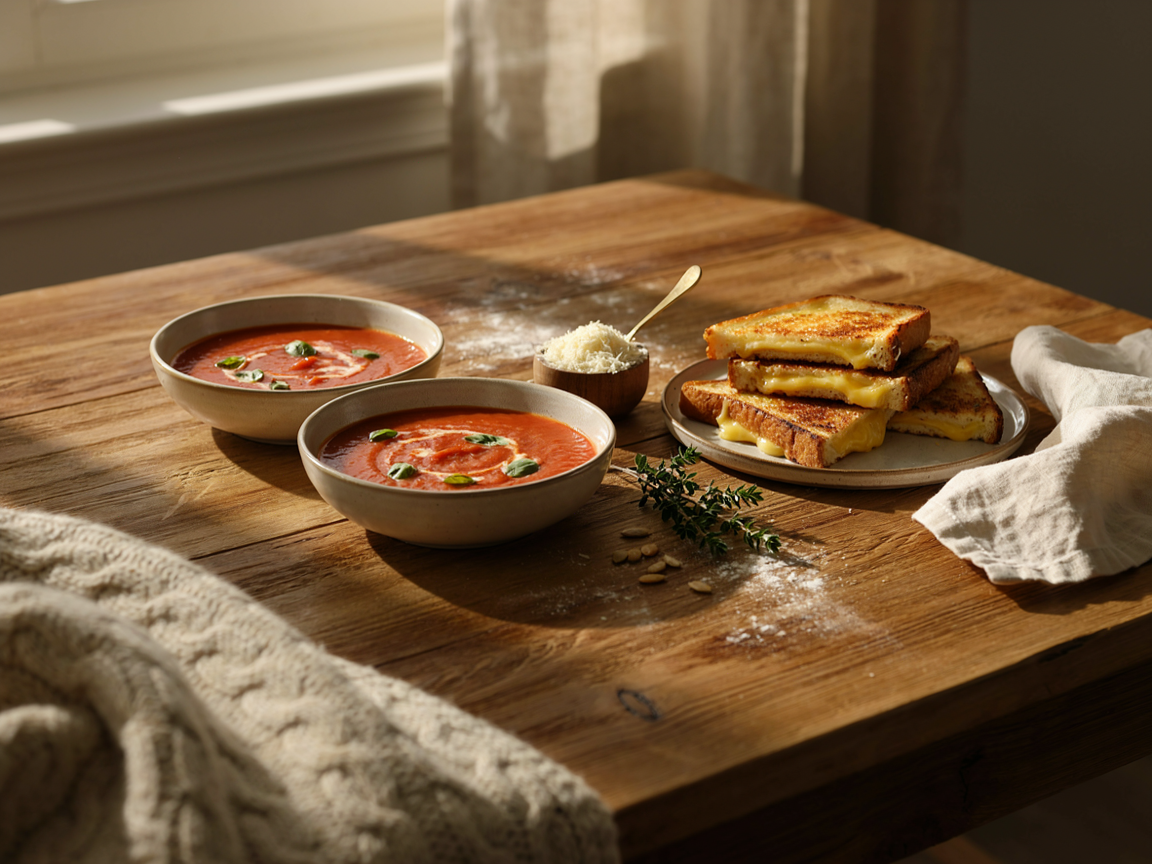
Soup made the day before, sandwiches done in the oven, everything on the table at once.
Pick your timeline:
Serving today
The soup is better after 20 minutes off the heat than it is straight off the stove — the flavours settle and the texture thickens slightly. Make it first, let it sit covered while you cook the sandwiches, then warm it gently for a minute before serving. Do not let it boil once the cream is in.
Soup up to 4 days ahead
It genuinely improves overnight. Make it through the blending step but leave the cream out, cool it and refrigerate for up to 4 days. Reheat gently on the stove, then stir the cream in off the heat just before serving. Holding the cream back is what keeps it from splitting on the second heating.
Freezing — up to 3 months
Freeze it without the cream, in portions, leaving an inch of headspace. Thaw overnight in the fridge, reheat gently and add the cream at the end. Frozen with the cream already in, it will separate on thawing — still edible, but grainy and thin. Grilled cheese does not freeze in any useful way, so make those fresh.
Grilled cheese for a crowd
Do not stand at the stove doing them one at a time. Assemble every sandwich, butter the outsides, and lay them on a preheated sheet pan in a 425°F oven for 6 minutes, then flip and give them 4 to 5 more. They come out evenly golden and all at once. For a large batch, preheat two pans and rotate them halfway through.
What Else to Put on the Table
The pairing is already complete, so everything here is about making it go further.
A toppings bar
Small bowls of parmesan crisps, croutons, chilli oil, basil oil and cracked pepper. It costs nothing and turns one pot of soup into something people build themselves.
A sharp, undressed salad
Bitter leaves with lemon and olive oil. Against a creamy soup and a rich sandwich, you want acid and crunch, not another soft texture.
Turn it into dinner
Stir a drained can of white beans or a handful of cooked orzo into the finished soup. It goes from a starter to a full meal without changing the flavour.
More things to dunk
Breadsticks, cheese straws, or a halved and toasted bagel. Anything with a firm crust holds up; anything soft does not.
Troubleshooting
Pick whatever went wrong:
The soup tastes sharp or sour
Canned tomatoes vary enormously in acidity and some brands need a lot more balancing than others. The fix: add sugar a quarter-teaspoon at a time, tasting between each — you are not making it sweet, you are cancelling the sharpness. A pinch of baking soda neutralises acid directly if sugar is not enough, but add it off the heat because it foams up dramatically.
The soup is too thin
Too much stock, or not enough simmering. The fix: simmer it uncovered for another 10 minutes to reduce, which concentrates the flavour at the same time. For a faster fix, blend in a slice of the sandwich bread torn up, or a tablespoon of tomato paste — both thicken without diluting. Remember that it thickens noticeably as it cools.
The cream curdled into specks
Cream added to a boiling acidic soup will split almost every time. The fix: blend it again — an immersion blender brings most curdled tomato soup back together completely. To prevent it, take the pot off the heat, wait 30 seconds, then stir the cream in. Warming the cream slightly first helps too.
Bread burnt, cheese still cold
The pan was too hot. This is the single most common grilled cheese failure. The fix: start the sandwich in a cold pan and set the heat to medium-low, then cover it with a lid for the first 3 to 4 minutes. The trapped steam melts the cheese while the crust browns slowly. If the outside is already dark and the middle is not melted, finish it in a 350°F oven for 3 minutes.
The sandwich went soggy
Bread too thin, crust too pale, or it was sitting in the soup. The fix: use half-inch slices of tight-crumbed bread, butter right to the edges so the whole surface crisps, and rest the sandwich against the rim of the bowl rather than in it. Cut on the diagonal and dunk corner-first.
Questions, Answered
What is the best cheese for grilled cheese?
A blend beats any single cheese. Sharp cheddar brings the flavour, gruyère melts smoothly and evenly, and low-moisture mozzarella provides the stretch. Two ounces of cheddar with one ounce each of gruyère and mozzarella covers two sandwiches. Always grate it yourself, because pre-shredded cheese is coated in starch that stops it melting cleanly.
How do I stop my tomato soup tasting acidic?
Add sugar a quarter-teaspoon at a time and taste between each addition. You are not trying to make the soup sweet, just to cancel the sharpness of the canned tomatoes, which varies a lot between brands. Cooking the tomato paste until it darkens also builds sweetness naturally, and a pinch of baking soda stirred in off the heat neutralises acid directly if sugar is not enough.
Why did my tomato soup curdle when I added cream?
Cream added to boiling acidic soup splits almost every time. Take the pot off the burner, wait about 30 seconds, then stir the cream in. Warming the cream slightly beforehand helps as well. If it has already curdled, blending the soup again with an immersion blender brings it back together almost completely.
Can I make tomato soup ahead of time?
Yes, and it improves overnight. Make it through the blending step but leave the cream out, then refrigerate for up to 4 days or freeze for up to 3 months. Reheat it gently and stir the cream in off the heat just before serving. Holding the cream back is what stops the soup splitting when you reheat it.
What bread is best for grilled cheese to dunk?
Sturdy bread with a tight crumb, sliced about half an inch thick. Sourdough, country white and pain de mie all work well. Avoid soft sandwich bread, which is too thin and goes limp on contact with soup, and avoid open-crumbed breads like ciabatta, which let the soup straight through and collapse in your hand.
Should I use butter or mayonnaise on grilled cheese?
Both work and each has a trade-off. Butter tastes better and browns richer but burns more easily because of its milk solids. Mayonnaise has a higher smoke point, spreads straight from the fridge and gives a very even golden crust, but it tastes slightly tangier. Whichever you use, spread it right to the edges so the whole surface crisps.
How do I make grilled cheese for a crowd?
Use the oven rather than a pan. Assemble the sandwiches, butter the outsides, and lay them on a preheated sheet pan in a 425°F oven for 6 minutes, then flip them and give them another 4 to 5 minutes. They come out evenly golden and all at the same time. For a large batch, preheat two pans and rotate them halfway through.
Do I need to peel or strain the tomatoes?
No, provided you blend for long enough. Blending for a full 2 minutes with an immersion blender, or in batches in a countertop blender, breaks down the skins and seeds completely and gives a velvety texture with no straining at all. Most gritty homemade tomato soup is simply under-blended rather than in need of a sieve.
Keep Reading
More from the soup shelf, for when tomato is not what tonight calls for.
Cook the tomato paste until it darkens, blend the soup longer than feels necessary, add the cream off the heat, and cook the sandwich lower and slower than you think. Four small things, and together they are the whole difference.
Pin this tomato soup with grilled cheese so both recipes and the cheese blends are there the next time it turns cold — then come back and tell us which blend you went with.
