
Water Bath · Tested Method · Shelf Stable
Best Homemade Pizza Sauce for Canning (Tested Water Bath Recipe)
Thick, herby and genuinely safe on the shelf: paste tomatoes reduced by half, seasoned with dried herbs, and acidified jar by jar the way tested canning recipes require. Easy enough for a first canning day.
- Water bath
- Makes 6 pints
- Keeps 1 year
- Printable card
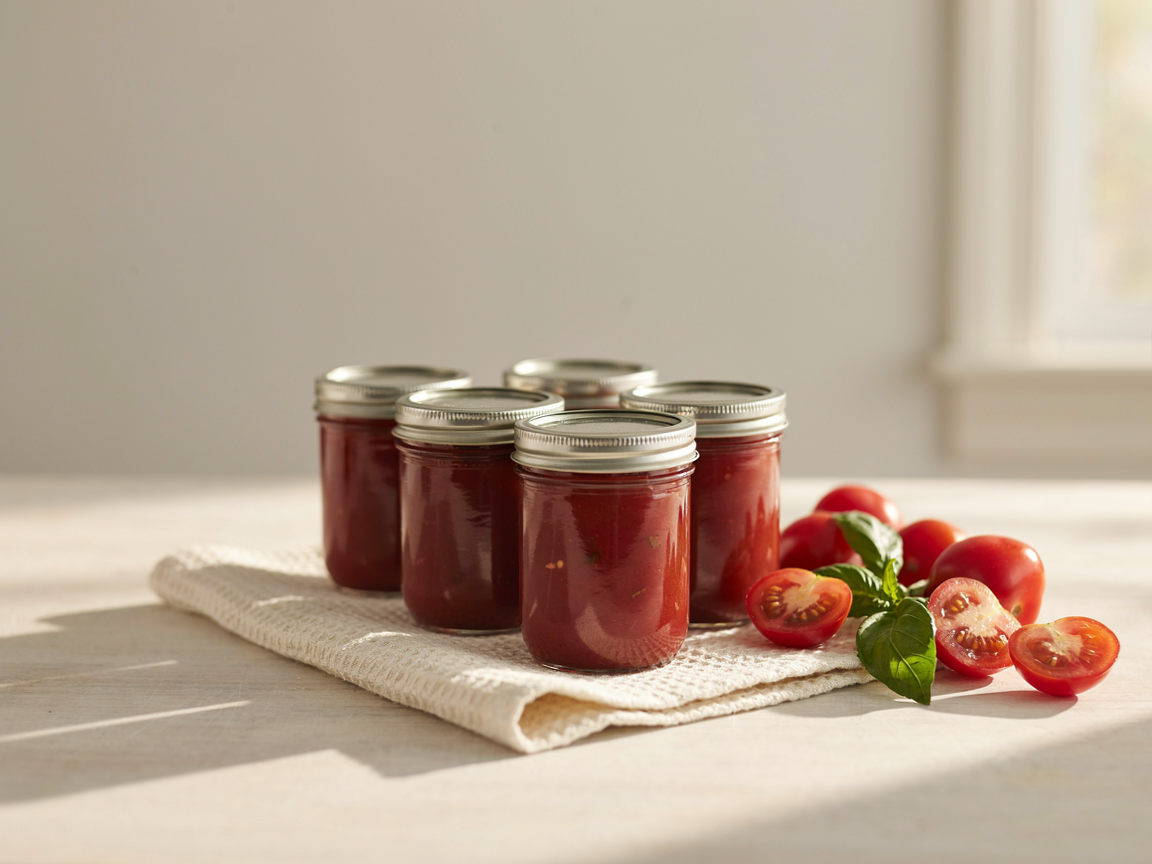
Six sealed pints from a single afternoon and twenty pounds of tomatoes.
This homemade pizza sauce for canning follows the tested water bath method rather than a version invented for a blog: tomatoes, dried herbs and spices in the jar, bottled lemon juice added to every jar, 35 minutes in a boiling water bath for pints.
The fresh garlic, onion and olive oil you want in a pizza sauce are not in the jar, and that is deliberate. They are low-acid, and they make a water-bath sauce unsafe. They go in when you open it, which takes three minutes and tastes better anyway — there is a whole section on it below, along with a pressure-canning route if you would rather have them in the jar.
Making sauce for this week instead of the pantry? Our homemade pizza sauce with fresh tomatoes is the one to use, with the garlic and oil in it from the start.
Read This First: What Makes Canned Pizza Sauce Safe
Almost every pizza sauce canning recipe online has fresh onion, fresh garlic and olive oil in the jar and a water bath time underneath it. Those two things do not go together, and this is the part worth understanding before you start.
Tomatoes sit right on the line
The line between water-bath safe and pressure-canner territory is pH 4.6, and tomatoes hover right around it — most land between 4.0 and 4.9, and some varieties test above 4.6 outright. Variety, ripeness, soil and even the weather push individual batches either side of it. That is why every tested recipe acidifies: you are not adjusting flavour, you are moving the whole jar reliably below 4.6.
Bottled lemon juice, per jar, every time
1 tablespoon per pint or 2 tablespoons per quart, or ¼ teaspoon of citric acid per pint and ½ per quart. Bottled, not fresh — bottled juice has a standardised acidity and fresh lemons do not. Sugar can offset the taste, but the acid never comes out.
Onion, garlic and oil are low-acid
Adding them raises the pH of the whole jar and gives botulism spores somewhere to survive. The tested recipe that does contain them is pressure-canned only, and even that one warns against increasing the proportions. In a water bath, they stay out of the jar.
Never thicken with starch
Cornstarch, flour and roux are not safe in home-canned goods, because they slow the heat reaching the middle of the jar. You get a thick pizza sauce by evaporating water out of it, or by thickening it after you open it.
Where these numbers come from. The processing times, headspace and acid amounts on this page are the National Center for Home Food Preservation’s figures for Standard Tomato Sauce, which permits salt only and no vegetables or oil. The pressure-canned version further down is their Spaghetti Sauce without Meat. The acid amounts are their tomato acidification directions. We have not adjusted any of them.
Home canning is one of the few places in cooking where improvising has real consequences. Season to taste all you like, but treat the tomato-to-acid ratio, the headspace and the processing time as fixed.
Choosing Tomatoes and How Many Pounds You Need
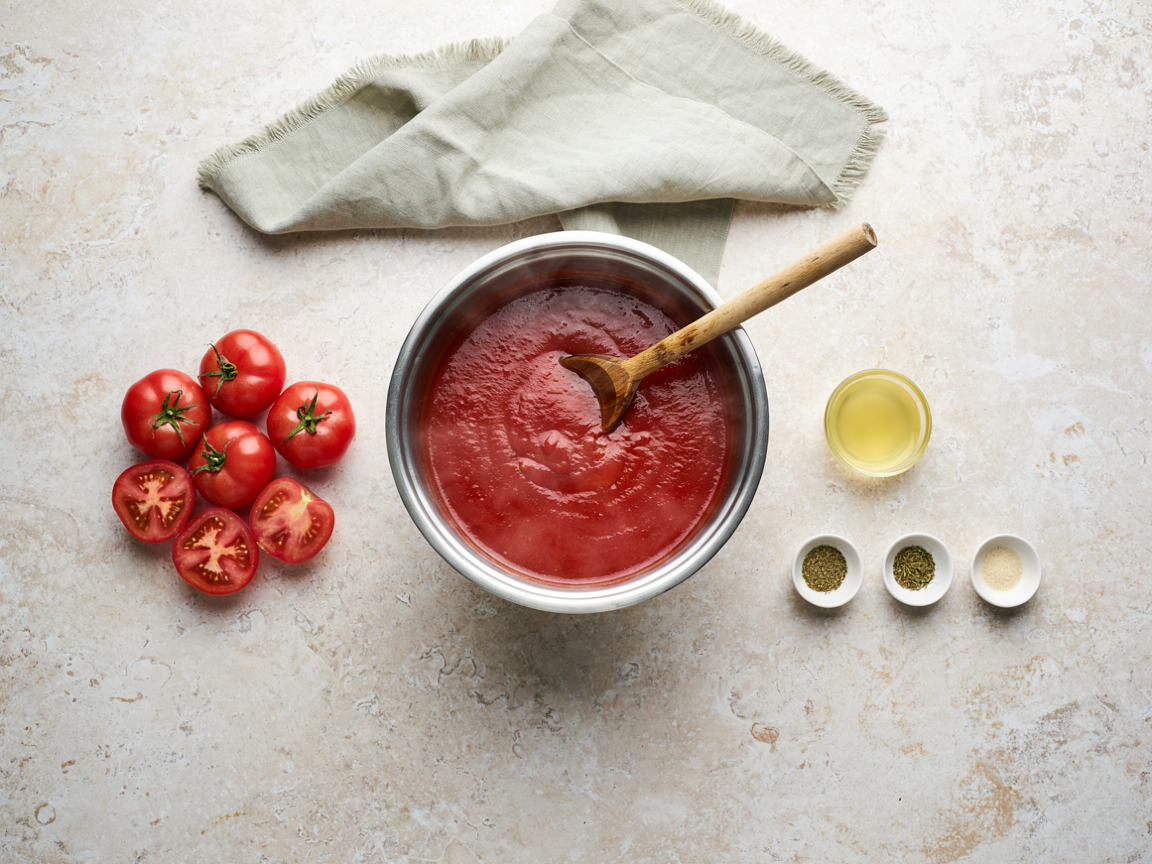
Paste tomatoes, dried herbs and bottled lemon juice. Nothing else goes in the jar.
Paste tomatoes have dense flesh and little seed pulp, so they turn into thick sauce with far less boiling. Anything will work, but the choice changes how long you stand at the stove.
| Tomato | What it is like | How it behaves |
|---|---|---|
| TomatoRoma | What it is likeMeaty, low moisture, few seeds | How it behavesThe default. Cooks down fastest and gives the thickest sauce for the least time on the stove. |
| TomatoSan Marzano | What it is likeSweet, low acid, very little seed pulp | How it behavesThe best flavour of the three and worth the price if you can get them. Still needs acidifying like any other tomato. |
| TomatoOther paste varieties | What it is likeAmish Paste, Opalka, Heinz and similar | How it behavesAnything sold as a paste or sauce tomato behaves the same way. Look for dense flesh rather than size. |
| TomatoBeefsteak and slicers | What it is likeJuicy, seedy, high water content | How it behavesThey work but take roughly twice as long to reduce, and you lose more to evaporation. Use them if that is what the garden gave you. |
| TomatoCherry and grape | What it is likeSweet but very high skin-to-flesh ratio | How it behavesBest run through a food mill rather than peeled by hand. Expect a lower yield per pound. |
How Many Tomatoes for Canning Pizza Sauce
This is where most recipes mislead people. Thick sauce takes roughly 6 to 7 pounds of tomatoes per quart, because more than half the weight is water that has to boil away.
| Fresh tomatoes | Finished sauce | What to expect |
|---|---|---|
| Fresh tomatoes10 lb | Finished sauceAbout 3 pints | What to expectA single large pot. The right size for a first attempt. |
| Fresh tomatoes20 lb | Finished sauceAbout 6 pints | What to expectA full canner load of pints, and the quantities on the recipe card. |
| Fresh tomatoes30 lb | Finished sauceAbout 9 pints | What to expectTwo canner loads. Reduce in two pots so it does not take all day. |
| Fresh tomatoes53 lb (one bushel) | Finished sauceAbout 15 to 16 pints | What to expectA whole bushel from the farmers market. Plan for a full day. |
Short on fresh tomatoes? Six 28-ounce cans of crushed tomatoes replace 20 pounds of fresh and cut the simmering to 30 or 40 minutes. Acidify every jar exactly the same way — commercially canned tomatoes are not acidified for home canning.
Homemade Pizza Sauce for Canning Recipe
Equipment You Need
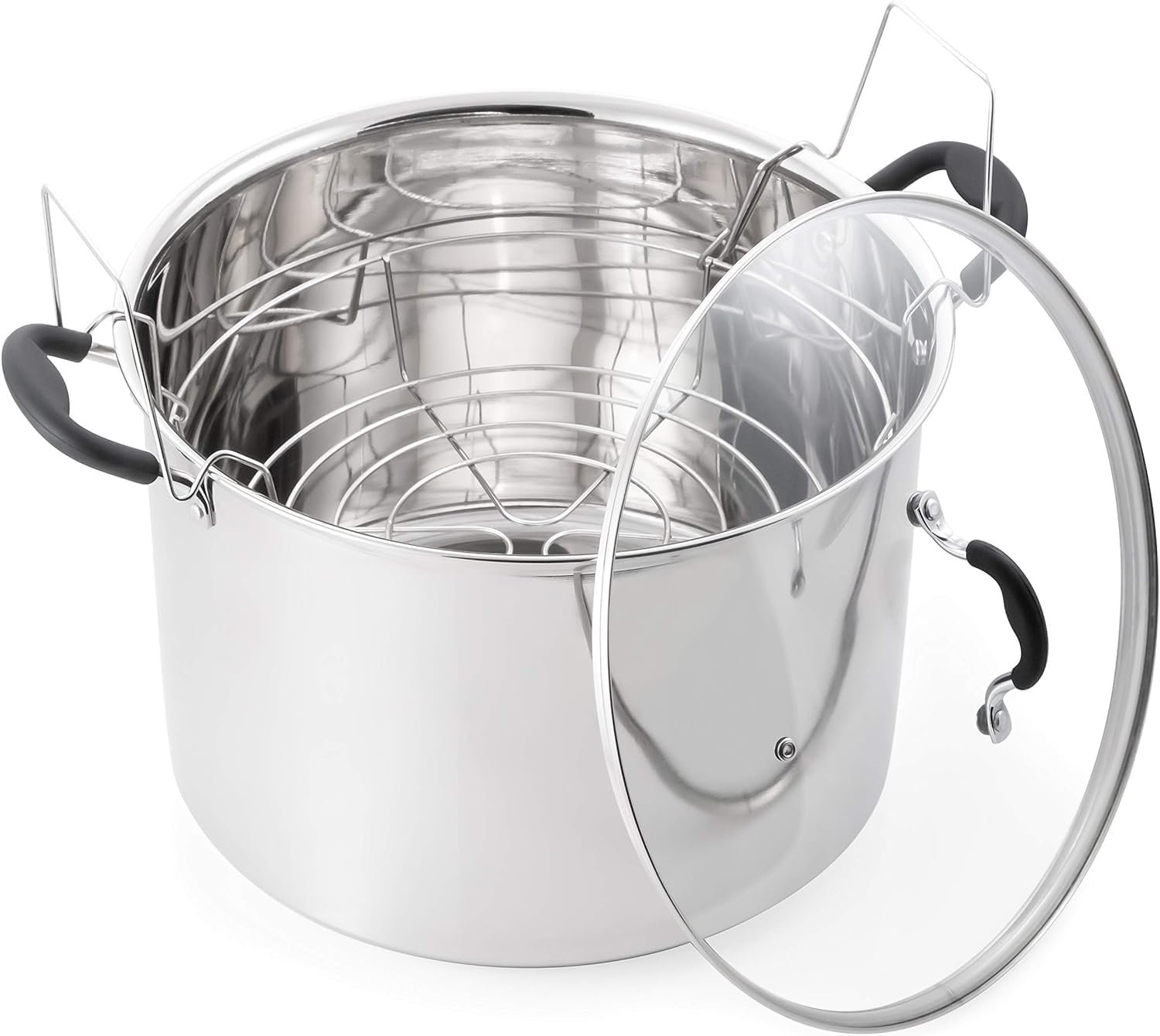
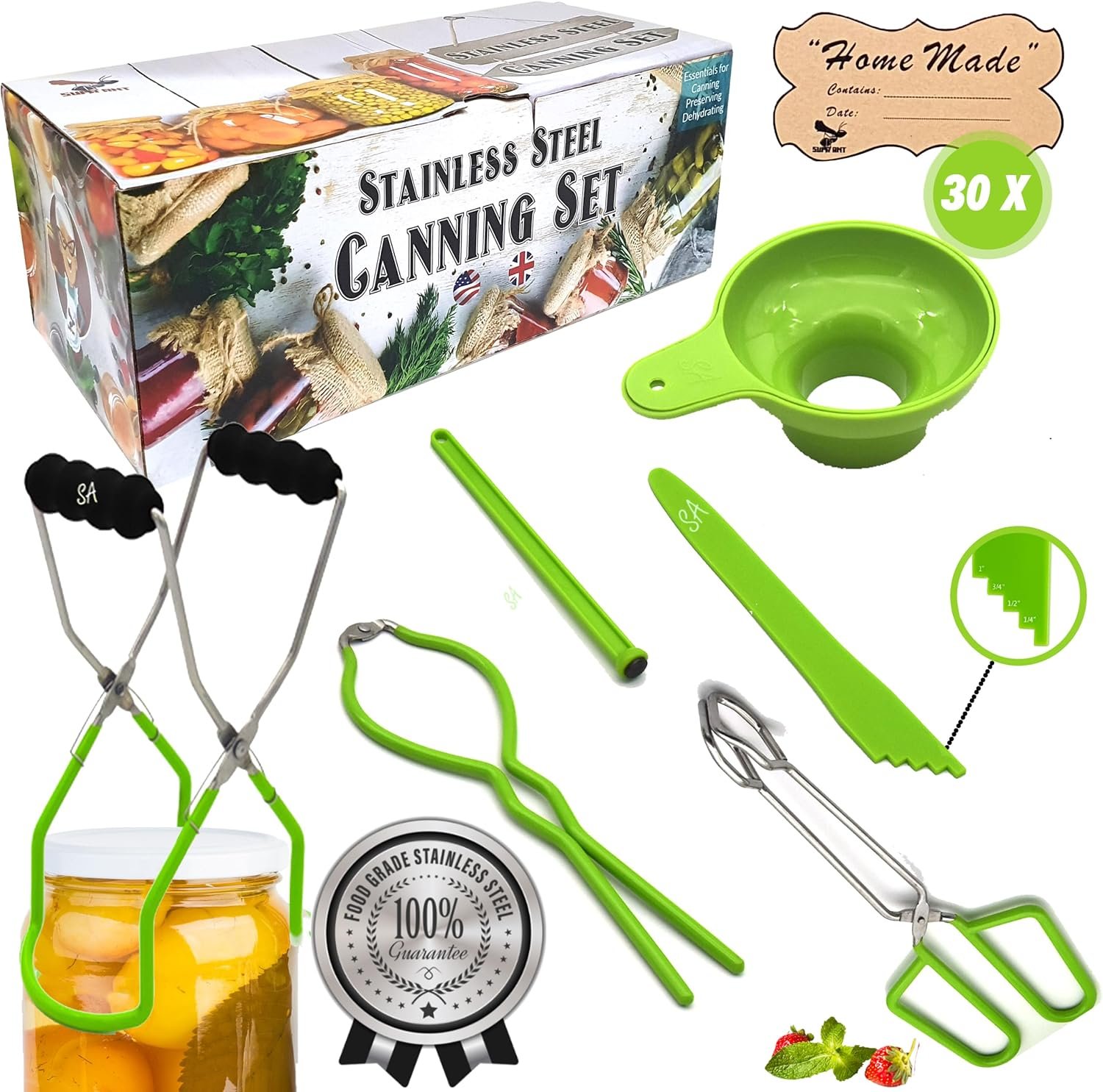
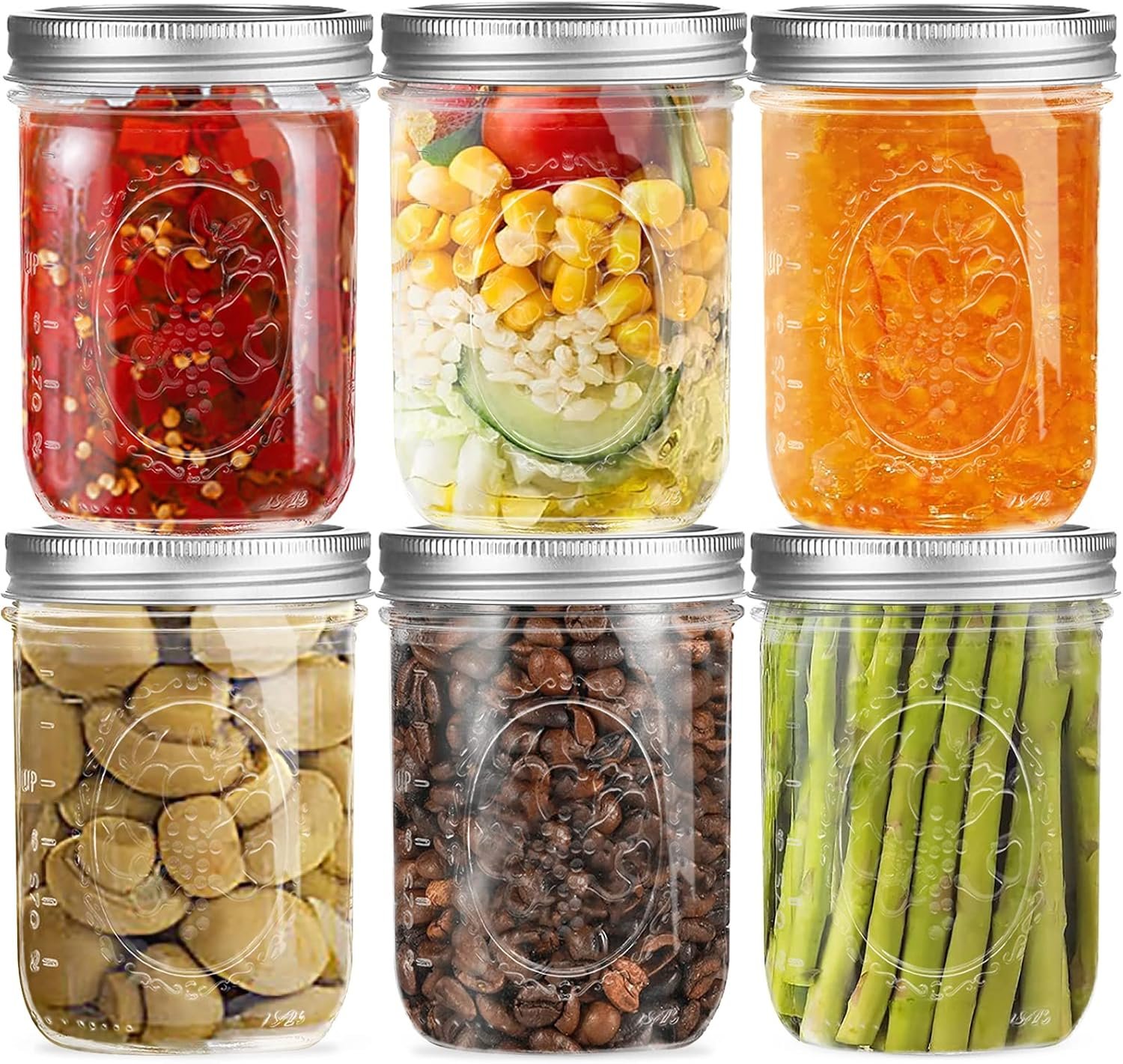
This post contains affiliate links. If you buy through one, Kitchen Guide 101 may earn a small commission at no extra cost to you.
Homemade Pizza Sauce for Canning
A thick, herby tomato sauce for the water bath canner, acidified jar by jar the way tested recipes require. No fresh onion, no fresh garlic and no oil in the jar — those go in when you open it.
How much are you making?
Ingredients
- 10 lb20 lb30 lb40 lb ripe paste tomatoes (Roma or San Marzano)
- 1 tbsp2 tbsp3 tbsp¼ cup dried oregano
- 1½ tsp1 tbsp1½ tbsp2 tbsp dried basil
- 1 tsp2 tsp1 tbsp4 tsp garlic powder
- 1 tsp2 tsp1 tbsp4 tsp onion powder
- ½ tsp1 tsp1½ tsp2 tsp ground black pepper
- 1 tsp2 tsp1 tbsp4 tsp granulated sugar, to balance the acid (optional)
- ¼ tsp½ tsp¾ tsp1 tsp crushed red pepper flakes (optional)
- 1 tbsp per pint bottled lemon juice, added to each jar
- ½ tsp per pint canning or pickling salt, for flavour (optional)
Instructions
Fill and heat the canner
Half fill the boiling water canner and bring it to a simmer with the rack in place. Wash the jars, lids and bands in hot soapy water and keep the jars hot. Jars do not need sterilising when the process time is 10 minutes or longer, but they must not be cold when the hot sauce goes in.
Wash, core and peel the tomatoes
Wash the tomatoes and cut out the cores. Dip them in boiling water for 60 seconds, lift them into ice water, and the skins slip off. Halve them and squeeze out the watery seed pockets, which is the single biggest thing you can do to shorten the simmering.
Cook them down and keep stirring
Bring the chopped tomatoes to a boil in a wide heavy pot, then hold them at a strong simmer, uncovered, stirring often. A wide pot evaporates faster than a tall one. Cook until the volume has dropped by about half and a spoon drawn through the bottom leaves a track.
Add the herbs and spices near the end
Stir in the oregano, basil, garlic powder, onion powder, black pepper, optional sugar and optional red pepper flakes for the last 15 minutes. Together they make a homemade pizza seasoning, and dried herbs and spices are safe in a tested tomato sauce. Fresh onion, fresh garlic and oil are not, and they go in after you open the jar.
Blend if you want it smooth
Use an immersion blender in the pot, or work in batches in a blender, until the sauce is as smooth as you like it. Return it to a full simmer afterwards so it goes into the jars hot.
Put the lemon juice in the jars, not the pot
Add 1 tablespoon of bottled lemon juice to each empty hot pint jar, or 2 tablespoons per quart. Add the optional salt now too. Use bottled juice, never fresh, because bottled is standardised and fresh lemons vary batch to batch. Never leave the acid out.
Fill, debubble and wipe
Ladle the hot sauce into the jars through a wide funnel, leaving a half inch of headspace. Run a thin plastic tool around the inside to release trapped air, adjust the headspace, and wipe every rim with a clean damp cloth. A speck of sauce on the rim is the usual cause of a failed seal.
Process in the boiling water bath
Set the lids on, screw the bands to fingertip tight, and lower the jars into the canner so they are covered by at least an inch of water. Bring it to a full rolling boil, then start timing: 35 minutes for pints and 40 minutes for quarts at sea level, adjusted upward for your altitude using the table on this page.
Rest, lift out and cool
Turn off the heat, take the lid off the canner and leave the jars in the water for 5 minutes. Lift them straight up without tilting and set them on a towel-lined counter with space around each one. Leave them undisturbed for 12 to 24 hours.
Check the seals and store
Press the centre of each lid. A sealed lid is slightly concave and does not flex. Remove the bands, wipe the jars, label them with the contents and date, and store them in a cool dark place. Refrigerate any jar that did not seal and use it within a week.
Processing Times by Altitude
Water boils cooler the higher you are, so the process gets longer. This is a banded table, not a per-thousand-feet formula — find your row and use it.
| Your elevation | Pints | Quarts |
|---|---|---|
| Your elevation0 to 1,000 ft | Pints35 minutes | Quarts40 minutes |
| Your elevation1,001 to 3,000 ft | Pints40 minutes | Quarts45 minutes |
| Your elevation3,001 to 6,000 ft | Pints45 minutes | Quarts50 minutes |
| Your elevationAbove 6,000 ft | Pints50 minutes | Quarts55 minutes |
Not sure of your elevation? Your county extension office publishes it, and so does any mapping app. When in doubt, use the next band up. Over-processing costs you a little texture; under-processing costs you the jar.
How to Get Pizza Sauce Thick Without Thickeners
Pizza sauce has to be thick enough to sit on dough without soaking it. You cannot reach that with cornstarch or flour, because starch slows the heat reaching the centre of the jar and no tested recipe allows it. You reach it by removing water.
Evaporate, do not thicken
A wide pot, a strong simmer and no lid. Reducing by half is what turns tomato sauce into pizza sauce. There is no safe shortcut with starch, and there does not need to be.
Seed them first
Squeezing the watery seed pockets out of halved tomatoes before they go in the pot removes liquid you would otherwise spend an hour boiling off.
Drain off the first water
Let the chopped tomatoes sit in a colander for 20 minutes and pour away what collects. You can lose a third of the cooking time to that one step.
Thicken in the pan, later
If a jar still opens thinner than you wanted, simmer it for 5 minutes with a spoonful of tomato paste when you use it. That is the moment thickeners are safe, not before the jar goes into the canner.
The No-Peel Method for Canning Pizza Sauce
Blanching and peeling twenty pounds of tomatoes is the slowest part of the day. A food mill removes the step entirely.
Use a food mill, not a blender
Cook the quartered tomatoes down with the skins on, then run the hot sauce through a food mill or tomato press. The skins and seeds come out one side and smooth sauce out the other, and you never blanch or peel anything.
Do not just blend the skins in
Blending skins into the sauce makes it noticeably bitter and darker, and the skins hold water, so it takes longer to thicken. The mill removes them; the blender only chops them smaller.
The yield is a little lower
A mill leaves some pulp behind with the skins, so expect roughly 10 percent less sauce per pound than peeling by hand. The time saved is usually worth it.
Everything else is unchanged
Acidify per jar, use the same headspace and process for the same time. Skipping the peeling changes the method, not the safety numbers.
Add the Garlic, Onion and Oil After You Open the Jar
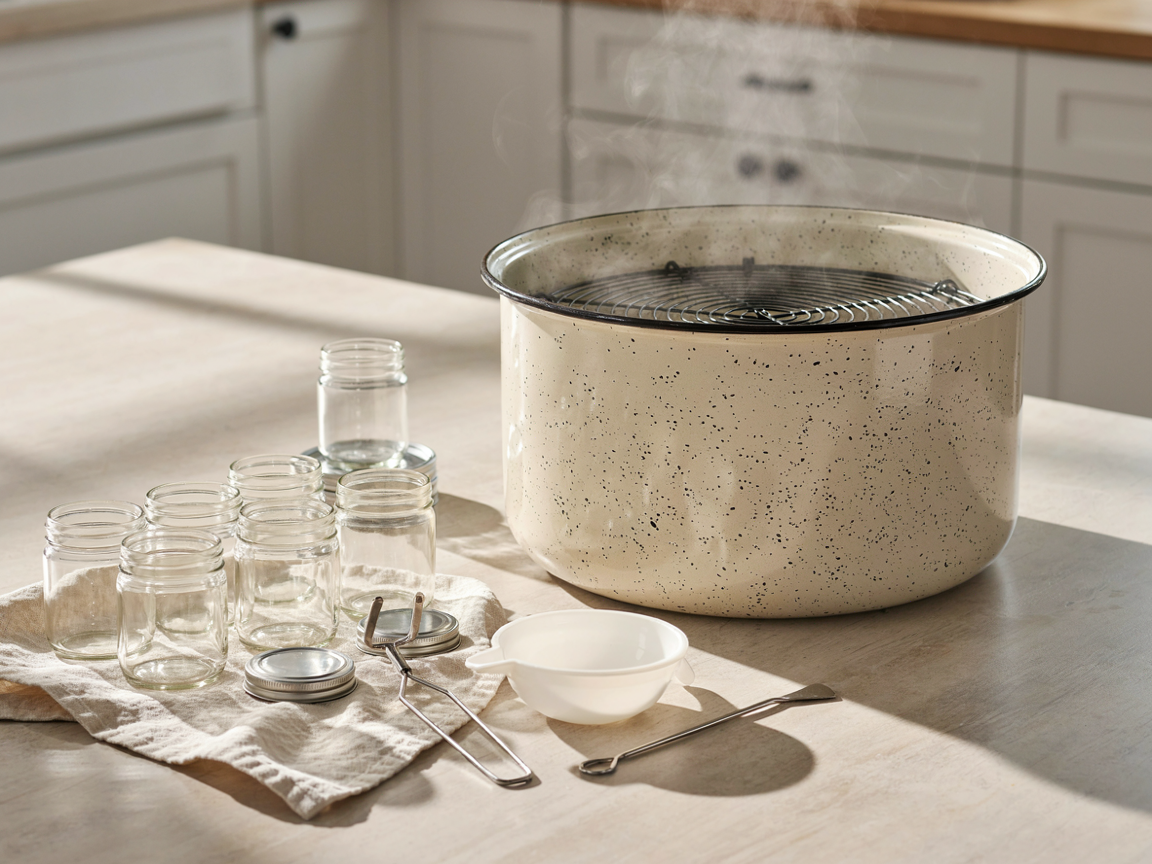
Everything that goes into the jar, and nothing that does not.
This is the part that makes the safe version taste like the unsafe one. Three minutes in a small pan when you open a jar gets you everything the low-acid ingredients would have given you, and more, because fresh garlic cooked in oil tastes better than garlic that spent a year in a jar.
Garlic and olive oil, the classic finish
Warm 1 tablespoon of olive oil in a small pan, add a minced garlic clove and cook it for 45 seconds until it smells sweet, then stir in about a cup of the canned sauce and simmer for 2 minutes.
This is the flavour people are trying to get into the jar, and it takes three minutes to add afterwards. Our garlic pizza sauce takes the same idea further.
Sauteed onion
Cook 2 tablespoons of very finely diced onion in a teaspoon of oil over low heat for 6 to 8 minutes until soft and sweet, then stir the sauce in and warm it through.
Low and slow is the point. Onion added raw to a jar of sauce tastes sharp; cooked properly it tastes like a long-simmered sauce.
Fresh basil and oregano
Dried herbs went into the jar because they survive canning. Fresh ones do not — they go grey and flat. Tear fresh basil in at the end, off the heat, when you use the sauce.
A teaspoon of fresh oregano stirred in at the same time wakes up the dried oregano already in the jar.
Thicker, richer, spicier
For a thick and spicy pizza sauce, simmer the opened jar for 5 minutes with 1 tablespoon of tomato paste and bloom ¼ teaspoon of red pepper flakes in the oil before the garlic goes in.
A pinch of sugar at this stage balances a batch of tomatoes that turned out sharper than usual.
Want the Vegetables in the Jar? Pressure Can It
If having onion, garlic and oil in the jar matters more to you than the convenience of a water bath, there is a tested way to do it — it just needs a pressure canner.
The recipe is the National Center’s Spaghetti Sauce without Meat, which contains chopped onion, garlic, celery or green pepper and vegetable oil. It is processed for 20 minutes for pints and 25 minutes for quarts — and unlike a water bath, it is the pressure that changes with altitude, not the time.
| Your elevation | Dial gauge, pints (20 min) | Dial gauge, quarts (25 min) |
|---|---|---|
| Your elevation0 to 2,000 ft | Dial gauge, pints (20 min)11 pounds | Dial gauge, quarts (25 min)11 pounds |
| Your elevation2,001 to 4,000 ft | Dial gauge, pints (20 min)12 pounds | Dial gauge, quarts (25 min)12 pounds |
| Your elevation4,001 to 6,000 ft | Dial gauge, pints (20 min)13 pounds | Dial gauge, quarts (25 min)13 pounds |
| Your elevation6,001 to 8,000 ft | Dial gauge, pints (20 min)14 pounds | Dial gauge, quarts (25 min)14 pounds |
A weighted-gauge canner is simpler: 10 pounds at 0 to 1,000 feet and 15 pounds anywhere above that, for the same 20 and 25 minutes.
Two rules come with it. Do not increase the proportion of onions, peppers or mushrooms, because the recipe was tested at those exact amounts. And do not water bath it, whatever a recipe elsewhere tells you — the pressure canner is the entire reason the vegetables are allowed.
No pressure canner? Then the sauce on this page, finished in the pan when you open it, is the right answer — not a water-bathed version with the vegetables in it.
Sealing, Storing and Troubleshooting
| Where | How long | What to know |
|---|---|---|
| WhereSealed jars, cool dark pantry | How longBest within 1 year | What to knowThey stay safe beyond a year if the seal holds, but colour and flavour fade. Store without the bands on so a failing seal is obvious. |
| WhereJars that did not seal | How longUp to 1 week, refrigerated | What to knowRefrigerate immediately and use it like any fresh sauce, or freeze it. Do not reprocess a jar the next day. |
| WhereOpened jars | How longUp to 1 week, refrigerated | What to knowKeep it covered in the fridge and use it within a week. Freeze what is left in an ice cube tray if a week is not enough. |
| WhereFreezing instead of canning | How longUp to 6 months | What to knowIf all this sounds like a lot, the same sauce freezes beautifully in bags or jars with headspace, and needs no acid at all. |
When Something Looks Wrong
Liquid separated into layers
Harmless. The tomatoes were not heated fast enough at the start, so an enzyme broke down the pectin. Shake the jar when you open it. Next time, work in smaller batches and bring them to a boil quickly.
Sauce siphoned out during cooling
The jars cooled too fast or the headspace was short. As long as the lid sealed, the jar is fine, even with sauce on the outside. Leave jars in the canner for 5 minutes after the heat goes off.
A lid that flexes when pressed
It did not seal. Refrigerate that jar and use it within a week, or freeze it. Do not put it back in the canner the next day.
Cloudy or murky liquid
Do not assume it is minerals. Cloudiness can be a sign of spoilage, and so can a bulging lid, a spurting jar, an off smell or any mould. Throw out any jar you are unsure of without tasting it.
Mould on the surface
Discard the whole jar. Do not scrape it off and do not taste it. Mould growth means the seal failed and the contents are no longer safe.
The rule that overrides everything else. If a jar bulges, spurts, smells wrong, shows mould or looks cloudy and you cannot explain why, throw it away without tasting it. Do not taste a home-canned food to decide whether it is safe.
Canning Pizza Sauce FAQs
Can you water bath can pizza sauce?
Yes, as long as the sauce is tomatoes, dried herbs and spices only, and each jar is acidified with bottled lemon juice or citric acid. That is what the recipe on this page is. You cannot water bath can a pizza sauce containing fresh onion, fresh garlic or oil, because those are low-acid ingredients and the tested recipe that includes them requires a pressure canner.
What is the proper pH for canned pizza sauce?
It has to be 4.6 or below to be safe in a boiling water bath, and tested recipes aim comfortably under that rather than sitting on the line. Tomatoes on their own usually fall between about 4.0 and 4.9 depending on variety, ripeness, soil and weather, and some test above 4.6 outright, occasionally as high as 5.0. That is exactly why acid goes into every jar rather than being left to chance. Home pH strips are not accurate enough to substitute for following a tested recipe.
Do you have to add lemon juice to canned pizza sauce?
Yes, and it is not optional in any tested recipe. Add 1 tablespoon of bottled lemon juice per pint jar or 2 tablespoons per quart. A quarter teaspoon of citric acid per pint, or half a teaspoon per quart, does the same job. If the taste bothers you, add a teaspoon of sugar to the batch, but never reduce the acid.
Can I use fresh lemon juice instead of bottled?
No. Bottled lemon juice has a standardised acidity, while fresh lemons vary considerably between fruit, variety and season. Every tested tomato canning recipe specifies bottled juice for exactly that reason. Vinegar is not recommended either, because it changes the flavour of the sauce.
Can I put onion and garlic in canned pizza sauce?
Not in a water bath. Onion and garlic are low-acid, so they raise the pH of the whole jar. The tested recipe that contains them, Spaghetti Sauce without Meat, is pressure canned for 20 minutes for pints at 11 pounds in a dial-gauge canner up to 2,000 feet, rising to 14 pounds at 8,000 feet, and it specifically warns against increasing the proportion of onions. Use garlic powder and onion powder in the jar instead, and add the fresh ones after you open it.
Can I add olive oil to pizza sauce before canning?
No. Oil is low-acid, it coats the food and interferes with heat reaching the centre of the jar, and it can prevent a proper seal by leaving a film on the rim. Stir the olive oil in when you open the jar, which is also when it tastes best.
What ingredients are best for pizza sauce canning?
Paste tomatoes such as Roma or San Marzano, bottled lemon juice, dried oregano, dried basil, garlic powder, onion powder and black pepper. Optionally a little canning salt and a pinch of sugar to balance the acid. Anything fresh and low-acid, and any oil or starch, belongs in the pan after opening rather than in the jar.
How many tomatoes do I need for canning pizza sauce?
About 6 to 7 pounds of paste tomatoes per quart of thick sauce, or roughly 3 to 3.5 pounds per pint. Ten pounds gives you about 3 pints and twenty pounds gives about 6. Sauce recipes that promise far more than that are not accounting for how much water has to boil away.
How do I make canned pizza sauce thicker?
Reduce it further before it goes into the jar. Seed the tomatoes, drain the chopped fruit in a colander for 20 minutes, and simmer uncovered in a wide pot until the volume has halved. You cannot add cornstarch or flour to home-canned goods safely. If an opened jar is still thin, simmer it for 5 minutes with a tablespoon of tomato paste.
Can you can pizza sauce without peeling the tomatoes?
Yes, if you use a food mill or tomato press. Cook the tomatoes down with the skins on and run the hot sauce through the mill, which removes the skins and seeds for you. Simply blending the skins into the sauce is not a good substitute, because it makes the sauce bitter and darker and adds water back in.
How long does home canned pizza sauce last?
Sealed jars stay safe indefinitely while the seal holds, but they are at their best within one year. Store them without the bands in a cool dark place so a failing seal shows itself. Once a jar is opened, refrigerate it and use it within a week, or freeze what is left.
Should homemade canned pizza sauce meld before using?
It is worth waiting. Dried oregano, basil and garlic powder keep releasing flavour into the sauce for the first few weeks, so a jar opened two weeks after canning tastes rounder than one opened the same night. There is no safety reason to wait, only a flavour one.
Why is my canned pizza sauce watery or separated?
Separation into a clear layer and a thick layer is caused by an enzyme that acts when tomatoes heat slowly, and it is harmless. Shake the jar before using it. To avoid it, work in smaller batches and bring each one to a boil quickly rather than letting a huge pot warm gradually. Genuinely thin sauce means it was not reduced far enough.
Can I use canned tomatoes instead of fresh?
Yes. Six 28-ounce cans of crushed tomatoes replace 20 pounds of fresh, and you skip the peeling and most of the reducing, needing only 30 to 40 minutes on the stove. Acidify each jar exactly as you would with fresh tomatoes, because commercially canned tomatoes are not acidified for home canning.
Is it safe if the liquid in the jar looks cloudy?
Not necessarily, so do not assume it is mineral deposits. Cloudiness, a bulging lid, a jar that spurts when opened, an off smell or any mould all point to spoilage. Discard the jar without tasting it. When there is any doubt at all about a home-canned jar, throw it out.
More Pizza Sauce Recipes
One for this week, one for the low-carb nights, and one that is not red at all.
Reduce the tomatoes by half, season with dried herbs only, put the bottled lemon juice in every jar, leave a half inch of headspace and process for the time your altitude calls for. Then add the garlic and oil in the pan when you open it.
Pin this homemade pizza sauce for canning so the acid amounts and the altitude table are there on canning day.