
Foolproof Same Day Focaccia Recipe: Soft, Fluffy and Golden
A bubbly, cloud-soft focaccia with a crisp olive oil crust and deep rosemary dimples, mixed and baked in one afternoon. No kneading, no overnight wait, no mixer, and about 15 minutes of actual work.
- Ready in 3 hours
- No kneading
- 4 pan sizes
- Printable recipe
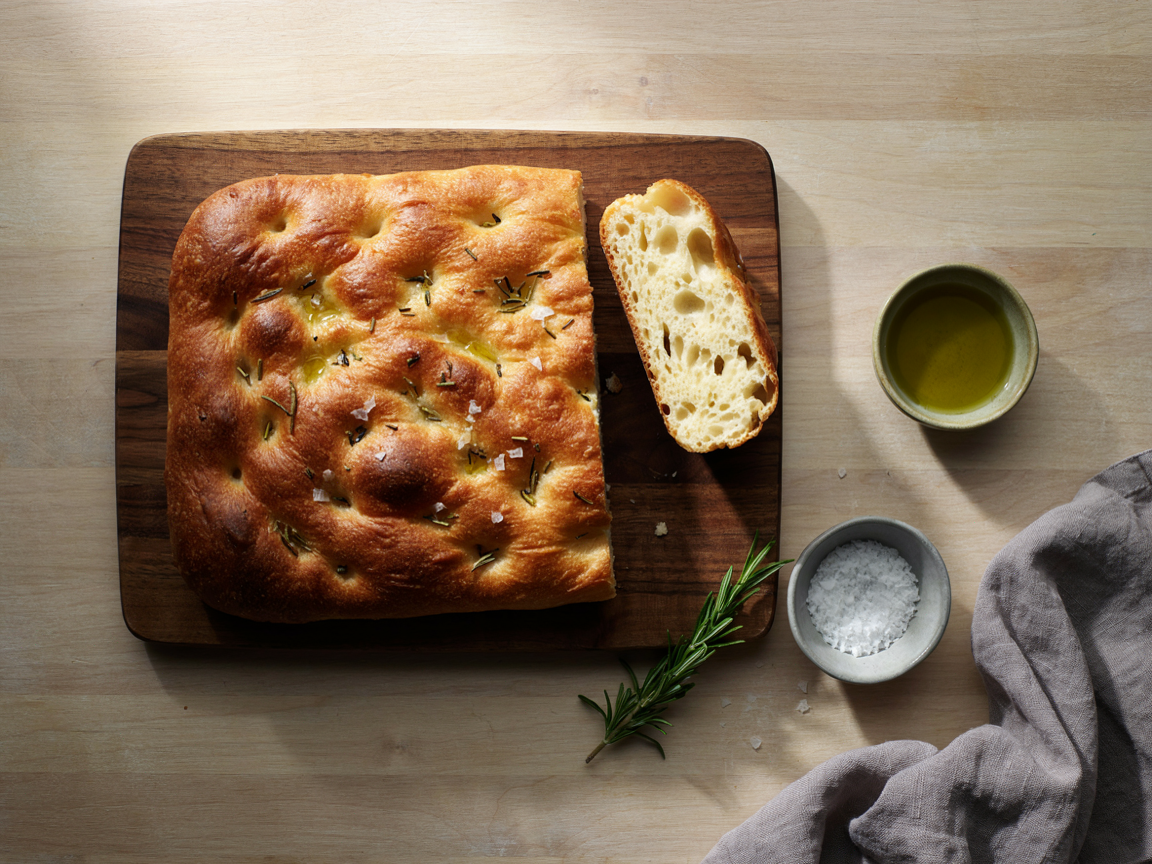
Golden same day focaccia with crisp edges, deep dimples, rosemary and flaky salt, cut to show the airy crumb.
Most focaccia recipes want the dough in the fridge overnight. This same day focaccia recipe does not. A full packet of yeast, a spoon of sugar and a warm corner of the kitchen take a wet, sticky, no-knead dough from the mixing bowl to a golden, bubbly slab with a crust that crackles in about three hours, and the only technique is folding the dough over itself a few times with a wet hand.
Below is the full recipe with a card that scales by pan size, a clock-time schedule from noon to eating, how the stretch-and-folds replace kneading, the four rules for a crisp olive oil crust, six toppings, a pan size table, what to serve it with, storage and freezer timing, and the answers to every question about making focaccia at home.
Why This Same Day Focaccia Works
Overnight focaccia gets its flavor from time. Same-day focaccia gets it from olive oil, salt and a hot pan, and nobody at the table can tell:
No overnight wait
A full packet of instant yeast, a spoon of sugar and a warm spot take the dough from flour to doubled in an hour. Mix at noon, eat at three.
No kneading
Three rounds of stretch-and-folds, 30 seconds each, build all the gluten a focaccia needs. Wet hands, no flour on the counter, no mixer.
A crisp olive oil crust
Three tablespoons of oil in a metal pan and a lower-rack bake fry the base while the top roasts golden. The crunch is the whole point.
Fluffy, bubbly inside
An 80 percent hydration dough is wet enough to blow big, irregular holes. It looks wrong in the bowl and comes out of the oven looking like the pin.
What You Need for Same Day Focaccia
Seven ingredients, five of them already in the cupboard. Notes on the ones that decide the result:
Bread flour
The extra protein gives a chewier, loftier crumb that holds its bubbles. All-purpose works and bakes a slightly softer, shorter focaccia; nothing else changes.
Instant yeast
A full packet for a 9×13 pan is what makes it same-day. Active dry works too: bloom it in the water for 10 minutes instead of 5, and add 15 minutes to the rise.
Warm water
105 to 110 degrees F, warm bath temperature. Hotter kills the yeast; cooler adds an hour. A thermometer takes the guessing out of it the first time.
Extra-virgin olive oil
Three places: in the dough for softness, in the pan for the crust, on top for the golden dimples. Use a good one; you can taste it.
Two salts
Fine sea salt in the dough for flavor and structure, flaky salt on top for crunch. Do not swap them; table salt in the dough is fine, flaky salt in the dough disappears.
Sugar
A teaspoon feeds the yeast for the fast rise and helps the top brown. Honey does the same job.
Rosemary
Fresh leaves, stripped from the stem, pressed into the dimples so they roast instead of burn. Thyme and sage work the same way.
Same Day Focaccia Recipe
The recipe makes a 9×13 pan, 12 squares, by default. Tap a pan size and the flour, the yeast, the oil and the printable card all update together.
Same Day Focaccia
A soft, fluffy, bubbly focaccia with a crisp olive oil crust and deep rosemary-and-salt dimples, mixed, risen and baked in about 3 hours with no kneading and no overnight wait. Tap a pan size and every amount updates, including the printable card.
Which pan?
Ingredients
- 250 g (2 cups)500 g (4 cups)750 g (6 cups)1 kg (8 cups) bread flour (or all-purpose)
- 1¼ tsp2¼ tsp (1 packet)3½ tsp4½ tsp (2 packets) instant yeast
- 1 tsp2 tsp1 tbsp4 tsp fine sea salt
- ½ tsp1 tsp1½ tsp2 tsp sugar or honey
- 200 ml (¾ cup + 2 tbsp)400 ml (1⅔ cups)600 ml (2½ cups)800 ml (3⅓ cups) warm water, 105–110°F
- 1 tbsp2 tbsp3 tbsp¼ cup extra-virgin olive oil, for the dough
- 2 tbsp3 tbsp¼ cup6 tbsp extra-virgin olive oil, for the pan
- 1 tbsp2 tbsp3 tbsp¼ cup extra-virgin olive oil, for the top
- 1 tbsp2 tbsp3 tbsp¼ cup fresh rosemary leaves
- ½ tsp1 tsp1½ tsp2 tsp flaky sea salt, for the top
Pan matters: a light-colored metal pan gives the crispest base. Glass and ceramic bake slower; add 4 to 5 minutes and expect a softer bottom.
Instructions
Mix the dough (5 minutes, no kneading)
Whisk the warm water, yeast and sugar in a large bowl and let it sit 5 minutes until foamy. Add the flour, fine salt and the olive oil for the dough and stir with a spatula until there is no dry flour. It will be a wet, sticky, shaggy dough. That is correct; do not add flour.
Stretch and fold, three times
Cover the bowl. Every 15 minutes for the next 45 minutes, wet one hand, grab the far edge of the dough, stretch it up and fold it over the middle, turn the bowl a quarter and repeat four times. Three rounds of folds replace kneading and build the strength that holds the bubbles.
Rise until doubled (about 1 hour)
Cover and leave the dough somewhere warm, 75 to 80 degrees F, for about an hour, until doubled, domed and full of bubbles. The oven with only the light on, or the top of the fridge, is warm enough.
Pan it
Pour the olive oil for the pan into a 9×13 metal pan and spread it over the base and sides. Scrape the dough in, fold the edges under so the top is smooth, flip it once to coat it in oil, and gently push it toward the corners. If it springs back, leave it; it will spread on its own.
Proof in the pan (30 to 40 minutes)
Cover loosely and leave it in the warm spot until it has filled the pan and looks puffy and jiggly, 30 to 40 minutes. Heat the oven to 425 degrees F (220 C) with a rack in the lower third during the last 20 minutes.
Dimple and top
Drizzle the olive oil for the top over the dough. Oil your fingertips and press straight down to the bottom of the pan all over the surface, making deep dimples that stay. Scatter the rosemary and flaky salt over everything.
Bake and crisp the base
Bake on the lower rack for 22 to 26 minutes, until the top is deep golden and the edges are crisp and pulling from the pan. Lift it out of the pan onto a rack after 5 minutes so the bottom stays crisp, then cut into squares.
The Same Day Schedule, Hour by Hour
Dinner at six? Start at three. Lunch at one? Start at ten. The schedule below starts at noon so the gaps are easy to see:
| Clock | What happens |
|---|---|
| Clock12:00 | What happensMix the dough. Cover. |
| Clock12:15, 12:30, 12:45 | What happensStretch and fold, four folds each time. |
| Clock12:45 to 1:45 | What happensBulk rise in a warm spot until doubled. |
| Clock1:45 | What happensOil the pan, pan the dough, cover. |
| Clock2:05 | What happensHeat the oven to 425°F, lower rack. |
| Clock2:25 | What happensDimple, oil, rosemary and salt. Into the oven. |
| Clock2:50 | What happensOut of the oven. Five minutes in the pan, then onto a rack. |
| Clock3:00 | What happensCut and eat, still warm. |
The warm spot is the secret. At 75 to 80°F the dough doubles in an hour; at 65°F it takes two. Turn the oven light on (not the oven), set the covered bowl inside and the rise runs on schedule. Take it out before preheating.
How Stretch-and-Folds Replace Kneading
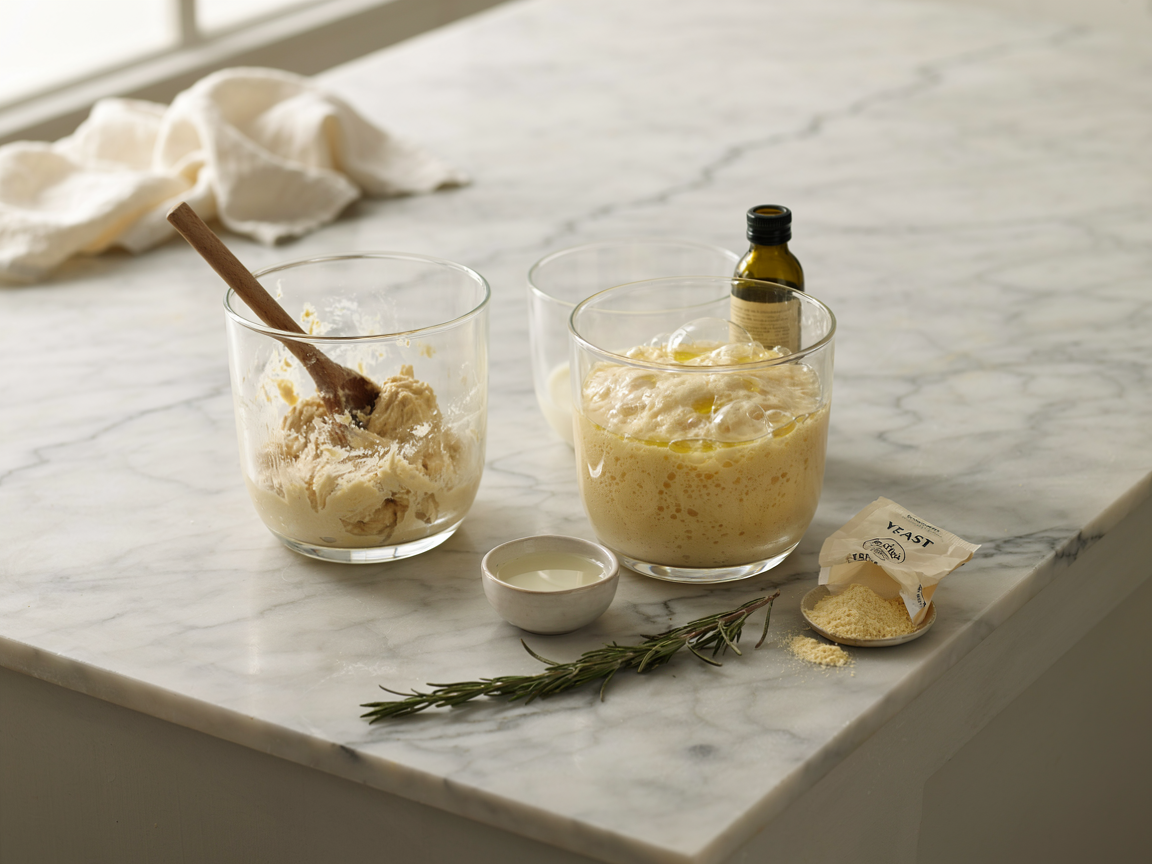
The wet dough after mixing, and the same dough after three rounds of folds and an hour of rising.
Kneading a dough this wet is impossible, and it does not need it. Three short rounds of folds do the job:
Wet hand, not floured
Dip one hand in water before every fold. The dough does not stick to a wet hand, and no flour goes in, which keeps the crumb open.
Stretch up, fold over, turn
Grab the far edge, pull it up until it resists, fold it over the center, turn the bowl a quarter. Four folds is one round; three rounds is the whole workout.
Watch it change
After the first round the dough is a puddle; after the third it holds a dome and feels like a water balloon. That is the gluten, and that is when you stop.
How to Get the Crisp Olive Oil Crust
The soft inside takes care of itself. The crust is four decisions:
Oil the pan generously
Three tablespoons for a 9×13 sounds like too much. It is the amount that fries the base into a crisp, almost crackling crust instead of a soft one.
Dimple to the bottom
Press straight down until you feel the pan. Shallow dimples puff out in the oven; deep ones hold the oil and the salt and give the bubbly, craggy top.
Bake low in the oven
A rack in the lower third puts the pan close to the heat so the bottom crisps before the top overbrowns. For extra crunch, set the pan on a preheated sheet pan.
Out of the pan at 5 minutes
Steam softens a crust that sits in its pan. Lift the focaccia onto a rack after 5 minutes and the base stays crisp as it cools.
Six Ways to Top Focaccia
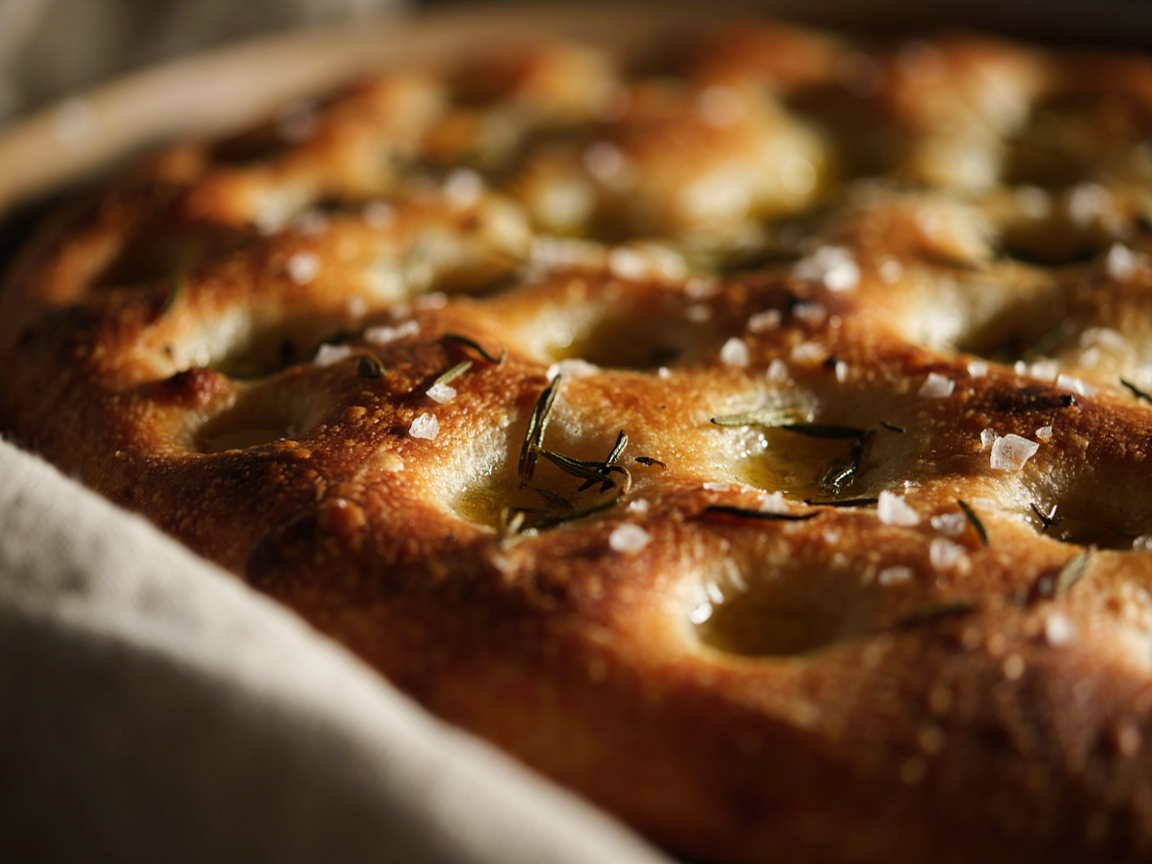
Deep dimples holding olive oil, rosemary and flaky salt, straight from the oven.
Same dough, different dinner. Tap a tab:
Rosemary and flaky salt (the recipe above)
The classic: fresh rosemary pressed into oiled dimples with flaky sea salt. The version on the pin, and the one to make first.
Garlic herb butter
Bake as written, then brush the hot focaccia with 3 tablespoons of melted butter mixed with 2 grated garlic cloves and chopped parsley. The bread for a lasagna night.
Cherry tomato and basil
Press halved cherry tomatoes cut side up into the dimples with the rosemary, bake, and scatter torn basil over the hot bread. The tomatoes roast and go jammy.
Caramelized onion and olive
Spread a cup of caramelized onions and a handful of halved kalamata olives over the dimpled dough before baking. Savory, sweet and the best one cold the next day.
Everything bagel
Skip the rosemary and shower the oiled, dimpled top with everything bagel seasoning. Cut into squares and split for sandwiches; it makes the best turkey sandwich on the site.
Parmesan and jalapeño
Scatter half a cup of grated parmesan and thin jalapeño rings over the dimpled dough. The cheese crisps into a lacy crust; serve with the creamy garlic pizza sauce for dipping. Want the whole thing to be dinner? The same dough makes our sheet pan focaccia pizza: sauce, mozzarella and basil over the dimples.
Pan Sizes and Bake Times
The recipe card scales the dough; this table matches it to the pan:
| Pan | Dough | Bake time | Result |
|---|---|---|---|
| Pan8×8 or 9-inch round | Dough250 g flour, half batch | Bake time20 to 22 minutes | ResultThick, tall squares; serves 6 |
| Pan9×13 metal | Dough500 g flour, the default | Bake time22 to 26 minutes | ResultThe classic; 12 squares |
| Pan12-inch cast iron skillet | Dough500 g flour | Bake time24 to 28 minutes | ResultCrispest crust of all; preheat the oiled skillet 5 minutes |
| Pan13×18 half sheet pan | Dough750 g flour | Bake time20 to 24 minutes | ResultThinner, crisper; 18 squares, the party pan |
| PanTwo 9×13 pans | Dough1 kg flour | Bake time22 to 26 minutes, rotate once | ResultA crowd; 24 squares |
What to Serve with Focaccia
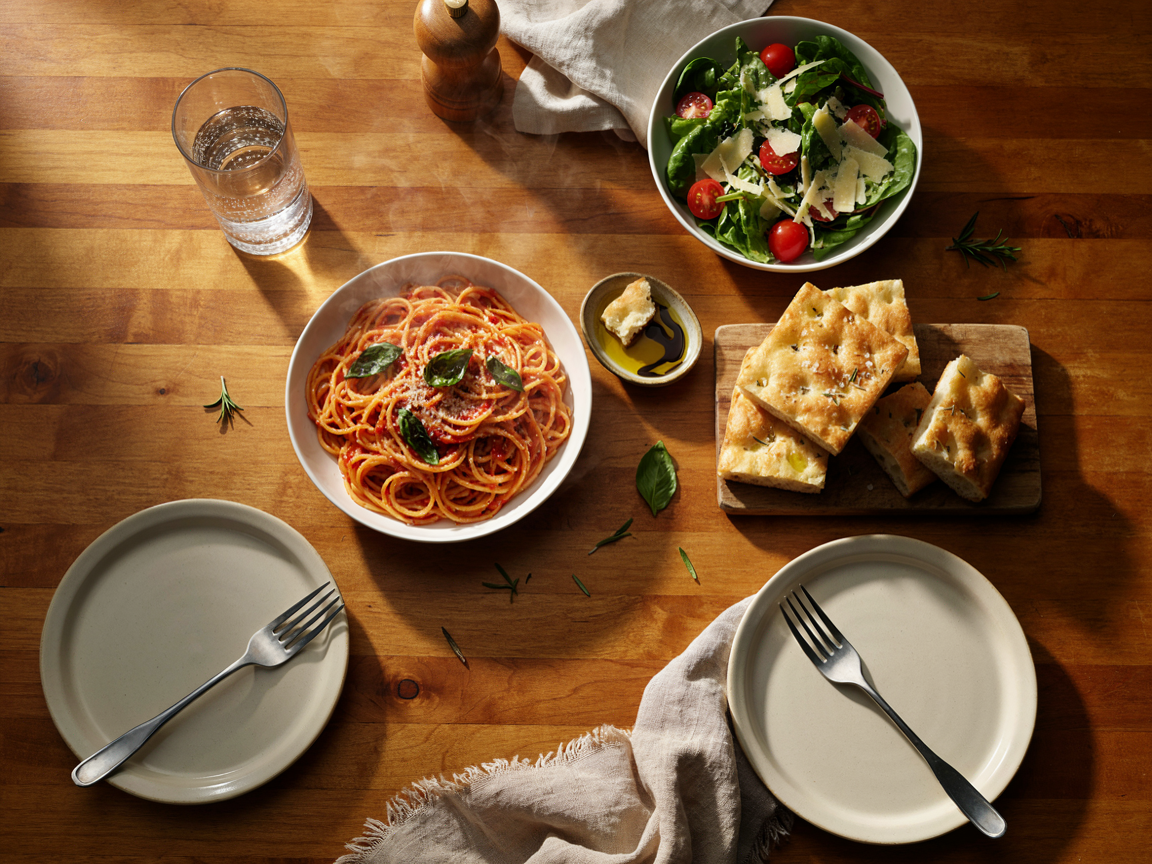
Focaccia squares on a board with a bowl of pasta and a dish of olive oil for dipping.
Focaccia is the bread that turns pasta night into a meal and soup night into a feast:
With pasta
Torn focaccia beside a lasagna with béchamel or a classic ricotta lasagna is the whole reason the pin says dinner bread.
With soup
Squares for dunking into lasagna soup, crockpot lentil soup or our Instant Pot white chicken chili.
As a dip bread
Warm squares with a bowl of good olive oil and balsamic, or the fresh tomato pizza sauce, for a table of guests.
As sandwich bread
Split a square horizontally for turkey, mozzarella and roasted peppers. Everything-bagel focaccia was made for this.
On a board
Cut into fingers around a cheese board with olives, roasted peppers and hummus.
For breakfast
Toasted and topped with ricotta and honey, or an egg. Our sourdough cinnamon roll focaccia is the sweet cousin.
How to Store, Freeze and Reheat Focaccia
| Where | How | How long |
|---|---|---|
| WhereRoom temperature | HowWrapped in foil or a bread bag | How long2 days; re-crisp 8 minutes at 375°F |
| WhereFridge | HowNot recommended | How longIt goes stale faster chilled |
| WhereFreezer, baked | HowSquares in a freezer bag | How longUp to 3 months; reheat from frozen 10 minutes at 375°F |
| WhereDough, refrigerated | HowCovered bowl after the folds | How longUp to 24 hours; pan it cold, proof 1 hour, bake (the flavor deepens; for the full slow-fermented version see the sourdough focaccia recipe) |
| WhereReheat | How375°F oven, 6 to 8 minutes, directly on the rack | How longBrings the crust back; the microwave makes it soft |
Troubleshooting Focaccia
| Problem | Likely cause | Fix |
|---|---|---|
| ProblemDense, tight crumb | Likely causeFlour added to a sticky dough, or under-risen | FixKeep it wet; let it fully double; check the water temperature |
| ProblemDid not rise | Likely causeDead yeast or cold kitchen | FixYeast should foam in 5 minutes; rise in the oven with the light on |
| ProblemSoggy bottom | Likely causeGlass pan, upper rack, or cooled in the pan | FixMetal pan, lower rack, out onto a rack at 5 minutes |
| ProblemDimples disappeared | Likely causePressed too shallow, or over-proofed | FixPress to the pan base; bake when puffy, not when collapsing |
| ProblemPale top | Likely causeOven not hot enough, no oil on top | Fix425°F, and the 2 tablespoons of oil on top |
| ProblemStuck to the pan | Likely causeUnder-oiled | FixThe full 3 tablespoons, spread up the sides |
| ProblemToo salty | Likely causeFlaky salt in the dough | FixFine salt in, flaky salt on top only |
Nutrition (approximate, per square)
Estimates for one of 12 squares from a 9×13 pan with the rosemary and salt topping. Vegan and halal as written.
Same Day Focaccia: FAQs
Can you really make focaccia the same day?
Yes. With a full packet of instant yeast, a spoon of sugar, warm water and a warm spot to rise, the dough doubles in about an hour, proofs in the pan in 30 to 40 minutes and bakes in 25. Start at noon and it is on the table by three, with about 15 minutes of actual work.
Do I need to knead focaccia dough?
No. Three rounds of stretch-and-folds, 15 minutes apart, build the gluten instead. Wet one hand, stretch the far edge of the dough up and fold it over the middle, turn the bowl and repeat four times. After the third round the dough holds a dome and is ready to rise.
Why is my focaccia dough so sticky?
Because it is supposed to be. This is an 80 percent hydration dough, which is what creates the big open bubbles and the fluffy crumb. Resist adding flour; use wet hands for the folds and oiled hands for dimpling.
Can I use all-purpose flour instead of bread flour?
Yes. All-purpose makes a slightly softer, less chewy focaccia with a little less height. Nothing else in the recipe changes. Bread flour is better if you want the tallest, bubbliest result.
Can I use active dry yeast?
Yes. Use the same amount, bloom it in the warm water for 10 minutes instead of 5 until it is foamy, and allow an extra 15 minutes for the rise. If it does not foam, the yeast is dead; start again with a fresh packet.
How do I get a crispy bottom on focaccia?
Three tablespoons of olive oil in a light metal pan, a rack in the lower third of the oven at 425 degrees F, and lifting the bread out of the pan onto a rack 5 minutes after baking. A preheated sheet pan under the focaccia pan adds even more crunch.
Why did my dimples disappear?
They were too shallow, or the dough was over-proofed and collapsed around them. Oil your fingers and press straight down until you feel the pan, and bake when the dough is puffy and jiggly rather than waiting until it starts to sink.
Can I make the dough ahead and bake it later?
Yes. After the folds, cover the bowl and refrigerate for up to 24 hours. Pan the cold dough, let it proof for about an hour until puffy, then dimple and bake. The flavor is deeper, so the overnight option is a bonus rather than a requirement. If you keep a starter, our sourdough focaccia recipe is the fully slow-fermented version of this pan.
What pan is best for focaccia?
A 9×13 light metal pan for the classic thick squares, a half sheet pan for a thinner, crisper party focaccia, or a 12-inch cast iron skillet for the crispest crust of all. Glass works but bakes slower and gives a softer base; the pan table above has times for each.
How long does focaccia last?
Two days at room temperature wrapped in foil, re-crisped for 8 minutes at 375 degrees F, or 3 months in the freezer. Do not refrigerate it; the fridge makes bread stale faster.
Can I freeze focaccia?
Yes. Cool it completely, cut it into squares and freeze them in a bag for up to 3 months. Reheat from frozen directly on the oven rack at 375 degrees F for 10 minutes and the crust comes back.
Is focaccia vegan and halal?
Yes as written. Flour, water, yeast, salt, sugar, olive oil and rosemary. The garlic herb butter topping adds dairy; use olive oil in its place for a vegan version.
What do you serve with focaccia?
Pasta and lasagna, soups and chili for dunking, a bowl of olive oil or garlic sauce for dipping, or split it for sandwiches. The serving section above links the recipes on the site that pair best. To make the focaccia itself the meal, top the dimpled dough with sauce and mozzarella for a sheet pan focaccia pizza.
Why is my focaccia dense instead of fluffy?
Usually flour was added to the sticky dough, the dough did not fully double before panning, or the water was too hot and slowed the yeast. Keep the dough wet, give it the full rise in a warm spot, and check that the water is 105 to 110 degrees F.
Save the pin so the schedule is one tap away on bread day.
More Breads from Our Kitchen
The sweet focaccia, the flatbreads and the loaves that need no special pot.
Easy Sourdough Focaccia with Rosemary and Sea Salt
The overnight, starter-based version of this pan. See the recipe → Make It DinnerThe Best Focaccia Pizza (Sheet Pan, Easy)
Thick, pillowy crust under sauce, mozzarella and basil. Make the pizza → Sweet FocacciaSourdough Cinnamon Roll Focaccia
The dessert version of this pan. Bake it → FlatbreadHomemade Pita Bread
Easy, fluffy and puffs every time. Make pita → For DippingCreamy Garlic Pizza Sauce
Ten minutes, and focaccia’s best friend. Make the sauce → Serve WithLasagna Soup
The soup this bread was made to dunk in. Get the recipe →Mix a wet dough, fold it three times, let it double somewhere warm, oil the pan hard, dimple to the bottom and bake it low and hot. Three hours, fifteen minutes of work, and a focaccia that is soft, fluffy and golden by dinner.
Pin this same day focaccia recipe so it is ready for the next pasta night, soup night or last-minute guest.