
The 1978 Original · Every Pan Size · Moist for Five Days
Southern Hummingbird Cake: The 1978 Original, and Why It Stays So Moist
Banana, crushed pineapple, cinnamon and toasted pecans under cream cheese frosting — the recipe that became the most-requested in Southern Living’s history, with the pan conversions the original never gave you.
- Three layers, 25 min bake
- No mixer, no creaming
- 8 pan sizes
- Printable card
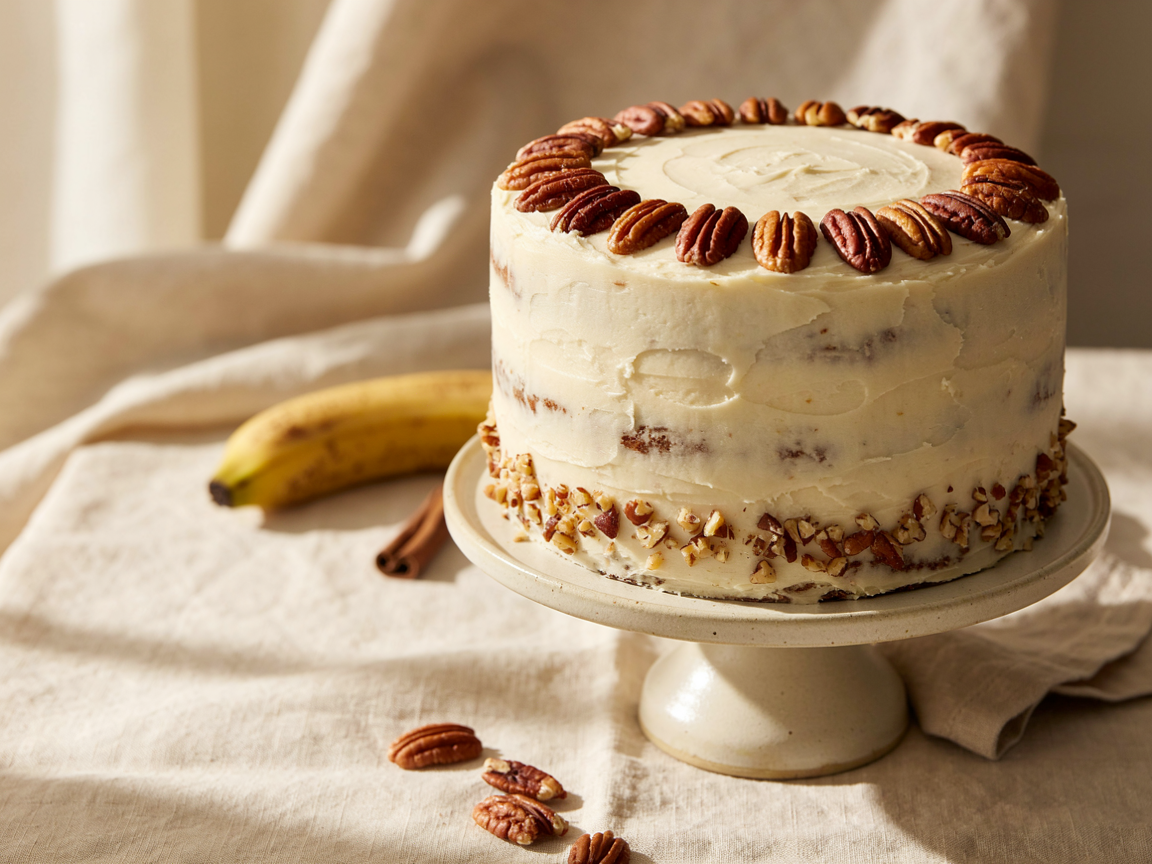
Three 9-inch layers, pecans pressed around the base. The original proportions, unchanged.
A hummingbird cake is a stir-together cake, which is the first surprising thing about it. There is no creaming, no mixer and no separating of eggs — you whisk the dry ingredients, whisk the wet, fold them together with a spatula and stop the moment the flour disappears.
The second surprising thing is how long it stays good. A slice cut on day four tastes the same as one cut on day one, and that is not an accident of the recipe; it is oil, pineapple and two cups of mashed banana doing specific work, which the section below explains.
What a Hummingbird Cake Actually Is
Besides banana, what is the main flavor in a hummingbird cake?
Crushed pineapple.
It is the ingredient that makes this a hummingbird cake rather than a banana cake, and it does two jobs at once: it cuts the richness of the oil and the cream cheese with a bright tropical acidity, and it keeps the crumb damp for days. After the pineapple, the flavours you notice next are cinnamon and toasted pecan.
So the full answer is four flavours working together — banana for warmth, pineapple for brightness, cinnamon for the Southern-bakery note, and pecan for the crunch that stops it feeling heavy.
Why it is called hummingbird cake
The cake did not begin in the American South. It travelled there from Jamaica, where a version circulated as Doctor Bird Cake, named after the streamer-tailed hummingbird that is Jamaica’s national bird — the bird’s long tail feathers were said to resemble the tailcoats of colonial-era doctors.
In February 1978 a North Carolina home baker, Mrs L. H. Wiggins, submitted her version to Southern Living magazine under the name hummingbird cake. It went on to become the most-requested recipe in that magazine’s history, and it has stayed on Southern tables ever since — at Easter, at showers, at weddings, and at a great many ordinary Sundays.
As for the name itself: the pretty explanation is that the cake is sweet enough to draw hummingbirds. The likelier one is that people hover over it.
What you are making is closer to a very good quick bread than to a classic layer cake — dense, close-crumbed, heavy with fruit, and held together by oil rather than creamed butter. That is why it behaves so differently from a sponge, and why almost nothing about the method is fussy.
Hummingbird Cake Recipe
Southern Hummingbird Cake
Banana, crushed pineapple, cinnamon and toasted pecans, stirred together by hand and baked into three layers under cream cheese frosting.
How many servings?
Ingredients
- 1½ cups3 cups4½ cups6 cups all-purpose flour
- 1 cup2 cups3 cups4 cups granulated sugar
- ½ tsp1 tsp1½ tsp2 tsp baking soda
- ½ tsp1 tsp1½ tsp2 tsp fine sea salt
- ¾ tsp1½ tsp2¼ tsp1 tbsp ground cinnamon
- 2356 large eggs, lightly beaten
- ¾ cup1½ cups2¼ cups3 cups vegetable oil
- 1 tsp2 tsp1 tbsp4 tsp vanilla extract
- 4 oz8 oz (1 can)12 oz16 oz crushed pineapple, drained very well
- 1 cup (~2)2 cups (~3–4)3 cups (~5)4 cups (~7) very ripe bananas, mashed
- ½ cup1 cup1½ cups2 cups pecans, chopped and toasted
- 8 oz16 oz24 oz32 oz full-fat cream cheese, softened
- 6 tbsp¾ cup1 cup + 2 tbsp1½ cups unsalted butter, softened
- 3 cups6 cups9 cups12 cups powdered sugar, sifted
- 1 tsp2 tsp1 tbsp4 tsp vanilla extract
- pinch¼ tspscant ½ tsp½ tsp fine sea salt
- ½ cup1 cup1½ cups2 cups pecan halves, to finish
Instructions
Toast the pecans before anything else
Spread the chopped pecans on a dry baking sheet and toast at 350°F for 6 to 8 minutes, until they smell nutty and have darkened a shade. Set them aside to cool. Raw pecans go soft in the batter and taste of almost nothing; toasted ones stay crisp through the bake and are the single cheapest upgrade in the recipe.
Prepare the pans properly
Grease three 9-inch round pans, line the bottoms with parchment circles, then grease the parchment as well. This cake is heavy with fruit and oil, which makes it stickier than a butter cake — the parchment is not optional insurance, it is the thing that gets the layers out whole.
Drain the pineapple hard, then keep the juice
Press the crushed pineapple into a fine mesh strainer with the back of a spoon and squeeze out as much liquid as you can. Undrained pineapple is the most common cause of a gummy, sunken middle. Keep the juice — a tablespoon of it beaten into the frosting at the end is better than any extra vanilla.
Mash very ripe bananas to almost-liquid
You want spotty brown bananas, mashed with a fork until only small lumps remain. Yellow bananas have not converted their starch to sugar yet and give you a cake that tastes faintly of nothing. Measure 2 packed cups, which is usually three to four large bananas.
Whisk the dry ingredients together thoroughly
Combine the flour, sugar, baking soda, salt and cinnamon in a large bowl and whisk for a good twenty seconds. There is only one teaspoon of baking soda lifting a very heavy batter, and a pocket of it in one corner means one layer rises and another does not.
Stir the wet into the dry — no mixer, no creaming
Whisk the beaten eggs, oil and vanilla together, pour them into the dry ingredients, and fold with a spatula only until no dry flour remains. The batter should look thick and lumpy, closer to quick bread than to cake batter. This is a stir-together cake; an electric mixer here develops gluten and makes it tough.
Fold in the fruit and nuts last
Add the drained pineapple, the mashed banana and the cooled pecans, and fold just until they are evenly distributed. Every extra stir past that point costs you crumb. Divide between the three pans, weighing them if you have a scale, and tap each pan once on the counter.
Bake 25 to 30 minutes and start checking at 25
A skewer in the centre should come out with a few moist crumbs clinging to it, not clean and not wet. Clean means you have gone too far. The moist crumb is the entire reason this cake has a reputation, and it is lost in the last three minutes of baking more often than anywhere else.
Cool completely — genuinely completely
Ten minutes in the pans, then out onto racks for at least an hour, ideally two. Cream cheese frosting has no structural sugar crust to protect it; on a cake that is even slightly warm it turns to liquid and slides. If you are short of time, an hour on the rack then thirty minutes in the refrigerator does it.
Beat the frosting cold-to-room, then assemble
Beat the softened cream cheese and butter together for a full 2 to 3 minutes before any sugar goes in, then add the sifted powdered sugar a cup at a time with the vanilla and salt. Stack the layers with about a cup of frosting between each, frost the top and sides, and press chopped pecans around the bottom edge. Chill 30 minutes for clean slices.
Roughly, per slice
Cut into 12 rather than 16 and it rises to roughly 810 a slice. Reducing the frosting sugar to four and a half cups takes about 70 calories off each serving.
This is an estimate, not a lab analysis. How generously you frost moves it more than anything else.
Why This Cake Stays Super Moist for Five Days
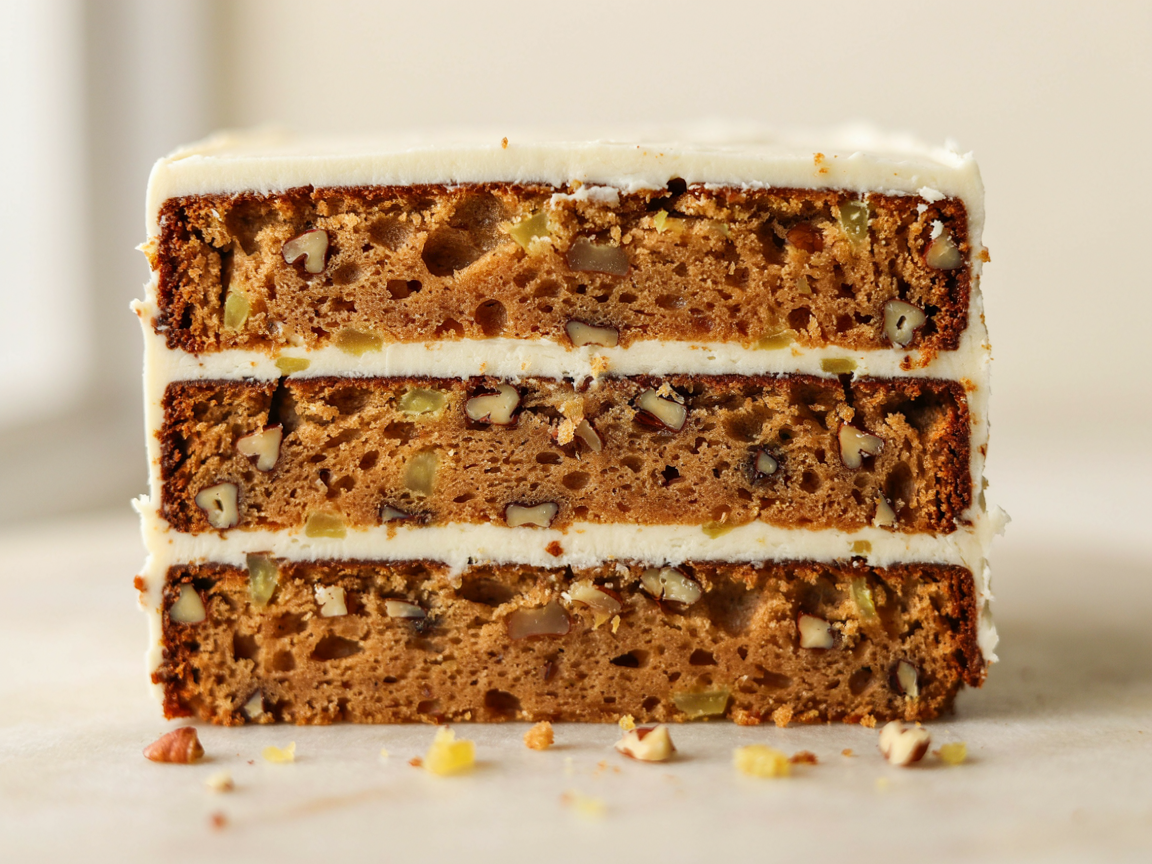
Dense and close-textured. That tight crumb is what holds the moisture in.
Most layer cakes are noticeably drier on day two. This one is not, and the reason is structural rather than magical — four things are working at once.
Oil, not butter
Butter is solid at room temperature, so a butter cake firms up as it cools and reads as dry by day two. Oil stays liquid at every temperature this cake will ever meet, which is why a slice cut on Thursday feels the same as one cut on Monday.
Crushed pineapple is an ingredient, not a flavour
Even drained hard, the pineapple carries water and sugar into the crumb, and sugar is hygroscopic — it holds onto that water rather than letting it evaporate. This is doing more work than the bananas are.
Two cups of mashed banana
That is a lot of fruit puree for three cups of flour. It is part starch, part sugar, part water, and it weighs the crumb down into the dense, close texture people mean when they say moist rather than light.
No creaming, no aeration
Creamed butter cakes rely on trapped air for lift, and air dries out. A stir-together batter has almost none, so the crumb is tight, and a tight crumb loses moisture far more slowly than an open one.
The practical consequence: do not treat this like a sponge that must be eaten the day it is baked. Bake the layers a day ahead, or frost the whole thing two days before you need it. It is one of the very few cakes that genuinely improves in the refrigerator.
Every Pan Size, Converted
The original recipe assumed three 9-inch rounds and said nothing about anything else. Here is the same batter in every pan people actually ask about, all at 350°F.
| Pan | Batter | Bake time | What to know |
|---|---|---|---|
| PanThree 9-inch rounds | BatterFull batch | Bake time25–30 min | What to knowThe 1978 original. Tallest, most impressive, and the only version that gives you two internal frosting layers. |
| PanTwo 9-inch rounds | BatterFull batch | Bake time32–38 min | What to knowThicker layers, fewer of them. Start checking at 32 minutes — the extra depth needs the time but overshoots quickly. |
| PanOne 9-inch round | BatterOne-third batch | Bake time28–32 min | What to knowA single-layer hummingbird cake, frosted on top only. Use the 8-serving column and bake one pan. |
| Pan9×13 sheet | BatterFull batch | Bake time40–45 min | What to knowFrosted in the pan and cut into squares. No stacking, no cooling anxiety, and the easiest version to carry anywhere. |
| Pan13×18 half sheet | BatterFull batch | Bake time22–28 min | What to knowShallow and quick, cut into roughly 24 squares. Watch it closely — a thin cake overbakes in a couple of minutes. |
| Pan12-cup bundt | BatterFull batch | Bake time50–60 min | What to knowGrease every crevice and flour it. Best with a cream cheese glaze poured over rather than a full frosting. |
| PanCupcakes | BatterFull batch, filled two-thirds | Bake time18–22 min | What to knowMakes about 30. Swirl the frosting high and press a pecan half into each. |
| PanTwo 9×5 loaves | BatterFull batch | Bake time50–60 min | What to knowThe most banana-bread-like version, and the one that freezes and gifts best. |
The rule behind the table: the deeper the batter sits in the pan, the longer and gentler the bake. Whatever you use, the test never changes — a skewer in the centre with a few moist crumbs on it, checked early rather than late.
The Cream Cheese Frosting
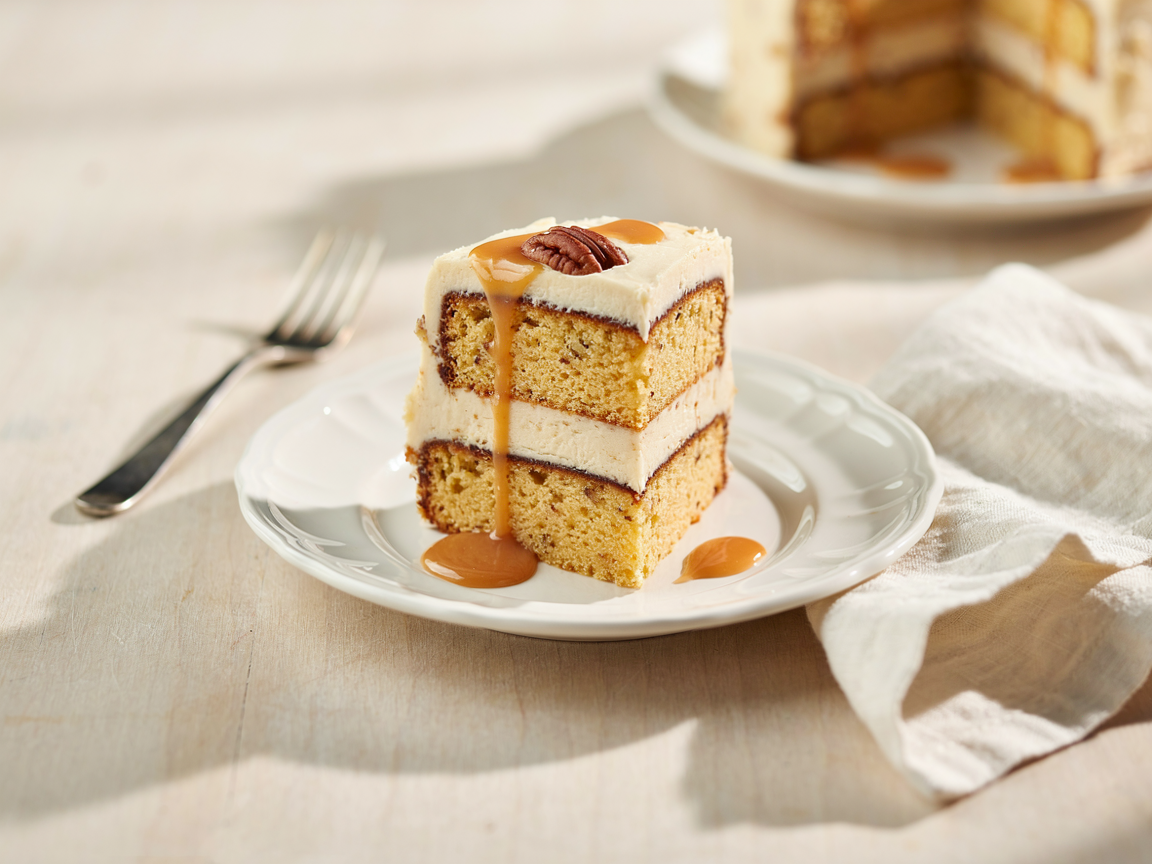
Chill for thirty minutes and wipe the knife between cuts. That is the whole trick to a clean slice.
The frosting is four ingredients and one non-negotiable rule: full-fat block cream cheese, never the spreadable tub. The tub version is thinned with water and will not thicken no matter how long you beat it.
Block cream cheese, straight from cold to soft
Leave it out for 45 minutes, no longer. Cream cheese that has gone genuinely warm never whips to a proper structure, and cream cheese used cold leaves lumps that no beating will remove.
Beat the cheese and butter before any sugar
A full two to three minutes on their own. Adding the sugar first makes a dense paste that will not lighten afterwards, however long you leave the mixer running.
Sifted sugar, a cup at a time
Powdered sugar compacts in the bag into small hard lumps. Sift it, add it in stages, and scrape the bowl between additions.
Finish with pecans, not decoration
Pecan halves in a ring on top and chopped pecans pressed around the bottom edge. It hides an imperfect side, it signals what is inside, and it is what the cake has looked like since 1978.
If you find it too sweet — and six cups of powdered sugar is a traditional quantity, not a modern one — take it down to four and a half cups, add a full half teaspoon of salt, and beat in a tablespoon of the pineapple juice you reserved. It will be softer, so chill the assembled cake before you slice it.
Eight Rules That Decide How It Turns Out
None of these are difficult. All of them are the difference between the cake people remember and the cake people are polite about.
Spotty brown bananas only
Yellow bananas are still mostly starch. The brown-spotted ones have converted that starch to sugar, which is where the banana-bread flavour actually comes from. If yours are stubbornly yellow, bake them at 300°F for 20 minutes and let them cool.
Squeeze the pineapple dry
Press it in a strainer until no more liquid comes out. Pineapple packed in juice carries a surprising amount, and undrained fruit is the cause of nearly every sunken middle reported for this cake.
Toast the pecans, then cool them
Six minutes at 350°F. Warm nuts folded into batter start melting the oil around them and go soft; let them cool to room temperature on the tray first.
Stop stirring when the flour disappears
Lumpy batter bakes into a tender cake. Smooth batter has been worked, and worked batter bakes into something that slices like bread.
Full-fat block cream cheese
Not the spreadable tub, which is thinned with water and will never hold its shape. This is the single most common reason a cream cheese frosting refuses to thicken.
Sift the powdered sugar
It takes ninety seconds and it is the difference between silky frosting and one with tiny hard specks that no amount of beating will dissolve.
Cool completely before frosting
Not mostly cool. A cake at even 90°F will melt cream cheese frosting into a slipping mess within ten minutes of assembly.
Chill 30 minutes before slicing
The frosting firms, the layers settle, and a serrated knife wiped between cuts gives you the clean cross-section the cake deserves.
What Went Wrong, and How to Fix It
Pick whatever happened:
The middle sank
Almost always undrained pineapple. The fix: press the fruit in a strainer until it stops giving up liquid, and measure your mashed banana rather than eyeballing it — too much fruit puree is the other cause. Opening the oven before 20 minutes will do it as well.
The frosting slid off the sides
The cake was warm, or the cream cheese was the tub kind. The fix: cool the layers to genuine room temperature, use full-fat block cream cheese, and if the frosting is already too soft, chill the whole bowl for 20 minutes and beat it briefly again before you spread it.
It came out dry
Overbaked, usually by three or four minutes. The fix: start checking at 25 minutes and pull it when the skewer has moist crumbs on it. A clean skewer means it is already past its best. Measuring flour by scooping the cup into the bag also adds up to half a cup too much.
The layers stuck to the pans
Grease alone is not enough for a cake this heavy. The fix: parchment circles in the bottom, greased on top as well. If a layer is already stuck, warm the base of the pan on a low burner for thirty seconds and try again.
It tasted flat, not like the one I remember
Underripe bananas and untoasted pecans, in that order. The fix: wait for the brown spots, toast the nuts, and do not cut the cinnamon — a teaspoon and a half sounds like a lot and it is what makes the cake taste Southern rather than merely sweet.
The frosting was too sweet
Six cups of powdered sugar is the traditional amount and it is a lot. The fix: take it to four and a half cups and add a full half teaspoon of salt plus a tablespoon of the reserved pineapple juice. The frosting will be softer, so chill the cake before slicing.
Storing It — and Why It Gets Better
Choose where it is going:
On the counter — day one
Under a cake dome, up to 24 hours, and only if your kitchen is cool. Cream cheese frosting is not shelf-stable in a warm room, and this cake is worth more than the risk.
In the refrigerator — where it belongs
Covered, up to 5 days, and it is genuinely better on days two and three than on day one: the cinnamon settles and the banana comes forward. Take each slice out 30 minutes before eating, or the oil firms and dulls the flavour.
In the freezer — unfrosted layers
Cooled layers, double-wrapped, up to 3 months. Thaw in the wrapping so the condensation forms on the plastic rather than on the cake, then frost as usual.
In the freezer — finished slices
Freeze slices uncovered on a tray until firm, then wrap individually. They thaw in about 40 minutes on the counter and are the best argument for making the full three layers when there are only two of you.
The one thing worth knowing about the refrigerator: cold dulls oil-based cakes. Take a slice out half an hour before you eat it and it tastes like it did the day it was made. Eaten straight from the cold, the same slice tastes flat and firm, and people blame the recipe.
Questions, Answered
Besides banana, what is the main flavor in a hummingbird cake?
Crushed pineapple. It is the flavour that separates a hummingbird cake from a banana cake, and it is doing two jobs at once — bright tropical sweetness against the richness of the oil and the frosting, and a real contribution to how moist the crumb stays. After the pineapple, the next most noticeable flavours are cinnamon and toasted pecan.
Is this the original 1978 recipe?
It is the same recipe in structure and proportions as the one Southern Living published in February 1978 — three cups of flour, two cups of sugar, oil rather than butter, an 8 oz can of crushed pineapple, two cups of mashed banana, pecans and cinnamon, baked in three 9-inch pans under cream cheese frosting. What has been added here is the detail that the original assumed you already knew: draining the fruit, toasting the nuts, and cooling before frosting.
Why is it called hummingbird cake?
It arrived in the United States from Jamaica, where a version was known as Doctor Bird Cake — named for the streamer-tailed hummingbird that is Jamaica’s national bird. When a North Carolina reader submitted it to Southern Living in 1978, it was renamed hummingbird cake. The charming explanation is that the cake is sweet enough to attract hummingbirds; the more likely one is that you hover over it.
Can I make it without pecans?
Yes. Walnuts work identically and cost less. If you are avoiding nuts entirely, leave them out and add a quarter cup more mashed banana — the cake loses its crunch but nothing else, and it still tastes unmistakably like a hummingbird cake.
Can I make it ahead?
It is better made ahead. Bake the layers a day early, wrap them once cool and leave them at room temperature, then frost on the day. A fully assembled cake also holds beautifully for two days in the refrigerator, which is why it turns up at so many gatherings that were planned a week in advance.
Why did my cream cheese frosting go runny?
Three causes, in order of likelihood: the cream cheese was the spreadable tub kind rather than the block, the butter was too warm and close to melting, or it was overbeaten after the sugar went in. Chill the bowl for 20 minutes, beat briefly, and it will usually come back.
Spotty bananas, pineapple squeezed dry, pecans toasted, and layers cooled all the way before the frosting goes near them. Get those four right and the rest of this recipe is stirring.
Pin this hummingbird cake so the pan conversions are there the next time you need a cake for a crowd.
Save it for later.