
One Pot · Slow Simmered · No Flour
Authentic Hungarian Goulash: The Slow-Simmered Beef and Paprika Stew
Made the way it is made in Hungary — paprika stirred in off the heat, beef given two unhurried hours, and not a spoonful of flour anywhere.
- ~3 hours, mostly unattended
- Better on day two
- Freezes beautifully
- One pot
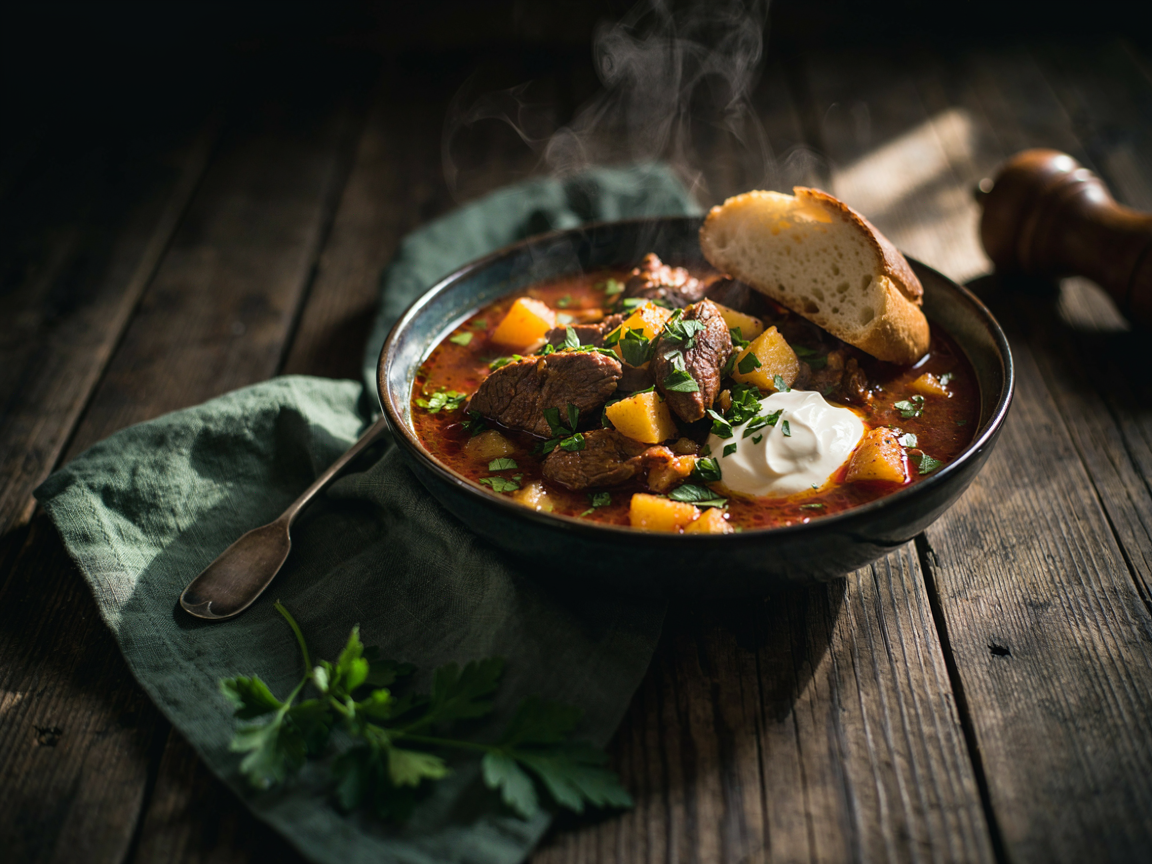
Brothy rather than thick — which, as the next section explains, is the whole point.
Authentic Hungarian goulash is a soup. Not a thick, dark, gravy-like stew you eat with a fork, but a brothy paprika-red bowl with potatoes in it and bread on the side. Almost every English-language recipe that calls itself authentic is actually describing a different dish entirely, and once you know the difference the whole thing makes far more sense.
The recipe below is the Hungarian version. It rests on two things nobody mentions often enough: as much onion by weight as beef, and paprika that never touches direct heat. Get those right and you do not need flour, stock cubes or tomato paste to make it taste like something that took all afternoon.
Save the pin so it is there when the weather turns.
Authentic Hungarian Goulash vs Pörkölt vs Paprikás
These three get used interchangeably in English and they are three separate dishes. If a recipe promises authentic Hungarian goulash and produces something thick enough to stand a spoon in, it has quietly given you pörkölt.
| Dish | What it is | How to tell |
|---|---|---|
| DishGulyás | What it isA brothy beef and paprika soup with potatoes and often csipetke | How to tellEaten with a spoon from a bowl. This recipe. |
| DishPörkölt | What it isThe same base cooked down to a thick stew, no potatoes, very little liquid | How to tellServed over nokedli or noodles and eaten with a fork |
| DishPaprikás | What it isPörkölt finished with sour cream, most often made with chicken | How to tellPale pink rather than deep red, and creamy |
The name comes from gulyás, the Hungarian word for herdsman — it was cooked in a cauldron over a fire by cattle herders, which is also why it scales so effortlessly and why it has never needed a thickener. Everything in the pot does that job by itself.
If you want the thick version: make this recipe, leave out the potatoes and the water, and simmer it down until the liquid barely coats the meat. That is pörkölt, and it is excellent over buttered noodles.
Paprika: The One Rule That Decides Everything
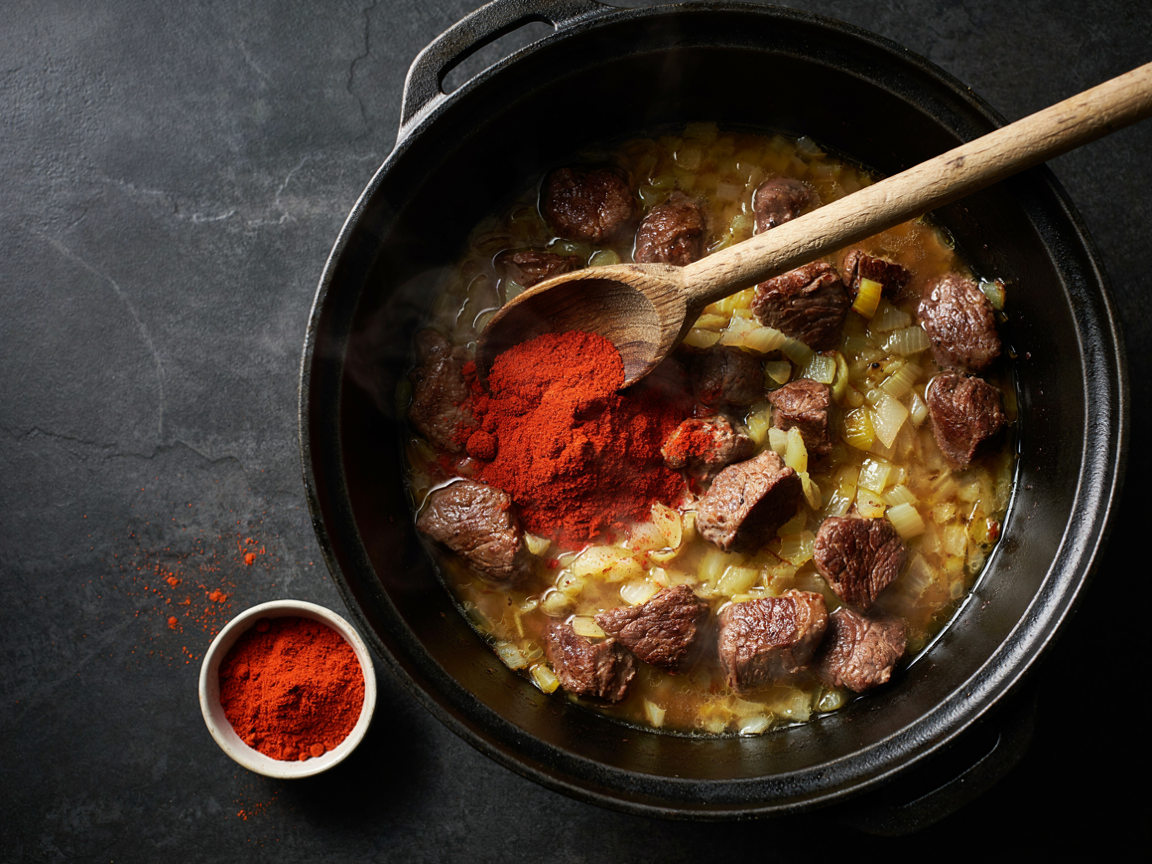
Off the burner, 30 seconds to cool, then the paprika. This is the moment the dish is won or lost.
Paprika burns at around 250°F. That is well below a normal frying temperature, which is why it scorches the instant it hits a hot pan. Once burnt it turns permanently, unmistakably bitter, and no amount of salt, sugar or sour cream will lift it back out. Take the pot off the heat, count to thirty, stir the paprika into the onions, then return it to a low burner.
Use sweet Hungarian paprika, not smoked. Smoked paprika is a Spanish product and it will take the whole pot somewhere else entirely. If the label says édesnemes, that is the standard sweet grade and exactly what you want.
Freshness beats brand. Paprika is a ground spice with a lot of surface area and it fades fast. After about a year it has lost most of its colour and nearly all of its aroma, and no quantity of stale paprika will give you that deep red. If yours is a dull brown rather than a bright brick red, replace it before you start.
Use more than feels comfortable. Three tablespoons for two pounds of beef sounds like a lot if you are used to treating paprika as a garnish. It is not a garnish here — it is the main flavouring, and under-doing it is the second most common reason homemade goulash tastes thin.
The onion ratio is the other half. Traditional gulyás uses roughly the same weight of onion as meat. It sounds absurd and it is correct — the onion melts away entirely over two hours and becomes the body of the broth. That is what replaces the flour.
The Recipe
Authentic Hungarian Goulash (Gulyásleves)
Beef simmered slowly with an equal weight of onion and a great deal of sweet paprika, finished with potatoes and — if you like — pinched noodles.
How many are you feeding?
Ingredients
- 1¼ lb (570g)2 lb (900g)2¾ lb (1.25kg)3½ lb (1.6kg) beef shin or chuck, cut into 1½-inch cubes
- 1½ tbsp2 tbsp3 tbsp¼ cup neutral oil, or beef dripping
- 1¼ lb (570g)2 lb (900g)2¾ lb (1.25kg)3½ lb (1.6kg) yellow onions, finely diced — yes, the same weight as the meat
- 2 tbsp3 tbsp¼ cup5 tbsp sweet Hungarian paprika, fresh and not smoked
- ¾ tsp1 tsp1½ tsp2 tsp caraway seeds, lightly crushed
- 2345 garlic cloves, finely chopped
- 1 small1 large22 large green pepper, sliced — Hungarian wax if you can find it
- 1 small1 medium22 large ripe tomato, roughly chopped
- 2345 carrots, cut into thick coins
- 10 oz (280g)1 lb (450g)1½ lb (680g)2 lb (900g) waxy potatoes, cut into 1-inch cubes
- 4 cups6 cups8 cups10 cups water or light beef stock
- 1 tsp1½ tsp2 tsp2½ tsp fine salt, plus more at the end
Instructions
Soften the onions properly
Heat the oil in a heavy pot over medium-low, add the onions with a good pinch of salt, and cook for 15 to 20 minutes until completely soft, golden and collapsed. This is the base of the whole dish and it cannot be hurried — pale, undercooked onion stays sharp right through to the end.
Paprika goes in off the heat
Take the pot off the burner entirely and let it cool for about 30 seconds. Stir in the paprika and crushed caraway, coating the onions completely. Paprika scorches above roughly 250°F and turns irreversibly bitter, so this step is not optional.
Coat the beef and sweat it
Return the pot to low heat, add the beef and stir until every piece is coated in the dark red onion paste. Cover and let it sweat for 10 minutes, stirring once. The meat is not being browned here — it is releasing its juices into the base.
Add water and simmer long
Pour in just enough water or stock to barely cover the meat, add the garlic, and bring to the gentlest possible simmer. Cover partially and cook for 1½ to 2 hours, until the beef gives way completely under a spoon. Top up with a splash of hot water if it reduces too far.
Vegetables in last
Add the carrots, peppers, chopped tomato and potatoes along with the rest of the liquid. Simmer uncovered for another 25 to 30 minutes until the potatoes are tender and the broth has thickened slightly on its own.
Csipetke, if you are making them
Drop the pinched noodles straight into the simmering broth for the last 5 minutes. They are cooked the moment they float and swell — they need no pre-boiling and they thicken the broth very slightly as they go.
Rest, then season
Take the pot off the heat and let it stand for 10 minutes before serving. Season with salt only at this point, since the broth concentrates as it cooks. Serve with chopped parsley and bread.
Roughly, per serving
Calculated from the 6-serving quantities — 2 lb beef chuck, 2 lb onions, 1 lb potatoes and 2 tbsp oil — divided six ways, without csipetke or sour cream.
This is an estimate, not a lab analysis. The cut of beef is the biggest variable: shin comes in lower than chuck, short rib considerably higher. Skimming the fat after an overnight chill takes off a meaningful amount.
Csipetke — the pinched noodles
Two ingredients, no rolling pin, and the detail that makes a bowl of gulyás taste like it came from someone’s grandmother rather than a recipe site. They are optional, they take four minutes, and they are worth it.
Mix 1 egg with ¾ cup flour and a pinch of salt into a very stiff dough — stiffer than pasta dough, barely tacky. Knead for a minute, then flatten it between your palms until it is about the thickness of a coin.
Pinch off small irregular pieces roughly the size of a fingernail and drop them straight into the simmering goulash for the last 5 minutes. They are done the moment they float and puff. Do not boil them separately — cooking them in the broth is what makes them taste of anything.
Substitutions That Actually Work
Each swap below keeps the method identical. Anything that changes the character of the dish is flagged.
| Instead of | Use | What changes |
|---|---|---|
| Instead ofBeef shin or chuck | UseBrisket, oxtail or short rib, all cut large | What changesRicher and fattier; skim the surface before serving |
| Instead ofSweet Hungarian paprika | UseAny fresh sweet paprika, ideally bought within the year | What changesStandard supermarket paprika is milder — use a little more |
| Instead ofLard or beef dripping | UseAny neutral oil, or butter with a splash of oil | What changesTraditional versions use lard; oil works identically here |
| Instead ofCaraway seeds | UseHalf the quantity of ground caraway, or a pinch of fennel seed | What changesGround caraway fades faster, so add it later in the cook |
| Instead ofHungarian wax pepper | UseAn ordinary green bell pepper, or half a banana pepper | What changesSlightly less sweet, no real difference to the broth |
| Instead ofWaxy potatoes | UseAny potato that holds its shape, or skip them entirely | What changesFloury potatoes break down and cloud the broth — that is pörkölt territory |
| Instead ofCsipetke | UseSmall pasta, spaetzle, or nothing at all | What changesShop pasta releases more starch, so add it at the very end |
The one swap not worth making: smoked paprika for sweet. It is not a stronger version of the same thing — it is a different spice, and it turns Hungarian gulyás into something that tastes Spanish.
What to Serve With It
It is a complete meal in a bowl, so everything here is about the edges rather than filling a gap.
Good bread, and plenty of it
A crusty white loaf or a soft roll. This is a brothy dish and the bread is doing real work — it is how the last third of the bowl gets eaten.
A spoonful of sour cream
Not traditional in gulyás — it belongs in paprikás — but a swirl cuts the paprika richness and most people at the table will want it. Serve it alongside rather than stirring it in.
Pickled things
Pickled cucumbers, pickled peppers or a sharp cabbage salad. Hungarian tables almost always have something vinegary next to the stew, and it resets the palate between spoonfuls.
Nothing else, honestly
It has meat, potatoes and vegetables in one bowl. Adding a side dish is how a two-hour stew turns into a three-hour evening for no gain.
Make Ahead, Freeze, and Feed a Crowd
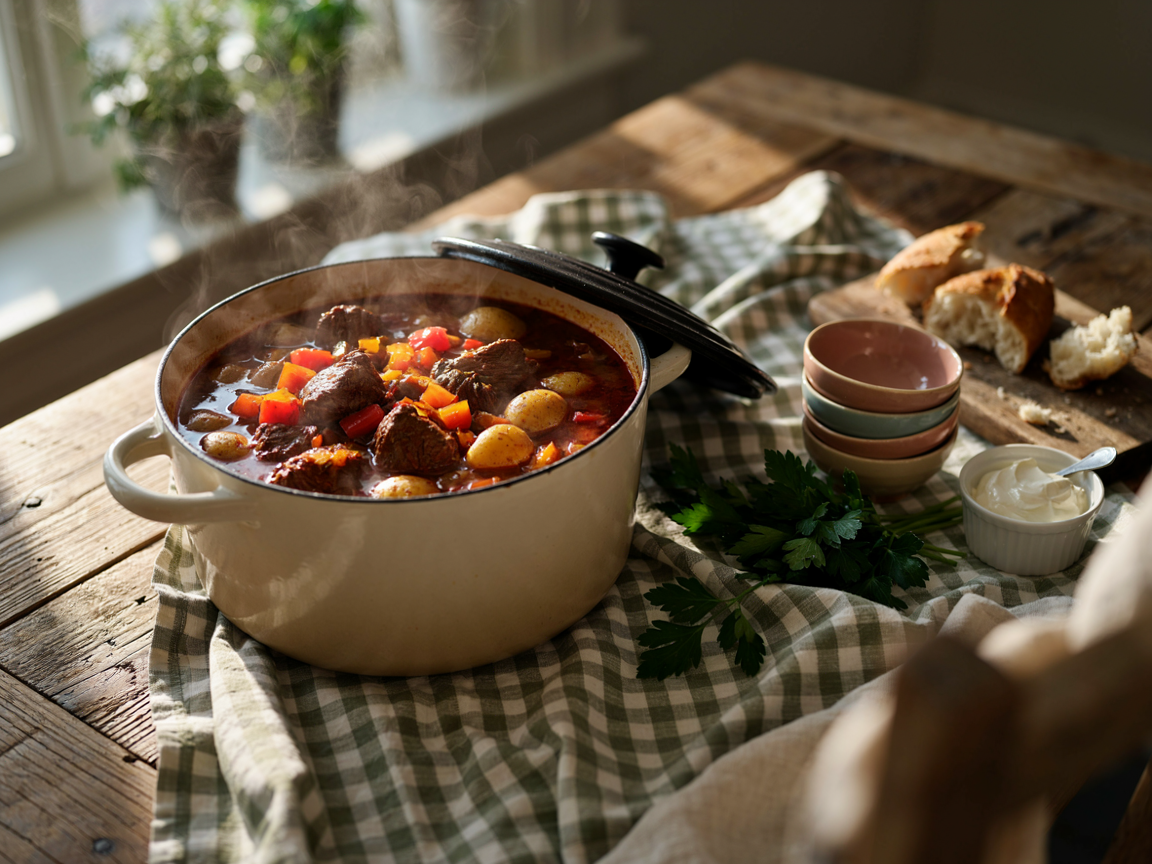
Made a day ahead and reheated gently, it is better than it was the night before.
Pick your timeline:
Serving today
Goulash is better after a rest. Take it off the heat a full 30 minutes before you plan to eat, leave it covered, then warm it gently through. The broth clarifies slightly and the paprika settles from sharp into round. Season with salt only at the end, after the resting, because the broth concentrates as it stands.
Up to 4 days ahead
This is the way to make it. Cook it completely, cool it and refrigerate for up to 4 days — it genuinely improves for the first two. Any fat will set on the surface, which makes it easy to lift off if you want a lighter bowl. Reheat gently on the stove, never at a boil, and add a splash of hot water if it has thickened too far.
Freezing — up to 3 months
Freeze it without the potatoes if you are planning ahead, because potato goes mealy and grainy after thawing. Cool completely, portion, and leave an inch of headspace. Thaw overnight in the refrigerator and reheat gently, adding freshly boiled potatoes for the last 10 minutes. Csipetke should also be made fresh.
Feeding a crowd
It scales without any adjustment at all — this is a dish that was designed to be cooked over a fire in a large pot for a lot of people. The only thing to watch is the pot: the onions need room to soften in a single layer at the start, so use something wider than you think you need, or soften them in two batches.
Troubleshooting
Pick whatever went wrong:
It tastes bitter
The paprika caught the heat. It burns at around 250°F and once it has, there is no fixing it — the bitterness does not cook out. The fix for next time: pot completely off the burner, 30 seconds to cool, paprika stirred in, then back on low. To salvage this batch, a spoonful of sour cream per bowl and a little extra salt will mask some of it, but not all.
The beef is still tough
It has not cooked long enough, or it boiled rather than simmered. Connective tissue needs time at a low temperature; a hard boil tightens the muscle fibres instead. The fix: put the lid back on and give it another 30 to 45 minutes at the barest simmer. Tough beef in a stew is almost always undercooked, not overcooked.
The broth is too thin
There was too much liquid at the start, or not enough onion. The fix: lift out the beef and vegetables with a slotted spoon and reduce the broth uncovered for 10 to 15 minutes, then return them. Do not reach for flour — mashing a few of the cooked potatoes against the side of the pot thickens it in the traditional way.
It is greasy on top
A fattier cut, which is not a problem — it is easily fixed. The fix: skim the surface with a wide spoon, or better, chill the whole pot and lift the set fat off in one piece the next day. That is one more argument for making it a day ahead.
It tastes flat
Almost always under-salted, because the broth concentrates over two hours and people salt it early and then leave it alone. The fix: salt at the end, in stages, tasting between each. If it still lacks lift, a small splash of vinegar or a squeeze of lemon sharpens the whole pot without making it taste sour.
Questions, Answered
Is Hungarian goulash a soup or a stew?
In Hungary it is a soup. Gulyás is brothy, contains potatoes and is eaten from a bowl with a spoon. The thick, dark, almost gravy-like dish that most English-speaking countries call goulash is actually pörkölt, which has no potatoes and far less liquid. This recipe makes the Hungarian version.
Why did my goulash turn bitter?
The paprika was added over direct heat. Paprika scorches at around 250°F and once it burns the bitterness cannot be cooked out or covered up. Always take the pot completely off the burner, wait about 30 seconds, then stir the paprika into the softened onions before returning it to a low heat.
What cut of beef is best for goulash?
Beef shin is the best choice, with chuck a close second. Both are full of connective tissue that breaks down over a long simmer into gelatin, which is what gives the broth body without any flour. Lean cuts like sirloin or round will go dry and stringy no matter how long you cook them.
Should goulash have flour or tomato paste in it?
No to both, in the traditional version. The broth thickens on its own from the collagen in the beef, the volume of onion breaking down, and the starch released by the potatoes. Flour makes it gluey and tomato paste pushes the flavour toward an Italian stew rather than a Hungarian one.
Can I use smoked paprika instead of sweet paprika?
Not for this dish. Smoked paprika is a Spanish product and it will make the goulash taste like chorizo stew rather than Hungarian gulyás. You want sweet Hungarian paprika, and freshness matters more than the brand — paprika older than about a year loses both colour and flavour.
How long does goulash need to cook?
Around two hours of gentle simmering before the vegetables go in, then another 25 to 30 minutes after. You are waiting for the beef to give way completely under the back of a spoon. Rushing it at a hard boil tightens the meat instead of tenderising it.
Can I make goulash in a slow cooker?
Yes, with one caveat. Do the onion and paprika steps on the stove first, because that base cannot be built in a slow cooker. Then transfer everything except the potatoes and simmer on low for 7 to 8 hours, adding the potatoes for the final hour so they do not disintegrate.
Does goulash freeze well?
Very well, for up to 3 months, and it tastes better on the second day regardless. Freeze it without the potatoes if you can, since they go grainy on thawing, and add freshly cooked ones when you reheat. Thaw overnight in the refrigerator and warm gently on the stove.
As much onion as beef, paprika stirred in off the heat, two unhurried hours, and salt only at the end. Four rules, no flour, and a pot that gets better every time you reheat it.
Pin this authentic Hungarian goulash so the paprika rule and the timings are there the next time the weather turns — then come back and tell us whether you made the csipetke.