
Beef Ragù · Silky Béchamel · Ricotta
Classic Lasagna with Béchamel Sauce and Ricotta
Slow beef ragù, a silky from-scratch béchamel and seasoned ricotta, layered in the right order so every slice stands tall. Make it a day ahead and it only gets better.
- Serves 8
- Mostly hands-off
- Make-ahead
- Printable card
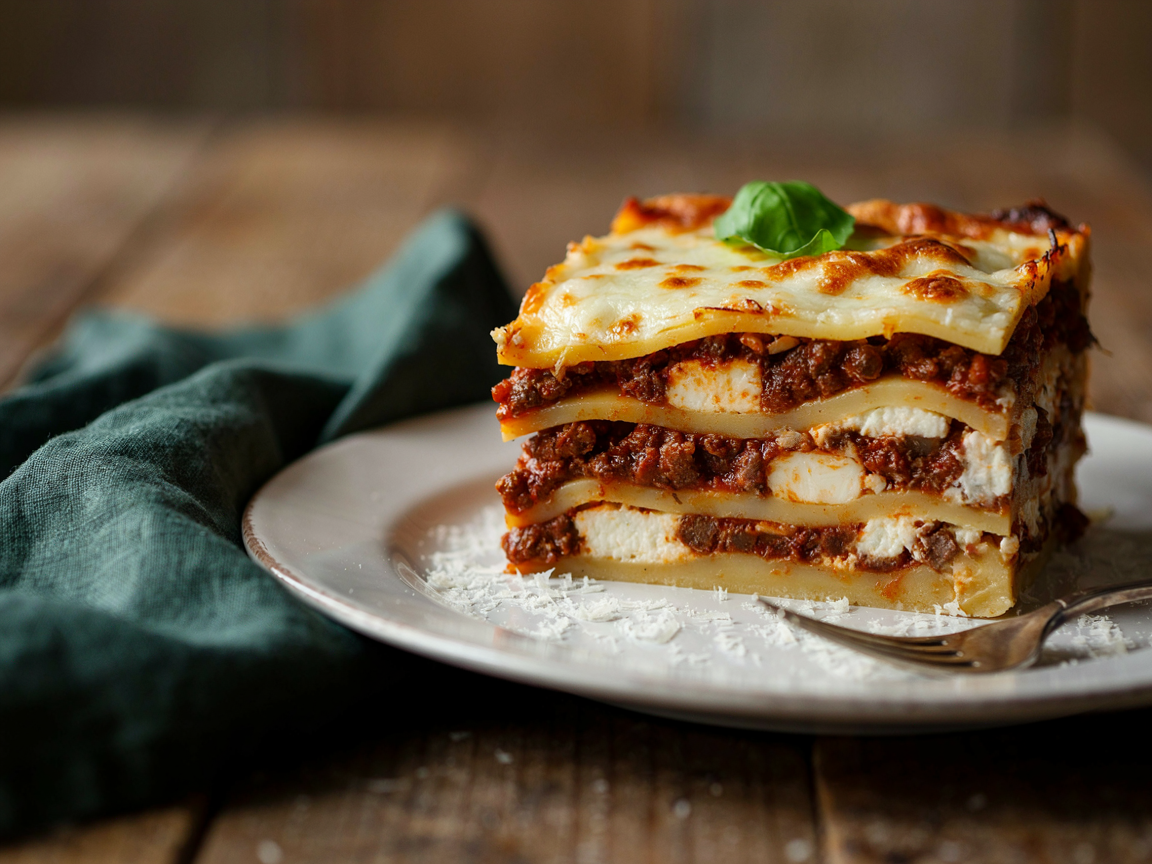
A tall, clean slice: golden béchamel on top, beef ragù and ricotta in every layer.
This classic lasagna with béchamel sauce is the creamy, layered kind you find in Northern Italy, with a little Italian-American ricotta for good measure. A slow-simmered beef ragù, a silky white sauce and a seasoned ricotta layer bake into tall, tidy slices with a golden, blistered top.
Most lasagna recipes with béchamel sauce stop at the white sauce. This one adds ricotta, because the two do different jobs. Béchamel binds the layers and keeps them moist; ricotta adds pockets of light, fresh creaminess. The ragù is all beef, with beef stock instead of wine, simmered until it’s thick enough to hold its shape.
What Is Lasagna with Béchamel Sauce?
Lasagna means layering sheets of pasta with meat or vegetable sauce, creamy béchamel or ricotta cheese, and grated cheese, then baking until golden and bubbling. Lasagna with béchamel sauce uses the creamy white sauce, made from butter, flour and milk, as one of those layers.
Should Béchamel Sauce Be Used in Lasagna?
So, is béchamel in lasagna traditional? Using béchamel sauce in lasagna is the classic Northern Italian way. Lasagne alla bolognese, from Emilia-Romagna in Northern Italy, is made with a meat ragù and béchamel, with no ricotta at all. Ricotta lasagna is the Southern Italian and Italian-American style. Both are authentic, but a béchamel lasagna feels different on the plate:
| Béchamel only | Ricotta only | Both (this recipe) | |
|---|---|---|---|
| Texture | Béchamel onlySilky, creamy, holds together | Ricotta onlyLighter, with soft cheesy pockets | Both (this recipe)Creamy and tall, with pockets of fresh cheese |
| Flavor | Béchamel onlyRich, buttery, a hint of nutmeg | Ricotta onlyFresh, mild, a little sweet | Both (this recipe)Rich but not heavy |
| Slices | Béchamel onlyVery clean | Ricotta onlyCan slump if the ricotta is wet | Both (this recipe)Clean, as long as it rests |
| Where it comes from | Béchamel onlyNorthern Italy (Emilia-Romagna) | Ricotta onlySouthern Italy and Italian-American kitchens | Both (this recipe)The best of both |
This lasagna with béchamel and ricotta uses both, so you get a creamy, sliceable lasagna that still has those soft pockets of fresh cheese.
The Best Béchamel Sauce for Lasagna
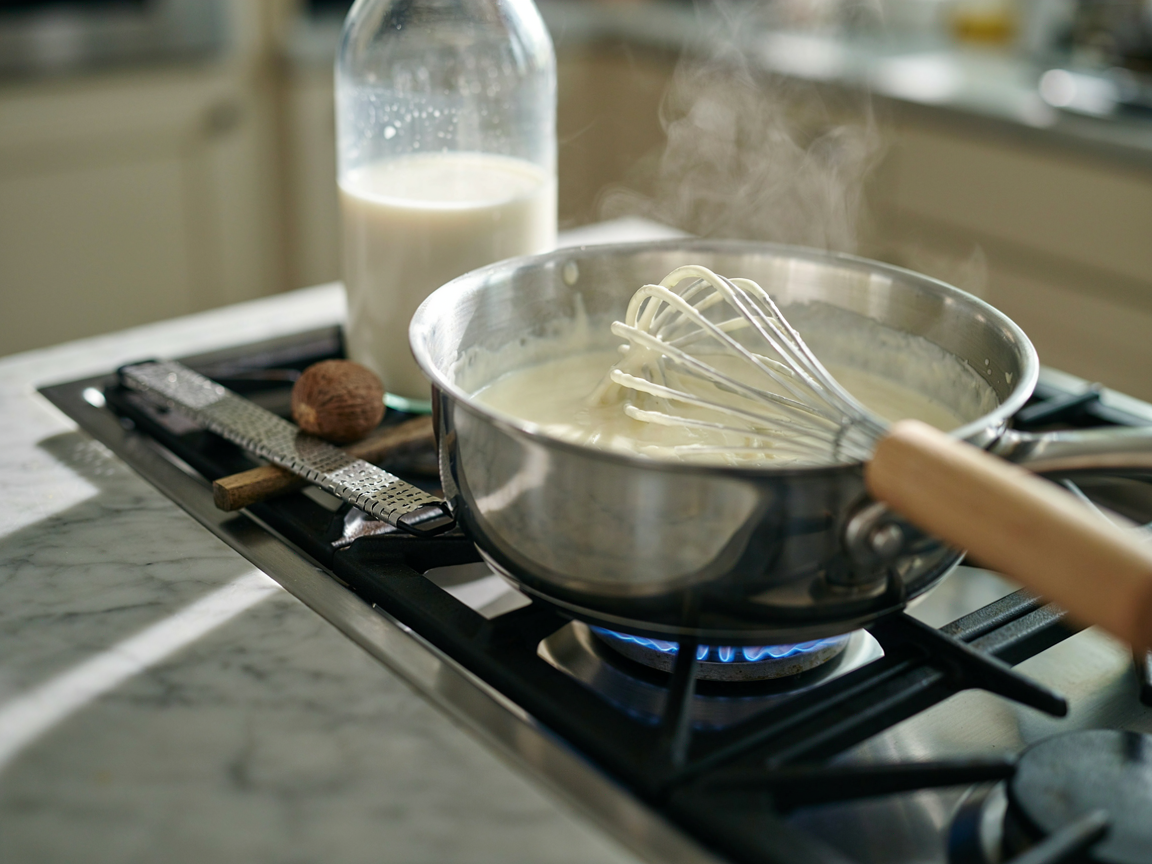
Ready when it coats the whisk and a spoon, like heavy cream. Fresh nutmeg goes in last.
This easy béchamel sauce recipe for lasagna with ricotta cheese and meat needs just three ingredients: butter, flour and milk. Getting it right comes down to the ratio and four small habits.
The Béchamel Sauce Ratio for Lasagna with Meat and Ricotta
Use equal weights of butter and flour, with about 12 times as much milk. With meat and ricotta, it can be on the thinner side, because the ricotta adds creaminess too. Without ricotta, make more and make it thicker.
| Lasagna | Butter | Flour | Milk | Consistency |
|---|---|---|---|---|
| LasagnaLasagna with meat and ricotta (this recipe) | Butter60 g | Flour60 g | Milk700 ml (3 cups) | ConsistencyPourable, like heavy cream |
| LasagnaBéchamel sauce lasagna with meat, no ricotta | Butter90 g | Flour90 g | Milk1 liter (4¼ cups) | ConsistencyA little thicker; coats a spoon |
| LasagnaWhite or vegetable lasagna | Butter90 g | Flour90 g | Milk1 liter (4¼ cups) | ConsistencyAdd 50 g Parmesan at the end |
| LasagnaSmall 8×8 pan | Butter30 g | Flour30 g | Milk350 ml (1½ cups) | ConsistencyPourable, like heavy cream |
The Lasagna Béchamel Sauce Recipe, Step by Step
Cook the roux for 2 full minutes
Butter and flour need time together, or the sauce tastes floury. Whisk until it smells nutty, like shortbread, but stop before it turns golden.
Warm the milk first
Cold milk hitting a hot roux is what makes lumps. Warm it until it steams, then add it a ladle at a time, whisking hard. It will seize into a paste at first. Keep going and it smooths out.
Stop at heavy-cream thick
Lasagna béchamel sauce should coat the back of a spoon and leave a clean line when you run a finger through it. Too thin and the lasagna turns watery; too thick and the layers bake dry.
Season it properly
Salt, a pinch of white pepper and freshly grated nutmeg. The nutmeg is what makes it taste like béchamel rather than plain white sauce, so do not skip it.
Want a cheesier béchamel? Stir ½ cup of grated Parmesan into the finished sauce off the heat. It’s technically a Mornay sauce, and it browns into a gorgeous golden top. For a golden saffron béchamel, steep a pinch of saffron threads in the warm milk for 10 minutes first.
Ricotta Béchamel Sauce and Other Creamy Layers
Ricotta and béchamel can also be combined into one sauce. A ricotta béchamel sauce, or a no-cook ricotta cream sauce for lasagna, is lighter than straight béchamel, creamier than plain ricotta and quicker to layer, since it replaces two layers with one. Here are four creamy layers, and when to use each:
| Sauce | What goes in | How to use it |
|---|---|---|
| SauceRicotta béchamel sauce | What goes in1 batch béchamel (3 cups) + 1 cup (250 g) ricotta + ¼ cup Parmesan | How to use itWhisk the ricotta into the hot béchamel off the heat. Use it in place of both the ricotta and béchamel layers. |
| SauceRicotta cream sauce | What goes in2 cups ricotta + ½ cup milk or cream + ½ cup Parmesan + 1 egg | How to use itNo cooking. Thinner and fresher than béchamel, for a quick, lighter lasagna. |
| SauceCheese béchamel (Mornay) | What goes in1 batch béchamel + ½ cup Parmesan or 1 cup shredded mozzarella | How to use itStir the cheese in off the heat until smooth. It browns beautifully on top. |
| SauceSaffron béchamel | What goes in1 batch béchamel + a generous pinch of saffron threads | How to use itSteep the saffron in the warm milk for 10 minutes before you whisk the milk into the roux. Golden color, gentle floral flavor. |
What does béchamel with ricotta taste like? Mild, creamy and slightly sweet, with a soft, almost cheesecake-like body. Ricotta makes béchamel taste fresher, and béchamel makes ricotta silkier and less grainy.
Classic Lasagna Recipe with Béchamel Sauce and Ricotta
This lasagna with béchamel sauce recipe fills one 9×13 pan. Tap your pan size and every amount on the card changes, including the printable version.
Classic Lasagna with Béchamel Sauce and Ricotta
Slow-simmered beef ragù, silky homemade béchamel and seasoned ricotta, layered four sheets high and baked until golden and bubbling. Made with beef stock instead of wine.
Which pan are you filling?
Ingredients
Beef ragù- 1 tbsp2 tbsp3 tbsp¼ cup olive oil
- ½ large1 large1½ large2 large onion, finely diced
- ½ each1 each1½ each2 each carrot and celery stalk, finely diced
- 2356 garlic cloves, minced
- 12 oz (340 g)1½ lb (680 g)2¼ lb (1 kg)3 lb (1.4 kg) ground beef (85/15)
- 1 tbsp2 tbsp3 tbsp¼ cup tomato paste
- 14 oz (400 g)28 oz (800 g)42 oz (1.2 kg)56 oz (1.6 kg) crushed tomatoes
- ½ cup1 cup1½ cups2 cups beef stock
- 1233 bay leaves
- ½ tsp1 tsp1½ tsp2 tsp dried oregano
- ¾ tsp1½ tsp2¼ tsp1 tbsp salt (plus black pepper to taste)
- a fewa handfula large handful2 handfuls fresh basil leaves, torn
- 2 tbsp (30 g)4 tbsp (60 g)6 tbsp (90 g)½ cup (120 g) unsalted butter
- ¼ cup (30 g)½ cup (60 g)¾ cup (90 g)1 cup (120 g) all-purpose flour
- 1½ cups (350 ml)3 cups (700 ml)4½ cups (1 liter)6 cups (1.4 liters) whole milk, warmed
- ⅛ tsp¼ tspa heaped ¼ tsp½ tsp freshly grated nutmeg (plus salt and white pepper)
- 1 cup (250 g)2 cups (500 g)3 cups (750 g)4 cups (1 kg) whole-milk ricotta
- 1 yolk1 large1 large + 1 yolk2 large egg
- ¼ cup (25 g)½ cup (50 g)¾ cup (75 g)1 cup (100 g) Parmesan, finely grated
- 1 tbsp2 tbsp3 tbsp¼ cup parsley or basil, chopped (plus salt and pepper)
- 6 to 8121824 no-boil lasagna sheets (or fresh, or par-boiled dried)
- 1 cup (115 g)2 cups (225 g)3 cups (340 g)4 cups (450 g) low-moisture mozzarella, shredded
- ⅓ cup (35 g)¾ cup (75 g)1 cup + 2 tbsp (110 g)1½ cups (150 g) Parmesan, grated, for the layers and top
Instructions
Start the ragù
Heat the oil in a heavy pot over medium heat. Cook the onion, carrot and celery with a pinch of salt for 8 to 10 minutes, until soft. Add the garlic for 1 minute.
Brown the beef
Turn the heat to medium-high, add the beef and break it up. Cook for 8 to 10 minutes, until browned. Stir in the tomato paste and cook for 2 minutes, until it darkens.
Simmer it low and slow
Add the tomatoes, stock, bay leaves, oregano, salt and pepper. Simmer uncovered on low for 1½ hours, stirring now and then, until a spoon dragged across the pot leaves a clear trail. Remove the bay leaves and stir in the basil.
Make the béchamel
Melt the butter over medium heat, whisk in the flour and cook for 2 minutes without browning. Whisk in the warm milk a little at a time, then simmer for 8 to 10 minutes, until it coats a spoon like heavy cream. Season with nutmeg, salt and white pepper, and press plastic wrap onto the surface.
Mix the ricotta
Stir the ricotta, egg, Parmesan, parsley, salt and pepper together until smooth.
Heat the oven
Heat the oven to 375°F (190°C). No-boil and fresh sheets go in as they are. Boil regular dried sheets until very al dente.
Layer the lasagna
Spread a thin layer of béchamel in the dish and cover with pasta. Add a third of the ragù, a third of the ricotta in spoonfuls, some béchamel, mozzarella and Parmesan. Repeat twice. Finish with pasta, the rest of the béchamel, mozzarella and plenty of Parmesan.
Bake
Cover with greased foil and bake for 25 minutes. Uncover and bake for 20 to 25 minutes more, until golden and bubbling at the edges.
Rest, then slice
Rest for 20 minutes before cutting, so the layers set and every slice stands tall.
The bake times on the card are for a 9×13 pan. For other pans, use this chart. All of them bake at 375°F (190°C):
| Pan | Pasta layers | Covered | Uncovered |
|---|---|---|---|
| Pan8×8-inch (4 servings) | Pasta layers3 | Covered20 min | Uncovered15 to 20 min |
| Pan9×13-inch (8 servings) | Pasta layers4 | Covered25 min | Uncovered20 to 25 min |
| PanDeep 9×13 or 10×15 (12 servings) | Pasta layers5 | Covered30 min | Uncovered25 to 30 min |
| PanTwo 9×13 pans (16 servings) | Pasta layers4 each | Covered25 to 30 min | Uncovered20 to 25 min, rotating halfway |
Save the pin so the béchamel ratio and the layering order are there on lasagna day.
Lasagna Layering Order with Béchamel Sauce
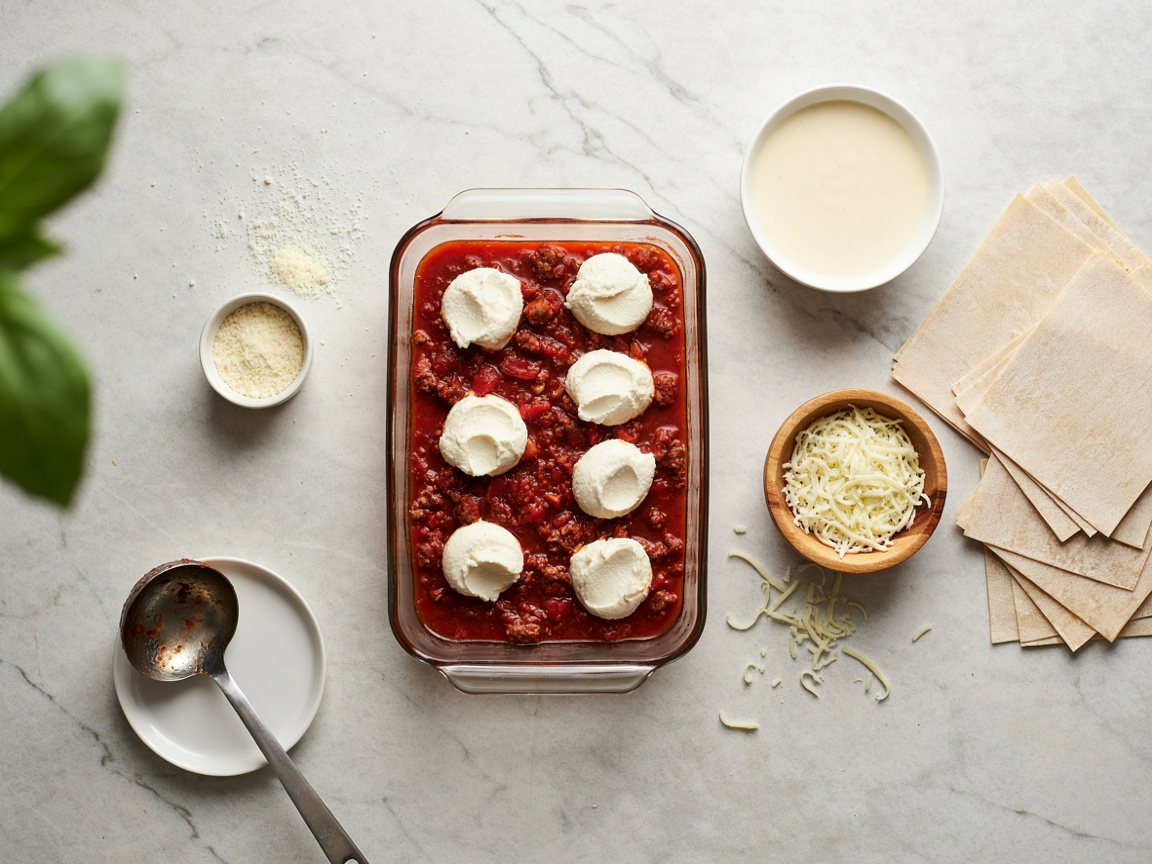
Halfway there: ragù down, ricotta dotted on top, béchamel and cheese waiting their turn.
If you’ve ever wondered what order to layer lasagna when using a béchamel sauce, this is it. Build from the bottom up:
- 1Thin béchamelJust enough to coat the base so the first sheets don’t stick or dry out.
- 2Pasta sheetsCover the whole base, edge to edge. Break sheets to fill gaps.
- 3Beef ragùA third of it, spread right to the corners.
- 4RicottaA third of the mixture in spoonfuls. Don’t spread it hard, or it mixes into the ragù.
- 5BéchamelA few spoonfuls over the ricotta. Gaps are fine; it melts together in the oven.
- 6Mozzarella and ParmesanA light scatter over the béchamel.
- Repeat layers 2 to 6 two more times
- TopPasta, béchamel, cheeseLast sheets, the rest of the béchamel to the edges, the last mozzarella and plenty of Parmesan.
How Much Goes in Each Layer?
Divide each filling into thirds, and save a generous share of béchamel for the top. This béchamel sauce for lasagna recipe makes about 3 cups, which is exactly enough for a 9×13 pan.
| Filling | 9×13 pan (per layer) | 8×8 pan (per layer) | Deep pan (per layer) |
|---|---|---|---|
| FillingRagù | 9×13 pan (per layer)About 1⅔ cups | 8×8 pan (per layer)About ¾ cup | Deep pan (per layer)About 2½ cups |
| FillingRicotta mixture | 9×13 pan (per layer)About ¾ cup | 8×8 pan (per layer)About ⅓ cup | Deep pan (per layer)About 1 cup |
| FillingBéchamel | 9×13 pan (per layer)About ½ cup, plus 1 cup on top | 8×8 pan (per layer)About ¼ cup, plus ½ cup on top | Deep pan (per layer)About ¾ cup, plus 1½ cups on top |
| FillingMozzarella | 9×13 pan (per layer)About ½ cup | 8×8 pan (per layer)About ¼ cup | Deep pan (per layer)About ¾ cup |
No-Boil, Fresh or Dried Lasagna Sheets?
| Sheets | Prep | Good to know |
|---|---|---|
| SheetsNo-boil (oven-ready) | PrepNone. Use straight from the box. | Good to knowEasiest. Make sure every sheet is covered in sauce so it cooks through. |
| SheetsFresh egg pasta sheets | PrepNone. | Good to knowThe most tender, silky layers. Trim to fit the pan. |
| SheetsRegular dried sheets | PrepBoil to very al dente, about half the packet time. | Good to knowLay them flat on an oiled tray so they don’t stick together. |
Make Ahead, Freeze and Reheat
This is one of the best make-ahead dinners there is. Every part can be made in advance, and the assembled lasagna is often better the next day.
| What | How long | How |
|---|---|---|
| WhatMake the ragù ahead | How longUp to 3 days | HowIt tastes even better the next day. Refrigerate in a covered container. |
| WhatMake the béchamel ahead | How longUp to 2 days | HowPress plastic wrap on the surface, chill, then warm with a splash of milk until spreadable. |
| WhatAssemble, bake later | How longUp to 24 hours | HowCover and refrigerate. Bake straight from the fridge and add 15 minutes to the covered time. |
| WhatFreeze unbaked | How longUp to 3 months | HowWrap tightly in plastic and foil. Thaw overnight in the fridge, then bake as above. |
| WhatFreeze baked slices | How longUp to 3 months | HowCool completely, wrap slices individually, then bag them. |
| WhatReheat | How long20 to 25 minutes | HowCovered at 350°F (175°C) for 20 minutes, or from frozen for about 45, uncovering for the last 10. |
How to Fix Watery, Dry or Lumpy Lasagna
Tap the problem you have:
Watery lasagna
Usually the ragù was too thin, the mozzarella was fresh and undrained, or the ricotta was low-fat. Simmer the ragù until a spoon leaves a trail, use low-moisture mozzarella (or drain fresh mozzarella on paper towels for 30 minutes), and use whole-milk ricotta mixed with egg.
Already baked? Let it rest a full 30 minutes. A lot of the liquid soaks back in.
Lumpy béchamel
Take it off the heat and whisk hard for 30 seconds. If lumps remain, push it through a fine sieve. Next time, warm the milk and add it gradually.
Dry lasagna
Not enough sauce around the pasta, or the béchamel was too thick. Every sheet needs sauce on both sides, especially no-boil sheets, which drink liquid as they bake. Keep the foil on for the first 25 minutes.
Slices fall apart
It was cut too soon. Rest it 20 minutes so the layers set. A thick ragù and an egg in the ricotta help it hold, too.
Top browns too fast
Keep it covered until the last 20 minutes and bake on the middle rack. If it’s browning before the edges bubble, tent it loosely with foil again.
Lasagna with Béchamel: 5 Variations
Same béchamel, same layering order, different fillings:
Roasted vegetable lasagna with béchamel
Swap the ragù for a tomato sauce full of roasted vegetables: eggplant, zucchini, bell peppers and mushrooms. Roast or sauté every vegetable first so they don’t release water in the oven. Add wilted, squeezed spinach to the ricotta.
White lasagna (lasagna bianca)
No tomato at all. Use a 1-liter batch of béchamel with 50 g Parmesan, and layer it with shredded roast chicken, garlicky sautéed mushrooms and spinach. Season the béchamel boldly, since there’s no tomato to add brightness.
Weeknight shortcut with marinara
Short on time? Use 4 cups of a good jarred marinara simmered with browned beef for 15 minutes, and make the ricotta béchamel below instead of separate layers. It’s on the table in about 90 minutes.
Spinach and ricotta lasagna
Leave out the meat and stir 10 oz (280 g) of thawed, well-squeezed frozen spinach into the ricotta. Layer it with a simple tomato sauce and the béchamel.
Lighter turkey ragù
Use ground turkey in place of beef, add an extra tablespoon of tomato paste for depth, and simmer for 1 hour. Use part-skim mozzarella, but keep the ricotta whole-milk, or it turns watery.
Lasagna with Béchamel Sauce FAQs
Should béchamel sauce be used in lasagna?
If you want the classic Northern Italian version, yes. Lasagne alla bolognese from Emilia-Romagna is made with béchamel, not ricotta, and the white sauce is what makes it creamy and lets it slice cleanly. Lasagna without béchamel, made with ricotta and tomato sauce, is the Southern Italian and Italian-American style. Both are authentic. This recipe uses both.
Do the most classic lasagna recipes use ricotta or béchamel?
It depends on the region. Classic Italian lasagna from Bologna uses béchamel and a meat ragù, with no ricotta. Ricotta is traditional in Southern Italy and became the standard in Italian-American lasagna. Using both gives you the creaminess of béchamel and the fresh pockets of ricotta.
Can you use béchamel instead of ricotta in lasagna?
Yes. Leave out the ricotta layer and make 1.5 times the béchamel, about 90 g butter, 90 g flour and 1 liter of milk for a 9×13 pan. Spread it between every layer. The lasagna will be creamier and a little richer.
What is the béchamel ratio for lasagna with meat and ricotta?
Use equal weights of butter and flour to about 12 times as much milk: 60 g butter, 60 g flour and 700 ml (3 cups) of milk for a 9×13 lasagna. Because the ricotta adds creaminess too, the béchamel can be on the thinner side, like heavy cream. Without ricotta, use 90 g butter, 90 g flour and 1 liter of milk.
What order do you layer lasagna with béchamel sauce?
Start with a thin layer of béchamel, then pasta, ragù, ricotta, more béchamel and a scattering of mozzarella and Parmesan. Repeat twice more. Finish with pasta covered in the rest of the béchamel, mozzarella and plenty of Parmesan.
How much béchamel do I need for a 9×13 lasagna?
About 3 cups if you also use ricotta, or 4 to 4½ cups if béchamel is the only creamy layer. That covers a thin base layer, a little between each layer and a generous layer on top.
What does béchamel with ricotta taste like?
Mild, creamy and slightly sweet. Ricotta makes béchamel lighter and fresher, with a soft, almost cheesecake-like body, while the béchamel makes the ricotta silkier and less grainy. With Parmesan stirred in, it tastes like a gentle cheese sauce.
Can I make béchamel sauce ahead of time for lasagna?
Yes, up to 2 days ahead. Press plastic wrap right onto the surface so it doesn’t form a skin, and refrigerate. It sets firm when cold, so warm it gently with a splash of milk, whisking until it’s smooth and spreadable again.
Why is my lasagna watery?
The usual causes are a ragù that wasn’t simmered long enough, fresh mozzarella that wasn’t drained, low-fat ricotta, or vegetables that went in raw. Simmer the sauce until it’s thick, use low-moisture mozzarella and whole-milk ricotta with an egg, and rest the baked lasagna for 20 minutes before cutting.
Do I need to boil lasagna noodles before layering?
Not for no-boil or fresh sheets; they go in straight from the package and cook in the sauce. Regular dried sheets do need boiling until very al dente, about half the packet time, then laying flat on an oiled tray until you layer them.
Can I make lasagna without wine?
Yes. This ragù uses beef stock instead of wine, and a long, slow simmer gives it all the depth it needs. A spoonful of tomato paste cooked until it darkens adds extra richness.
Can you freeze lasagna with béchamel?
Yes. Béchamel freezes well inside a lasagna. Freeze it unbaked, wrapped tightly, for up to 3 months, then thaw overnight in the fridge and bake. Baked slices also freeze well. Reheat them covered so the top doesn’t dry out.
Can I use cottage cheese instead of ricotta?
Yes. Blend full-fat cottage cheese until smooth, then mix it with the egg and Parmesan just like the ricotta. It’s a little tangier, but bakes up just as creamy. Skip low-fat cottage cheese, which can make the lasagna watery.
Related Reads
More lasagna, more ricotta and a few shortcuts for busy nights.
Lasagna with Oven-Ready Noodles
The no-boil method, start to finish, with no pot of pasta water. Skip the boiling → Meat-FreeCheese Lasagna with Ricotta
Three cheeses, a rich tomato sauce and no meat at all. See the recipe → No Ricotta?Lasagna Without Ricotta Cheese
Creamy layers with no ricotta needed. Béchamel fans, this one is for you. Make it tonight → From ScratchHow to Make Ricotta Cheese at Home
Fresh ricotta from milk and lemon, ready in time for the layers. Learn how → Cozy BowlCreamy Alfredo Lasagna Soup
All the creamy, cheesy comfort of white-sauce lasagna, in a bowl. Get the soup → ShortcutLasagna with Ravioli
Store-bought ravioli layered like lasagna for an easy weeknight bake. Try the shortcut →Slow ragù, silky béchamel, seasoned ricotta, the right layering order and a 20-minute rest. That’s the whole secret to a classic lasagna with béchamel sauce.
Pin this classic lasagna with béchamel recipe so the ratio and the bake chart are ready for your next Sunday dinner.