
No Added Pectin · 3 Methods · Any Orange You Can Buy
Easy Orange Marmalade Recipe — Homemade Orange Jam, No Pectin Needed
Four oranges, a lemon, sugar and water. Which oranges actually set, the whole-orange method that skips the knife work entirely, and the reason supermarket oranges need that lemon.
- No pectin packet
- About 3 jars
- 3 different methods
- Printable card
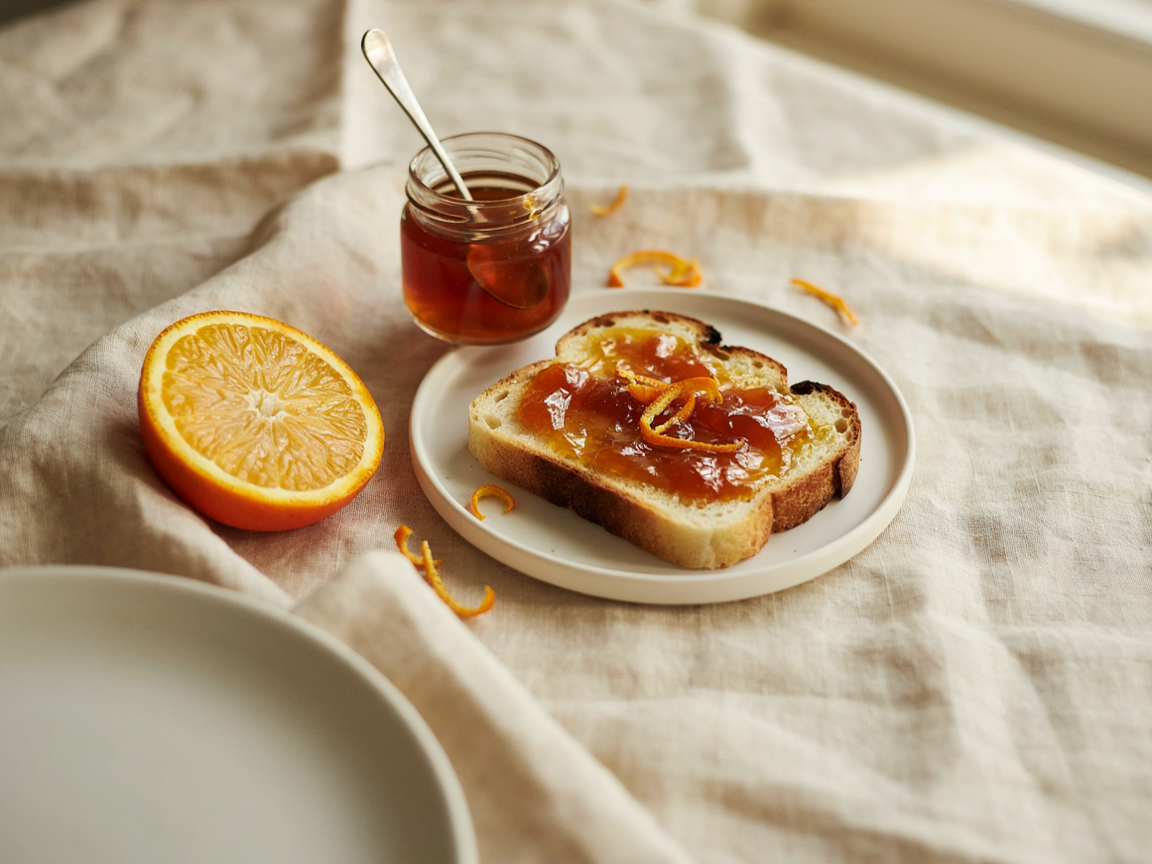
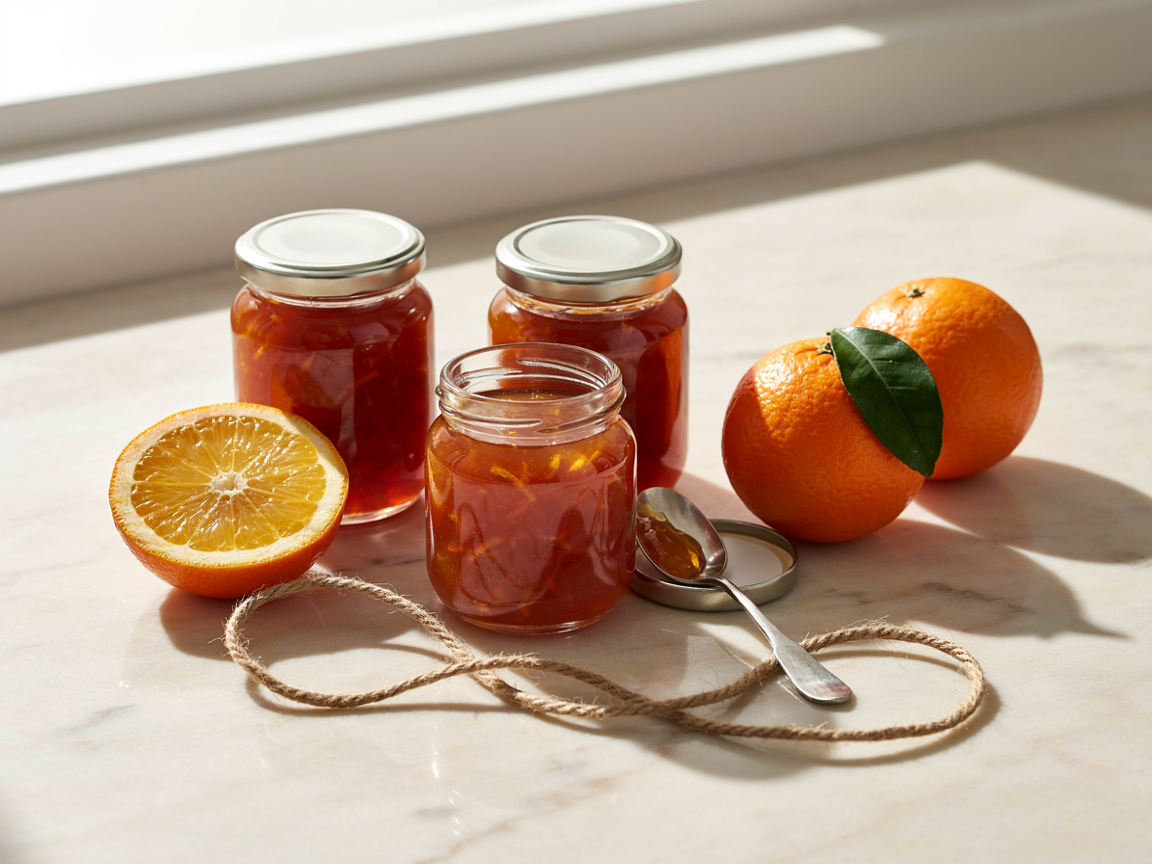
Three 8-ounce jars from four oranges. The shreds should sit suspended through the jar, not float on top.
This easy orange marmalade recipe makes about three jars from four ordinary oranges, with no pectin packet and no preserving sugar. The only piece of equipment you need that you may not own is a scrap of cheesecloth.
But before the method, the question everybody asks first — because orange jam and orange marmalade are not the same thing, and which one you are making changes the whole recipe.
Orange Marmalade or Orange Jam?
Is orange jam the same as orange marmalade?
No. Marmalade has the peel in it; jam does not.
That single difference drives everything else. The peel is what gives marmalade its shreds, its gentle bitterness, and — because pectin lives in the rind and the seeds — its ability to set without a packet. Orange jam is made from the flesh and juice alone: sweeter, smoother, no bitterness, and it almost always needs added pectin to thicken.
In everyday speech the two names get used interchangeably, and most people looking for an orange jam recipe are actually looking for this one. So: if you want shreds of peel and a grown-up bitterness, you want marmalade, and you are in the right place.
The practical consequence is that marmalade is the easier of the two to make, which surprises people. Jam needs help to set. Marmalade brings its own.
Which Oranges to Use
This matters more than any other decision in the recipe, because oranges vary enormously in the two things a set depends on: pectin and acid.
| Orange | Pectin & acid | What you get | Adjust |
|---|---|---|---|
| OrangeSeville, bitter | Pectin & acidHigh pectin, high acid | What you getThe classic. Properly bitter, deep amber, sets like a dream | AdjustSkip the lemon and take the sugar to 3 cups |
| OrangeNavel, sweet | Pectin & acidLow pectin, low acid | What you getBright, sweet, mild bitterness — what this recipe is written for | AdjustKeep the lemon. It is doing real work |
| OrangeValencia | Pectin & acidLow pectin, medium acid | What you getJuicier and a softer, looser set | AdjustKeep the lemon and boil 5 minutes longer |
| OrangeBlood orange | Pectin & acidLow pectin, medium acid | What you getDeep ruby colour with a berry note behind the orange | AdjustKeep the lemon. Do not over-boil or the colour muddies |
| OrangeCara cara | Pectin & acidLow pectin, low acid | What you getPink, very sweet, almost no bitterness | AdjustLemon plus an extra tablespoon of lemon juice |
| OrangeMandarin or clementine | Pectin & acidVery low pectin, low acid | What you getDelicate and fragrant, thin peel that softens fast | AdjustTwo lemons, and watch the set closely |
The short version: if you have Seville oranges, skip the lemon and enjoy yourself. If you have anything else — which is to say, if you are shopping in an ordinary supermarket in any month but January — add one lemon per four oranges. Sweet oranges are low in both pectin and acid, and that lemon is the difference between marmalade and orange soup.
The Fruit, Water and Sugar Ratio
Everything scales from one proportion. Note that the simmering time does not scale the way the quantities do — a bigger pot of the same mixture is deeper, and depth slows evaporation.
| Oranges | Water | Sugar | Makes | Simmer |
|---|---|---|---|---|
| Oranges¾ lb (3 oranges) | Water1⅓ cups | Sugar1⅔ cups | Makes2 jars | Simmer40–50 min |
| Oranges1¼ lb (4 oranges) — the base | Water2 cups | Sugar2½ cups | Makes3 jars | Simmer45–60 min |
| Oranges2½ lb (8 oranges) | Water4 cups | Sugar5 cups | Makes6 jars | Simmer60–75 min |
| Oranges3¾ lb (12 oranges) | Water6 cups | Sugar7½ cups | Makes9 jars | Simmer70–85 min |
On batch size: above about four pounds of fruit, marmalade becomes genuinely difficult to bring to setting point in a domestic pot, because the surface area does not grow with the volume. Two batches of three jars will beat one batch of six, every time.
Easy Orange Marmalade Recipe
Easy Orange Marmalade
Oranges, a lemon, sugar and water, set by the pectin in the peel and seeds. No pectin packet and no preserving sugar.
How many jars?
Ingredients
- 3 (¾ lb)4 (1¼ lb)8 (2½ lb)12 (3¾ lb) medium oranges
- 1 small123 lemon, juice and seeds
- 1⅓ cups2 cups4 cups6 cups water
- 1⅔ cups2½ cups5 cups7½ cups granulated sugar
- 1 square1 square1 square2 squares cheesecloth or muslin, plus kitchen string
- 2223 small plates, chilled in the freezer
- 2369 sterilised 8-ounce jars with lids
Instructions
Scrub the oranges and slice them as thinly as you can
Scrub the fruit under warm water, trim both ends, then quarter each orange lengthways and slice each quarter across into thin shreds, skin and all. Orange peel is thicker and more bitter than lemon peel, so thin slicing matters more here than it does in any other marmalade. Drop the seeds into a small bowl as you find them.
Add the lemon, and keep its seeds too
Squeeze the lemon into the pot and add its seeds to the bowl with the orange seeds. Sweet oranges are low in both acid and pectin, which is the whole reason supermarket-orange marmalade so often refuses to set. One lemon per four oranges fixes both problems at once and you will not taste it.
Tie the seeds into a bundle
Pile all the seeds, plus any loose scraps of pith, into a small square of cheesecloth and tie it shut with kitchen string. This is your pectin, and it is the only reason this recipe needs nothing from a packet.
Simmer until the peel is genuinely soft
Add the sliced fruit, the water and the seed bundle to a wide pot, bring to a boil, then simmer uncovered for 45 to 60 minutes. Orange peel takes noticeably longer than lemon peel, so start testing at 45 minutes: press a shred against the side of the pot and it should collapse with no chew at all. Peel that is still firm now will still be firm in the jar.
Squeeze the bundle, then dissolve the sugar slowly
Lift out the seed bundle, let it cool a moment, and squeeze it hard over the pot — the thick clear liquid that comes out is pectin and you want every drop. Add the sugar over low heat and stir until you cannot feel a single grain on the bottom of the pot. This takes about five minutes and rushing it is what makes marmalade grainy.
Boil hard to setting point
Bring it to a rolling boil that does not subside when you stir, and boil for 15 to 25 minutes. You are aiming for 220°F (105°C). Orange marmalade darkens faster than lemon, so start testing at 15 minutes rather than waiting for the thermometer to be exactly right.
Rest five minutes, then jar it
Off the heat, skim any foam, and let the pot stand for five minutes before you ladle. Those five minutes are what keep the shreds suspended through the jar instead of floating in a raft at the top. One gentle stir, then fill sterilised jars, wipe the rims and seal.
Roughly, per tablespoon
This is an estimate, not a lab analysis.
Three Ways to Cut the Fruit
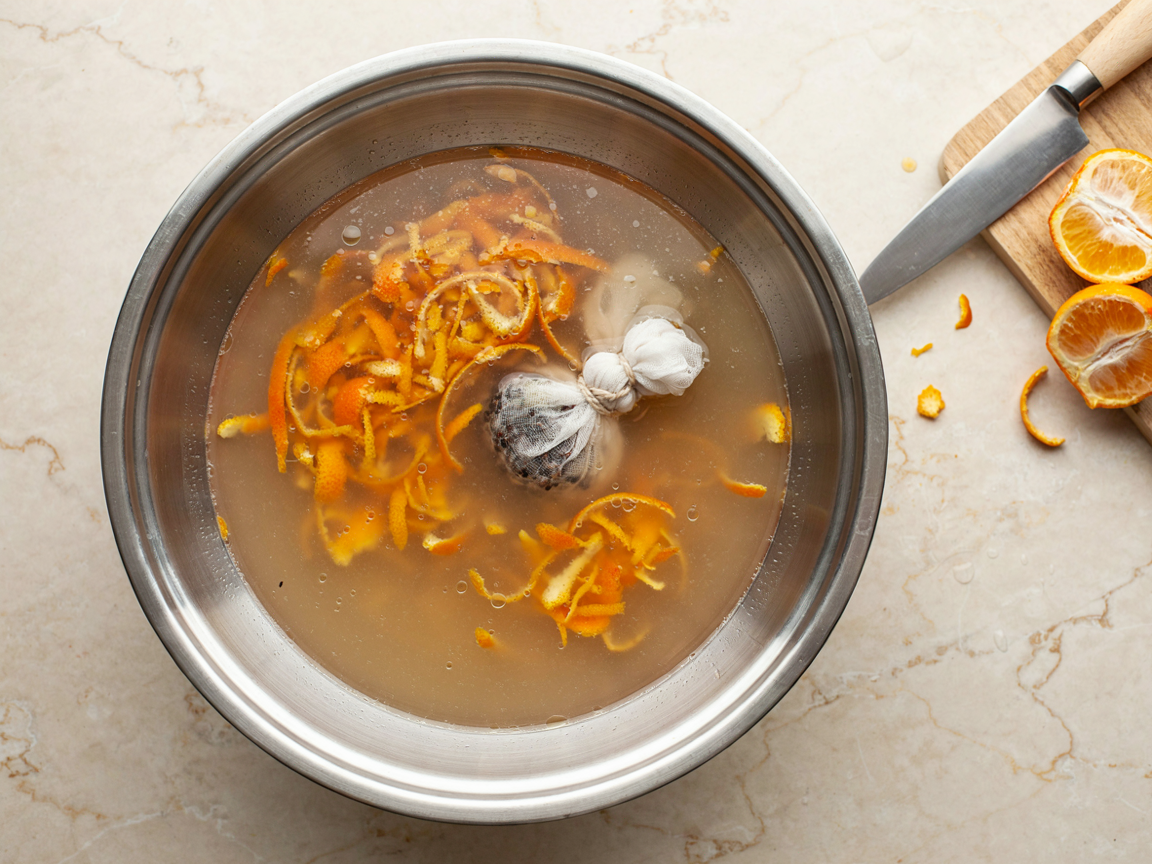
Forty-five to sixty minutes before the sugar goes anywhere near it. Orange peel is slower than lemon.
Same ingredients, same set, very different amounts of knife work:
Thin-sliced — the standard method
Quarter the oranges lengthways, slice each quarter across into shreds, then simmer. This is the recipe above and it is what gives you the clear amber jar with fine suspended peel. It is also the method with the most knife work, and the one where slicing thickness decides everything.
The whole-orange boil — no knife work at all
Simmer the whole oranges, unpeeled and uncut, in the water for 1½ to 2 hours until a skewer goes through with no resistance. Lift them out, let them cool enough to handle, then chop them roughly and return everything with the sugar. The peel comes out meltingly soft, the set is slightly cloudier, and you have done almost nothing. This is the method to use if you dislike slicing citrus, and the one people mean when they search for cooking the orange whole.
From candied orange peel
If you already have candied peel, chop it finely and use it in place of half the sliced fruit, with the juice and seeds of 3 fresh oranges plus a lemon to bring back the acid and pectin. Cut the sugar by a third, because the peel is already carrying a great deal. The result is sweeter, darker and more confectionery than a traditional marmalade — excellent on a cheese board, less good on breakfast toast.
The food processor shortcut
Quarter the oranges, remove the seeds, and pulse the fruit in a food processor in short bursts until roughly chopped. Ten seconds of work instead of fifteen minutes. The texture is a rougher, chunkier marmalade with no long shreds — closer to a preserve than to the classic cut. Do not blitz it smooth or you have orange puree, not marmalade.
Juice plus peel, for when you have juice on hand
Marmalade cannot be made from juice alone — there is no pectin and no peel, so what you get is thin orange syrup. But you can use juice as part of the liquid: replace half the water with orange juice and add the peel and seeds of 3 whole oranges plus a lemon. The flavour is brighter and more forward, and the set still works because the peel and seeds are still there.
If you hate slicing citrus: use the whole-orange boil. It takes longer on the stove and about a tenth of the time at the chopping board, and the softness of the peel is genuinely lovely. The only cost is a slightly cloudier jar.
Knowing When It Has Set
One nervous moment, two ways through it, and the cheaper one is the more reliable.
The cold-plate test
Chill two small plates in the freezer before you start. Take the pot off the heat, spoon a little marmalade onto a cold plate, wait 30 seconds and push it with a fingertip. If the surface wrinkles and holds the line, it has set. If it floods back, boil 3 to 5 more minutes and test again.
The thermometer
220°F, or 105°C. Treat it as the signal to start testing rather than as the final word — altitude, pan width and how juicy your oranges were all shift the real setting point by a degree or two.
What the boil looks like
The bubbles change. Early on they are small, fast and watery; at setting point they are larger, slower and glossier, and the marmalade sheets off a spoon rather than dripping off it.
When to stop regardless
Twenty-five minutes of hard boiling is the outer limit for oranges. Past that the colour goes toward caramel and the fresh orange flavour disappears. A slightly loose marmalade is always better than an over-boiled one.
Give it 24 hours before deciding it failed. Marmalade keeps thickening overnight, and a loose-looking jar at bedtime is very often a perfect jar by morning. Re-boiling something that was going to set anyway is how a bright marmalade turns dark and stiff.
Troubleshooting
Pick whatever happened:
It did not set
The most common problem with sweet oranges specifically, because they are low in both pectin and acid. The fix: wait a full 24 hours before judging it — marmalade goes on thickening overnight. If it is still loose, return it to the pot with the juice of one more lemon and boil hard for 3 to 5 minutes, testing on a cold plate. If you skipped the lemon entirely, that is almost certainly your answer.
It is much too bitter
Either the peel was sliced thickly or you used Seville oranges without adjusting the sugar. The fix: slice thinner next time, or blanch the shreds in boiling water for one minute and drain before you start. Going to the top of the sugar range rounds it off as well. Do not cut the pith away — that is where a large part of your set lives.
It turned dark brown and tastes caramelised
Boiled past the setting point. Orange marmalade darkens faster than lemon does. The fix: start cold-plate testing at 15 minutes rather than waiting for the thermometer to read exactly 220°F. Once the colour has gone it does not come back, though the marmalade is still perfectly usable in baking.
It came out grainy
Sugar that had not fully dissolved when the boil started. The fix: after the sugar goes in, keep the heat low and stir for a full five minutes, then drag a spoon along the bottom of the pot and feel for grit before you turn the heat up. There is no rescue once it has crystallised.
All the peel floated to the top of the jar
Jarred too soon. The fix: let the pot rest for five minutes off the heat, give it one stir, then ladle. It thickens just enough in those minutes to hold the shreds where they are.
Ways to Use It
Butter first, right to the edges, then marmalade thick enough to see the shreds.
On toast, and everything like it
Thickly, on warm buttered toast, crumpets, scones or brioche. Orange marmalade is the one preserve that is genuinely better on something buttered than on something plain.
As a glaze on chicken or lamb
Two tablespoons warmed with a splash of water and a little soy or mustard, brushed on in the last ten minutes of roasting. The sugar caramelises into a lacquer and the bitterness cuts the fat.
Stirred into an icing
Two tablespoons of marmalade warmed and sieved, beaten into a cup of sifted powdered sugar with a teaspoon of hot water. It sets to a glossy amber glaze that is very good on a loaf cake, and better than any orange extract.
Baked into cakes and biscuits
As the filling in thumbprint cookies, brushed between sponge layers, or spooned over a warm steamed pudding. Warm it and sieve out the shreds if you want the flavour without the texture.
On a cheese board
Beside a sharp cheddar, a hard sheep’s cheese, or something soft and white. This is where the candied-peel version really earns its place.
Whisked into a dressing or dipping sauce
A teaspoon with olive oil, vinegar and mustard makes a bright dressing; loosened with warm water and a pinch of chilli it becomes a dipping sauce in about two minutes.
Storing it
| How it is stored | How long | What to know |
|---|---|---|
| How it is storedOpened, in the refrigerator | How long3 to 4 weeks | What to knowClean spoon every time, lid on properly |
| How it is storedSealed, not processed | How longUp to 3 months | What to knowLadled hot into sterilised jars and sealed at once, kept cool and dark |
| How it is storedWater-bath processed | How longUp to 1 year | What to knowTen minutes in a boiling-water bath makes it properly shelf-stable |
| How it is storedFrozen | How longUp to 6 months | What to knowFreezes well with no texture change. Leave headspace for expansion |
Check the seal before you trust a jar. The centre of the lid should have no give at all. Anything that smells fermented, shows mould, or clicks when you press it goes in the bin.
Questions, Answered
Is orange jam the same as orange marmalade?
No, and the difference is one ingredient: peel. Marmalade is made from the whole citrus fruit including the rind, which is what gives it the shreds, the gentle bitterness and — because pectin lives in the peel and seeds — its set. Orange jam is made from the flesh and juice only, so it is sweeter, smoother, has no bitterness at all, and usually needs added pectin to thicken. In everyday use the two names get swapped freely, and most people searching for an orange jam recipe are in fact looking for marmalade.
What oranges are best for orange marmalade?
Seville oranges are the traditional choice because they are high in both pectin and acid, which means they set easily and taste properly bitter. They are only in season for a few weeks in winter. For the rest of the year, ordinary navel oranges work perfectly well — they are low in pectin and acid, so add one lemon per four oranges and the recipe behaves exactly like a Seville batch. Blood oranges make the most beautiful jar of the lot.
Do I need pectin for orange marmalade?
Not if you keep the seeds and the pith. Citrus concentrates its pectin in exactly the parts most recipes discard, so tying the seeds into a cheesecloth bundle and simmering them with the fruit supplies everything you need. The one caveat is sweet oranges: they carry less pectin and less acid than Sevilles, so a lemon goes in as well. With both of those in place, packet pectin is unnecessary.
Can I make orange marmalade from orange juice?
Not from juice alone. Juice has no peel and almost no pectin, so what you get is a thin orange syrup that never sets, however long you boil it. What does work is using juice as part of your liquid: replace half the water with orange juice and add the peel and seeds of three whole oranges plus a lemon. You get a brighter, more forward orange flavour and the set still holds.
How do I make it less bitter?
Slice the peel thinner, or blanch the shreds in boiling water for one minute and drain before you start cooking. Both reduce the bitter compounds without costing you much set. Using the full 2½ cups of sugar rather than the lower end rounds it off further. What does not work is cutting away the white pith — that is one of your two pectin sources, and removing it is a common reason marmalade fails to thicken.
Why didn’t my orange marmalade set?
Three likely causes, in order. You used sweet oranges without a lemon, so there was not enough pectin or acid in the pot. You did not squeeze the seed bundle before adding the sugar. Or you simply have not waited long enough — marmalade keeps thickening for a full 24 hours after jarring, and a great many good batches get re-boiled the same evening by someone who checked too soon.
How do I make icing with orange marmalade?
Warm 2 tablespoons of marmalade until it loosens, push it through a fine sieve to remove the shreds, then beat the strained liquid into 1 cup of sifted powdered sugar with a teaspoon of hot water. Add more water a few drops at a time until it ribbons off the spoon. It sets glossy and tastes far more like orange than any extract does. Keep the sieved shreds and scatter them on top.
Slice thin, keep the seeds, add a lemon unless your oranges are Seville, dissolve the sugar properly, and test on a cold plate rather than trusting the clock. That is the whole thing.
Pin this easy orange marmalade recipe so the orange chart and the ratio are there the next time you have a bag of oranges going soft.