
Authentic Spanish Paella Recipe: Paella Valenciana the Way It Is Made in Spain
The traditional Valencian paella: chicken and rabbit browned in olive oil, flat green beans, white garrofó beans, saffron and bomba rice in one wide pan, never stirred, with a toasted crust underneath. Plus the eight principles Spanish cooks follow, how to do it on a home stove, the seafood version and the rice, liquid and pan sizes for 4 to 12.
- 10 core ingredients
- 75 minutes
- Socarrat guide
- Printable recipe
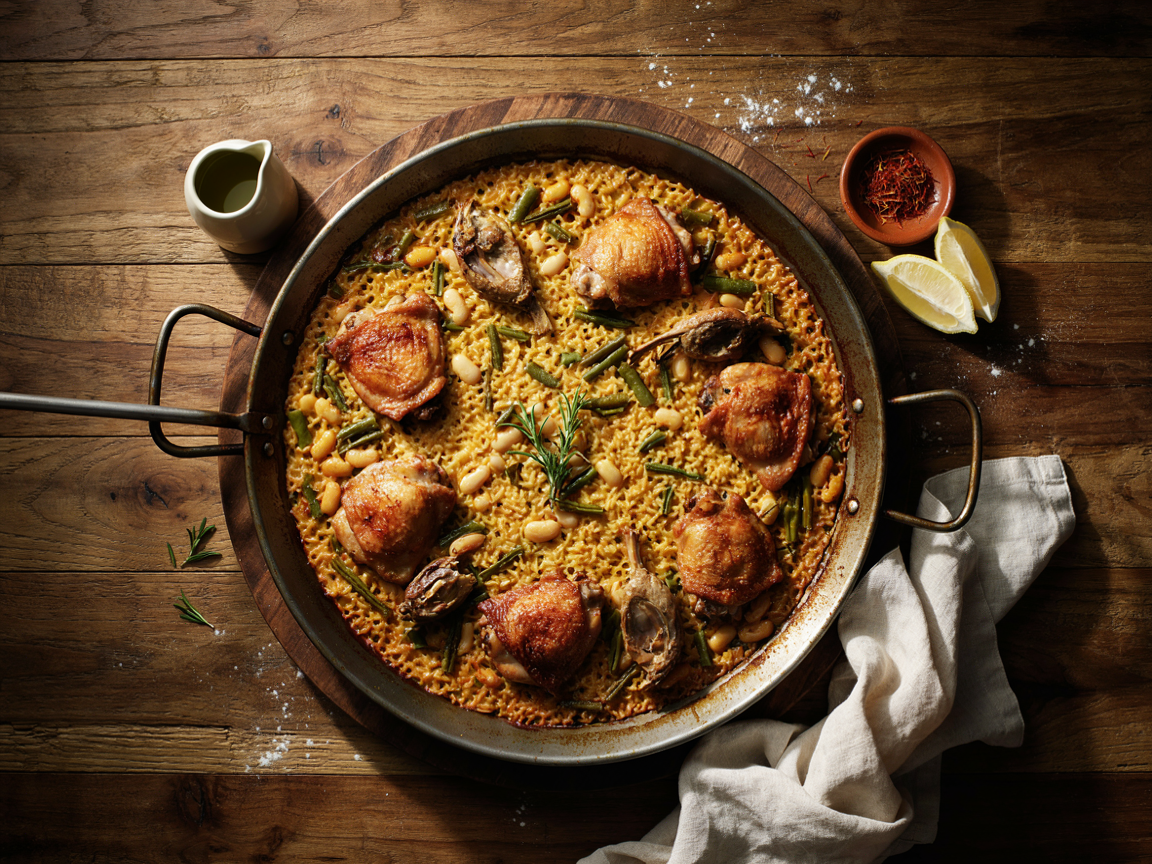
Paella Valenciana in the pan: chicken, rabbit, green beans, garrofó and saffron rice with the crust forming underneath.
Ask in Valencia for an authentic Spanish paella and you get one answer: chicken, rabbit, two kinds of beans, tomato, olive oil, saffron, rice and water, cooked in a wide pan over a wide fire and never stirred. No chorizo, no seafood in the same pan, no peas. This is that recipe, written for a home stove, with the seafood paella of the coast as a full variation, because both are real Spanish paella and the mixed restaurant version is the one that is not.
Below: what paella is made of and why each ingredient is there, the principles that make it paella rather than rice with things in it, the recipe with a card that scales from 4 to 12 and tells you the pan size, how to cook it on an ordinary burner or finish it in the oven, the socarrat, five variations, a table of the paella types and which are traditional, what to serve, storage, troubleshooting and every question people ask before making paella at home.
What Is Spanish Paella Made Of?
The short answer
A classic Spanish paella is made of bomba rice, chicken, rabbit, flat green beans, large white garrofó beans, grated tomato, olive oil, saffron, sweet paprika, water and salt, usually with a sprig of rosemary and a little garlic. That is paella Valenciana, the original. The seafood paella of the coast swaps the meat and beans for shrimp, mussels and squid in seafood stock. Neither contains chorizo, peas or onion.
What each ingredient does, and what to use if you cannot find it:
Bomba rice
A short, round Spanish rice that absorbs three times its volume of liquid and stays separate instead of turning creamy. Calasparra is its equal. Arborio works in a pinch; long-grain does not.
Chicken and rabbit
Bone-in pieces, browned hard. Rabbit is traditional in Valencia and tastes like a leaner, sweeter chicken; using all chicken is the normal substitution even in Spain.
Flat green beans
Wide, flat romano beans (ferraura in Valencia), cut in lengths. Regular green beans work; they just cook a little faster.
Garrofó beans
Large flat white beans. Butter beans or large limas are the closest; a can, drained, is fine and is what most Spanish home cooks use outside bean season.
Tomato, grated
Halved ripe tomatoes rubbed on a box grater so the pulp falls through and the skin stays in your hand. The sofrito base, with garlic.
Olive oil
More than you think. It carries the paprika and saffron through the rice and is what makes the crust release from the pan.
Saffron
The color and the perfume. A generous pinch of real threads, bloomed in hot liquid first. Turmeric gives color but not the flavor; the saffron FAQ below covers the swap.
Sweet paprika
Spanish pimentón dulce, stirred into the sofrito off the heat. Smoked paprika is a Spanish ingredient too, but it is not traditional in paella; use it only if you want a smoky pan.
Water, salt and rosemary
Valencians cook paella in water, not stock, because the browned meat makes the broth in the pan. A light chicken stock is insurance on a home stove. A rosemary sprig goes in the broth and comes out before the rice.
The Principles of la Paella: How It Is Cooked in Spain
Paella is a method more than a recipe. Change the ingredients and it is still paella; break these eight rules and it is rice with things in it:
A wide, shallow pan
The word paella is the pan. Wide and shallow means a thin layer of rice, maximum evaporation and a crust on the bottom. A deep pot makes risotto-style rice, not paella.
Rice one finger deep
The layer of rice should be no thicker than a finger. Every grain touches hot pan or hot broth, so it cooks evenly and the bottom can toast. Too much rice for the pan is the most common home mistake.
Brown the meat properly
The meat is fried in olive oil until crusty before anything else. Those browned bits dissolve into the broth and are the deepest flavor in the pan; there is no other stock in a traditional Valencian paella.
The broth is made in the pan
Meat, vegetables, water and saffron boil together for 10 minutes before the rice goes in. The rice then cooks in the flavor the pan made, not in a stock from a carton.
Rice last, then never stirred
The rice goes in, gets spread flat once, and is left alone. Stirring releases starch and makes the rice creamy; leaving it alone keeps the grains separate and lets the socarrat form.
Heat across the whole pan
In Spain the pan sits over a wide ring of flame or a wood fire. At home, a large burner plus rotating the pan, or two burners, or finishing in the oven, does the same job.
The socarrat
The toasted, caramelized layer of rice stuck to the bottom, made in the last 90 seconds over high heat. The crackle and the toasty smell are the signal. It is the best part and the proof it is paella.
Rest, then eat from the pan
Five minutes under a towel lets the top finish steaming. Paella is served from the pan, traditionally eaten with a spoon straight from it, and lemon on the side is a coastal habit, not a Valencian one.
Authentic Spanish Paella Recipe
The card serves 6 in a 15 to 16-inch pan by default. Tap a size and the rice, the liquid, the meat and the pan size all update together.
Authentic Spanish Paella (Paella Valenciana)
The paella Valencia calls its own: chicken and rabbit browned hard in olive oil, flat green beans, white garrofó beans, grated tomato, sweet paprika, saffron and bomba rice, cooked in one wide pan and never stirred, with a toasted crust underneath. Tap a serving size and every amount, including the pan size, updates with the printable card.
How many people?
Ingredients
- ¼ cup⅓ cup½ cup¾ cup extra-virgin olive oil
- 1½ lb2¼ lb3 lb4½ lb bone-in chicken thighs, chopped through the bone into 2-inch pieces (or boneless thighs, halved)
- ¾ lb1 lb1½ lb2 lb rabbit, cut in small pieces (optional; replace with the same weight of chicken)
- 6 oz9 oz12 oz18 oz flat green beans (romano), trimmed and cut in 2-inch lengths
- ¾ cup1 cup1½ cups2 cups large white lima beans (butter beans), cooked or canned, drained
- ¾ cup1 cup1½ cups2 cups ripe tomatoes, grated on a box grater, skins discarded
- 2346 garlic cloves, minced
- 2 tsp1 tbsp4 tsp2 tbsp sweet paprika (pimentón dulce)
- ¼ tsp½ tsp¾ tsp1 tsp saffron threads
- 6 cups9 cups12 cups18 cups water or light chicken stock, hot
- 1123 fresh rosemary sprigs
- 1½ tsp2 tsp1 tbsp1½ tbsp salt, plus more to taste
- 2 cups3 cups4 cups6 cups bomba rice (or Calasparra; see the rice note)
- 1 lemon2 lemons2 lemons3 lemons lemon wedges, to serve
Seafood instead? The seafood version (paella de marisco) is in the variations tabs below with its own full amounts: shrimp, mussels and squid in seafood stock, same method with the seafood added over the rice.
Instructions
Bloom the saffron and heat the pan
Crumble the saffron into 2 tablespoons of the hot water and leave it to steep. Set the paella pan over your largest burner (or across two) on medium-high and heat the olive oil until it shimmers. Season the chicken and rabbit all over with salt.
Brown the meat hard
Add the meat in one layer and leave it alone for 4 minutes before turning. Brown it on every side, 10 to 12 minutes in all, until deep golden with crusty edges; this browning is the flavor base of the whole pan. Push the meat to the outer rim.
Cook the beans and the sofrito
Add the green beans to the center and fry 3 minutes. Add the grated tomato and garlic and cook, stirring, until the tomato darkens and turns jammy, about 4 minutes. Pull the pan off the heat, stir in the paprika for 30 seconds (it burns on the flame), and return to the heat.
Make the broth in the pan
Pour in the hot water or stock, add the lima beans, the rosemary and the saffron with its liquid, and bring to a rolling boil. Boil 10 minutes so the meat flavors the liquid. Taste: the broth should be noticeably saltier than you want the rice, because the rice absorbs it. Remove the rosemary.
Add the rice and stop stirring
Pour the rice in a line across the pan, then shake and nudge it with a spoon into one even layer no thicker than a finger. Make sure the meat is spread evenly. From this moment the rice is not stirred again, which is what lets the bottom crust form.
Boil hard, then simmer
Keep the heat high for 8 to 10 minutes, with the liquid bubbling across the whole surface; rotate the pan a quarter turn every 2 minutes if the burner is smaller than the pan. Lower to medium-low and cook 8 to 10 minutes more, until the liquid has dropped below the rice and the grains on top are just tender. Do not add liquid unless the rice is still crunchy with the pan dry; then add ½ cup hot water around the edge.
Make the socarrat
Raise the heat to high for 60 to 90 seconds. Listen for a crackle and smell for toasted rice, not burning; that is the socarrat, the caramelized crust on the bottom. Pull the pan off the heat the moment it smells toasty.
Rest and serve from the pan
Cover the pan with a clean kitchen towel and rest 5 minutes so the top grains finish steaming. Serve from the pan with lemon wedges, scraping up the crust with each portion.
How to Make Spanish Paella at Home
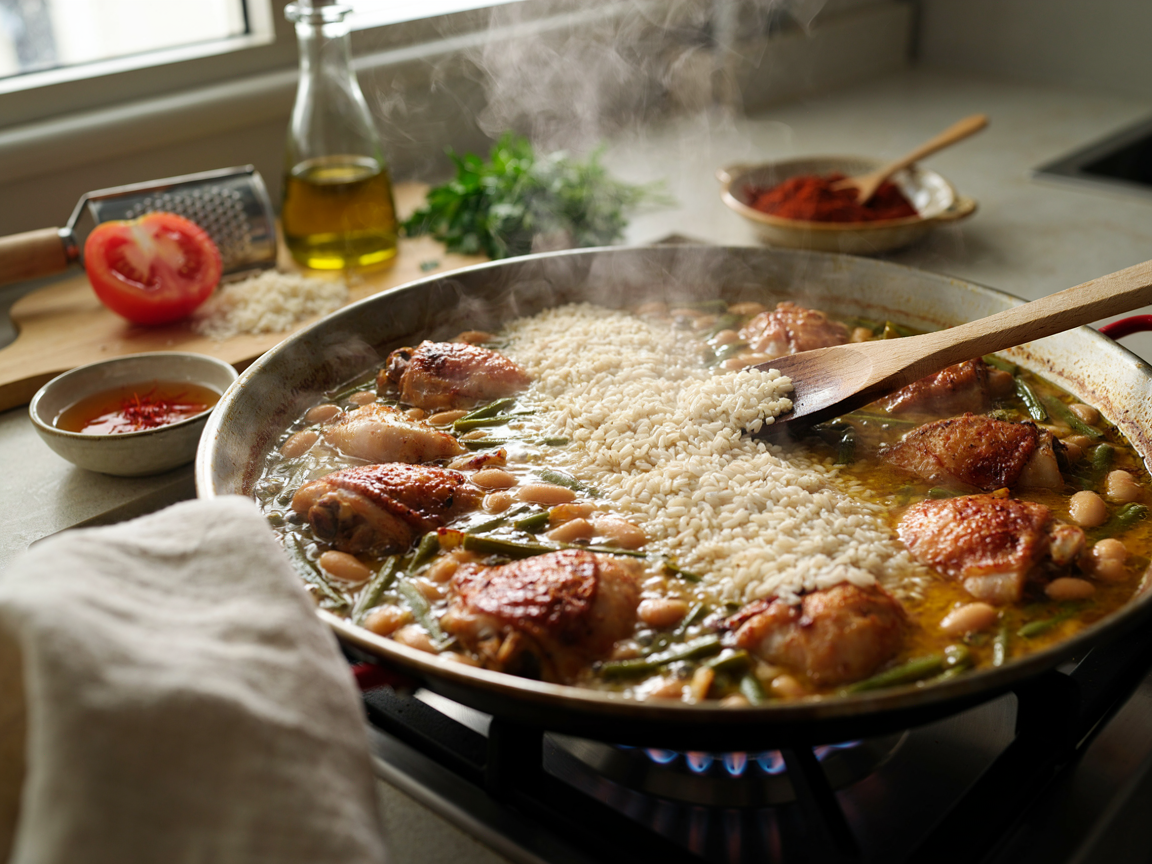
The rice going in: poured in a line across the boiling broth, then spread one finger deep and left alone.
The recipe above is the Valencian one; these six adjustments are what make it work on a home burner without a ring of fire:
Pick the burner, not the pan
A 15-inch pan on a 9-inch burner cooks only the middle. Use your largest burner, straddle two if the pan fits, and rotate a quarter turn every 2 minutes during the boil. A grill or an outdoor burner gives the even heat Spanish cooks have.
Or finish in the oven
Do steps 1 to 5 on the stove, then slide the pan into a 425°F oven, uncovered, for 15 to 18 minutes. The oven heats the whole pan at once. Return it to a high burner for the 90-second socarrat.
No paella pan
For 4 servings a 12 to 13-inch cast iron or stainless skillet works; for 6 or more, use two skillets or a large rimmed sheet pan in the oven. Nonstick works for the cooking but gives a weaker crust.
Stock from scratch
For the from-scratch version, simmer the chicken trimmings, an onion half, a bay leaf and 10 cups of water for 40 minutes while you prep, then use that instead of water. For seafood paella, simmer the shrimp shells in the stock for 15 minutes.
Cheaper
All chicken thighs instead of rabbit, canned butter beans, regular green beans and medium-grain rice bring the cost close to a weeknight dinner. The saffron is the one thing not to skip; a small jar does 4 paellas.
The two timers
Set one for 10 minutes when the broth boils, another for 10 when the rice goes in. The rest of the cooking is by eye and ear: the liquid dropping below the rice, then the crackle.
Rice, Liquid and Pan Size
One part bomba rice to three parts liquid, and a pan wide enough that the rice sits no deeper than a finger:
| Serves | Bomba rice | Liquid | Pan | Heat at home |
|---|---|---|---|---|
| Serves4 | Bomba rice2 cups bomba | Liquid6 cups | Pan13 to 14 inch | Heat at home1 large burner, rotate |
| Serves6 | Bomba rice3 cups | Liquid9 cups | Pan15 to 16 inch | Heat at home2 burners or oven finish |
| Serves8 | Bomba rice4 cups | Liquid12 cups | Pan18 inch | Heat at homeOven finish or outdoor burner |
| Serves12 | Bomba rice6 cups | Liquid18 cups | Pan22 inch, or two 15-inch pans | Heat at homeTwo pans is easier than one giant pan |
Is it worth making paella at home?
For four or more people, yes. One pan feeds a table, the ingredients cost a fraction of a restaurant paella per serving, and a home stove makes a real crust. What it cannot give you is wood smoke.
Time
About 75 minutes, 20 of them hands-off. Faster than a roast, slower than a stir-fry, and it feeds 6 to 12 from one pan.
Cost
Chicken thighs, beans, tomato and rice are cheap; saffron and bomba rice are the two premium items and both last for several paellas. Per serving it is a fraction of a restaurant paella.
Equipment
A paella pan is 20 to 40 dollars and worth it if you will make it twice; a large skillet does the job the first time.
What you cannot copy
The wood-fire smoke of a Valencian paella in the countryside. Everything else, the crust included, a home stove can do.
Five Traditional Ways to Change the Pan
Same pan, same method, same rice ratio. The seafood tab has its own complete amounts:
Paella de Marisco (for 6)
Leave out the chicken, rabbit, green beans and lima beans. Use 9 cups hot seafood or shrimp-shell stock, and have ready 1 lb large shell-on shrimp, 1 lb cleaned mussels, ½ lb squid cut in rings, 1 roasted red pepper in strips and ½ cup peas. Make the sofrito with 1 diced onion, the tomato, garlic and paprika, boil the stock and saffron 5 minutes, add 3 cups rice and spread it. After 10 minutes of boiling, nestle the shrimp, squid and mussels (hinge down) over the rice, scatter the pepper and peas, and finish exactly as the card: simmer until the mussels open and the liquid is gone, 90 seconds for the socarrat, rest 5 minutes.
Paella Mixta
The chicken-and-seafood pan most people picture. Make the card with all chicken and half the green beans, use chicken stock, and after 10 minutes of rice-boiling add 1 lb shrimp and 1 lb mussels over the top with a roasted red pepper in strips. It is not what Valencia calls paella, and it is delicious.
Paella de Verduras
Skip the meat. Fry 4 quartered artichoke hearts, 1 sliced red pepper, 8 oz mushrooms and the green beans in the oil until browned, then make the sofrito and use vegetable stock. Add the lima beans and a handful of peas with the rice. A pinch of smoked paprika is welcome here.
Chicken Paella
Replace the rabbit with the same weight of chicken thighs, everything else as the card. This is how most Spanish families make it on an ordinary Sunday. For the simpler weeknight version with boneless thighs, see our simple chicken paella recipe.
Arroz Negro
Make the seafood version with squid only (1½ lb), stir 2 tablespoons of squid ink into the hot stock, and leave out the peas and pepper. Serve with a spoon of garlic aioli on each portion and lemon.
Which Paella Is the Most Authentic?
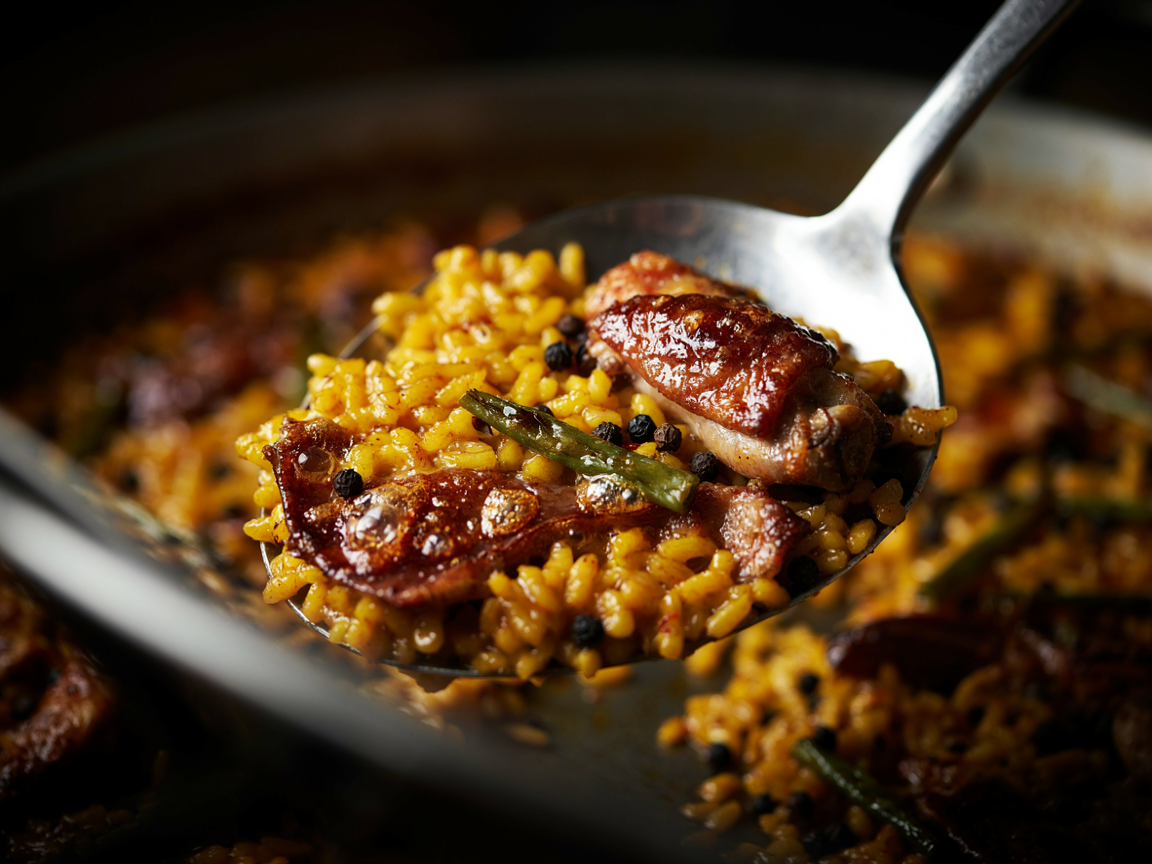
The socarrat: the toasted layer of rice lifted from the bottom of the pan.
Paella Valenciana is the original and the one Valencia itself defines. The coast has its own traditional versions. The rest are good food with a different name:
| Paella | Where it is from | What is in it | Traditional? |
|---|---|---|---|
| PaellaPaella Valenciana | Where it is fromValencia | What is in itChicken, rabbit, green beans, garrofó, saffron | Traditional?The original; the recipe Valencia regulates |
| PaellaPaella de marisco | Where it is fromValencian and Catalan coast | What is in itShrimp, mussels, squid, seafood stock | Traditional?Traditional on the coast; the tab below |
| PaellaPaella mixta | Where it is fromRestaurants, 20th century | What is in itChicken plus seafood, often peppers and peas | Traditional?Loved by visitors, not considered traditional |
| PaellaArroz negro | Where it is fromValencia and Catalonia | What is in itSquid, squid ink, aioli on the side | Traditional?Traditional; technically an arroz, not a paella |
| PaellaPaella de verduras | Where it is fromInland Valencia | What is in itArtichokes, beans, peppers, mushrooms | Traditional?Traditional vegetable version |
| PaellaWith chorizo | Where it is fromOutside Spain | What is in itChorizo, peppers, anything | Traditional?Not Spanish paella; Spaniards object to it |
What to Serve with Spanish Paella
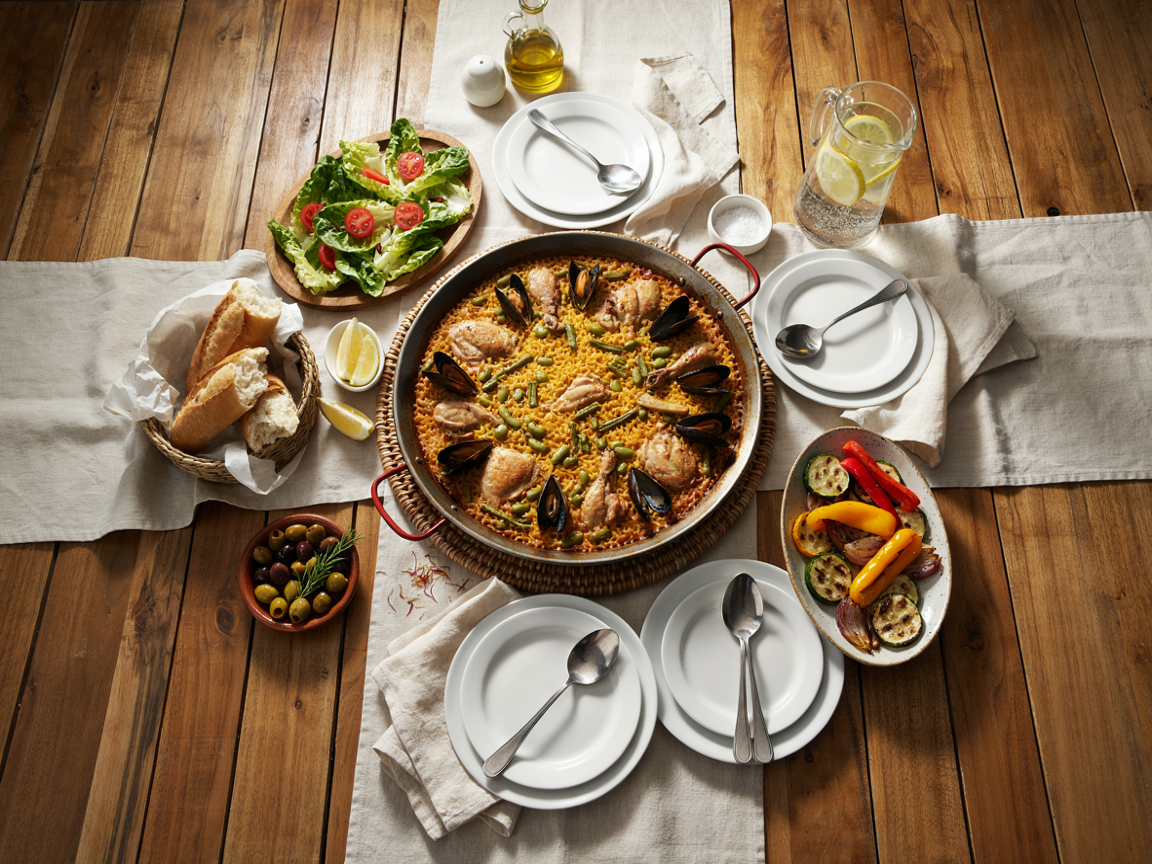
A paella table: the pan in the center, a green salad, roasted vegetables, bread, lemon and a pitcher of lemonade.
Paella is the whole meal in Spain, so the sides stay light: a plain green salad with sherry-free vinaigrette, a plate of Mediterranean roasted vegetables, and bread for the crust. A pitcher of homemade lemonade or cold sparkling water with lemon is the drink. Finish with something small and sweet, like our churro cheesecake, and if the table wants a second rice dish another night, the five-minute Spanish rice is the quick one.
Storage and Make-Ahead
| Where | How long | Notes |
|---|---|---|
| WhereFridge | How long3 days | NotesSpread flat in a container so it cools fast |
| WhereReheat | How longSkillet, 5 minutes | NotesA splash of water, covered, medium heat; the crust comes back on the bottom |
| WhereFreezer | How long2 months | NotesThe rice softens; fine for fried-rice-style leftovers, not for serving as paella |
| WhereMake ahead | How longSofrito and broth, 2 days | NotesMake steps 1 to 4 ahead and refrigerate; reheat to a boil before the rice goes in |
Troubleshooting Paella
| Problem | Likely cause | Fix |
|---|---|---|
| ProblemRice is mushy | Likely causeStirred, too much liquid, or the wrong rice | FixNever stir after spreading; measure 1:3; bomba or Calasparra |
| ProblemRice is crunchy in the middle | Likely causeHeat too high, too little liquid, or pan too thick with rice | FixAdd ½ cup hot water at the edge, lower the heat, cover with a towel 5 minutes |
| ProblemNo socarrat | Likely causeHeat too low at the end, or nonstick pan | Fix90 seconds on high at the end; carbon steel or stainless pan; enough oil |
| ProblemBottom burnt, not toasted | Likely causeSocarrat stage too long | FixPull the pan the second it smells toasty; 60 seconds is often enough |
| ProblemCenter cooked, edges raw | Likely causeBurner smaller than the pan | FixRotate every 2 minutes, use two burners or finish in the oven |
| ProblemBland | Likely causeBroth not salted enough before the rice | FixTaste the broth: it should be a little too salty before the rice goes in |
| ProblemPale, no saffron flavor | Likely causeSaffron not bloomed, or turmeric used | FixCrumble real threads into hot liquid 10 minutes ahead |
Nutrition (approximate, per serving)
Estimates for one of six servings of the Valencian recipe with chicken and rabbit. The seafood version is about 480 calories and 30g protein. No pork, no alcohol; gluten-free and dairy-free as written.
Spanish Paella: FAQs
What is Spanish paella made of?
A classic Spanish paella (paella Valenciana) is made of bomba rice, chicken, rabbit, flat green beans, large white garrofó beans, grated tomato, olive oil, saffron, sweet paprika, water and salt, often with a sprig of rosemary and a little garlic. Seafood paella replaces the meat and beans with shrimp, mussels and squid in seafood stock. The ingredient cards above explain each one and its substitute.
What is the most authentic paella recipe?
Paella Valenciana, the chicken-and-rabbit paella from the rice fields around Valencia, where the dish was born. Valencia’s own cooks and rice council define it by a short list of ingredients, and that list is the recipe card above. Seafood paella is traditional on the coast; mixed paella with chicken and seafood is a restaurant invention, and paella with chorizo is not Spanish at all.
How is paella cooked in Spain?
In a wide, shallow pan over a ring of flame or a wood fire. The meat is browned hard in olive oil, the vegetables and tomato fried, water added and boiled into a broth in the pan, and the rice added last in a thin layer and never stirred. It boils, simmers until dry, toasts for a minute to make the socarrat, rests under a towel and is eaten from the pan. The principles section above has all eight rules.
Is seafood paella authentic?
Yes. Paella de marisco is the traditional paella of the Valencian and Catalan coast, made with shrimp, mussels and squid in seafood stock and no meat. What is not traditional is mixing meat and seafood in one pan, which Spaniards call paella mixta and regard as a tourist dish, though it tastes fine.
Does authentic paella have chorizo in it?
No. No traditional Spanish paella contains chorizo; the strong, fatty sausage overwhelms the saffron and rice, and Valencians treat it as a foreign addition. This recipe has none, which also keeps it halal: chicken, rabbit, beans and rice, or seafood in the seafood version.
What rice do you use for paella, and can I use another?
Bomba, or Calasparra, both short-grain Spanish rices that absorb three times their volume and stay separate. Arborio is the nearest substitute and works with a little less liquid (1:2½). Medium-grain rice from the supermarket works too. Long-grain and basmati stay separate but never absorb the broth properly, and jasmine turns mushy.
Do I need a paella pan, and what size?
You need width, not a specific pan. For 4 servings a 13 to 14-inch paella pan or a 12-inch skillet; for 6, a 15 to 16-inch pan; for 8, an 18-inch pan; for 12, two 15-inch pans. The rule is rice no deeper than a finger. Carbon steel and stainless give the best crust; enameled works; nonstick gives a weaker socarrat.
What is socarrat and how do I get it?
Socarrat is the layer of toasted, caramelized rice that sticks to the bottom of the pan, and it is the most prized part of a paella. Make it in the last 60 to 90 seconds by turning the heat to high once the liquid is gone, listening for a crackle and smelling for toast, then pulling the pan off at once. Enough oil and a non-coated pan are what let it form.
Why is paella never stirred?
Stirring releases starch from the rice and makes the dish creamy, like risotto, and it also lifts the grains off the pan so no crust can form. Paella rice is spread once and left alone so every grain cooks separately in the broth and the bottom layer toasts.
Can I make paella without saffron?
You can, and the rice will still taste good, but it will not taste like paella. Saffron gives the perfume and the deep gold color; ½ teaspoon of turmeric gives the color only. Saffron is sold in small jars that cover four or five paellas, so per pan the cost is small. Bloom the threads in hot liquid for 10 minutes so they release fully.
Is it worth making Spanish paella at home?
If you are feeding four or more, yes. The ingredients cost a fraction of a restaurant paella per serving, the active cooking is about 35 minutes, and a home stove with a large burner or an oven finish makes a proper crust. The only thing you cannot replicate is the wood-fire smoke of a Valencian field paella. The ‘worth it’ box above weighs time, cost and equipment.
What is the rice to liquid ratio for paella?
One part bomba rice to three parts liquid by volume, so 2 cups of rice to 6 cups of broth for 4 servings, 3 to 9 for 6. For arborio or medium-grain rice use 1 to 2½. Hold back a cup of hot liquid to add at the edge if the rice is still hard when the pan goes dry.
Can I make paella ahead or reheat it?
The sofrito and broth (steps 1 to 4) can be made two days ahead and reheated to a boil before the rice goes in, which turns the party-day cooking into 25 minutes. Finished paella keeps 3 days in the fridge and reheats in a skillet with a splash of water, covered, and even gets its crust back; it is best eaten the day it is made.
What do you serve with Spanish paella?
Very little, because the paella is the meal. A green salad, a plate of roasted or grilled vegetables, bread for the crust and a cold drink such as lemonade or sparkling water with lemon. Dessert is something small and sweet. The serving section above has the links.
Save the pin so the recipe, the pan sizes and the socarrat timing are ready; the seafood paella on the pin is the first variation tab above.
More Spanish and Mediterranean Cooking
The quick chicken paella, the five-minute rice and the sides for the table.
Simple Chicken Paella
Boneless thighs and bomba rice in 45 minutes. See the recipe → Quick RiceFive-Minute Spanish Rice
Fluffy, golden and done in minutes. Make the rice → SideMediterranean Roasted Vegetables
The vegetable platter that goes with any paella. Roast a tray → Meal Plan21-Day Mediterranean Meal Plan
High-protein Mediterranean dinners for three weeks. See the plan → BreadSame Day Focaccia
Soft, golden bread for scraping the crust. Bake a pan → DrinkHomemade Lemonade Recipes
The pitcher drink for a paella table. Pour a glass →Brown the meat, fry the beans and tomato, boil the broth in the pan, spread the rice one finger deep and leave it alone until it crackles. That is paella the way Valencia makes it.
Save this Spanish paella recipe so the ingredient list, the pan sizes and the socarrat timing are one tap away the next time the table is full.

