
No Bake Filling · 4 Crust Options · Sets in 4 Hours
Sugar Free Fresh Strawberry Pie with Jello: The Glaze That Actually Sets
Whole fresh berries in a clear strawberry glaze, with the one visual cue that tells you the glaze is ready and the trick that keeps the crust crisp underneath.
- 4 pie sizes
- 4 crusts compared
- Gelatin alternatives
- No sugar in the filling
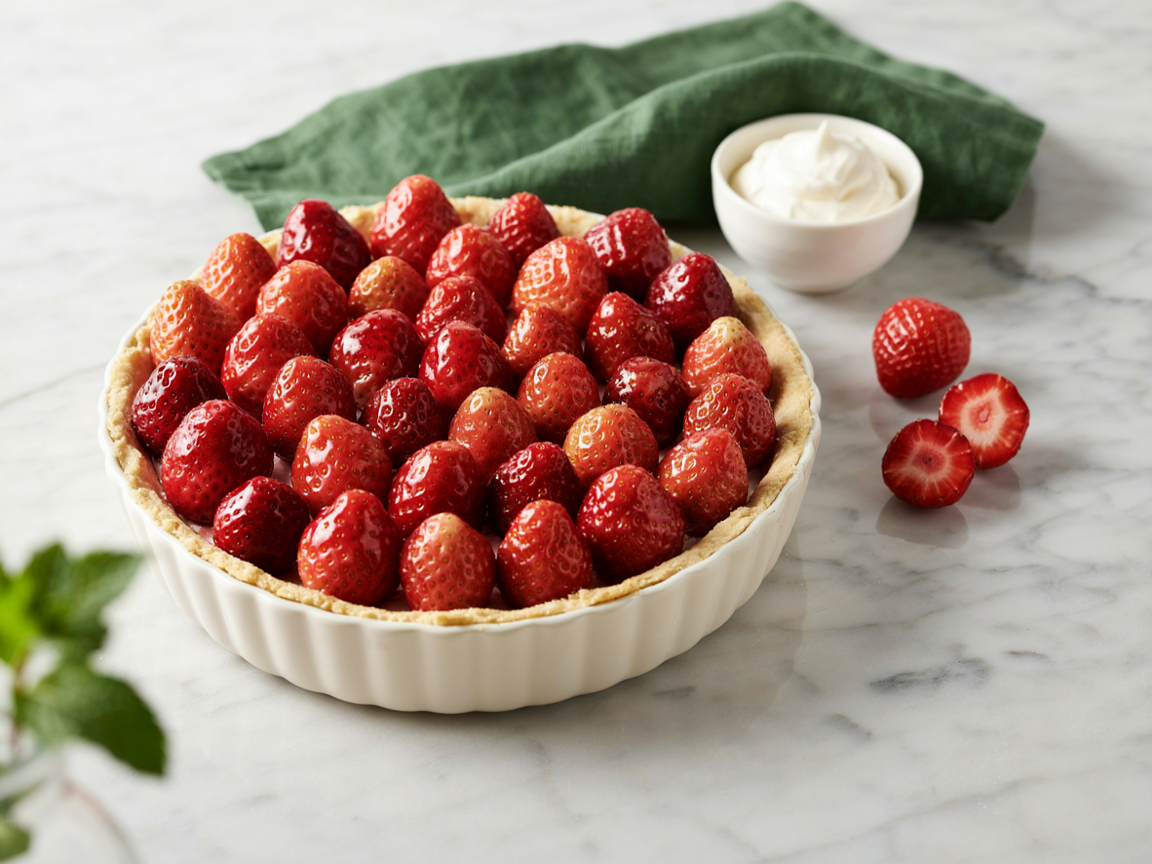
Whole berries, packed tightly, point-side up. The packing is structural, not decorative.
A sugar free fresh strawberry pie with jello is really two recipes stacked on each other: a crust that has to stay crisp, and a glaze that has to set clear and hold a slice together. The glaze is where it goes wrong, and it fails for a reason you can actually see in the pan.
Cornstarch only thickens once it has boiled, and the moment it does, the mixture stops looking milky and turns glossy and translucent. Pull it off before that and no amount of chilling will save it. Watch for the clarity, not the clock.
How the Glaze Sets, and How to See It Happen
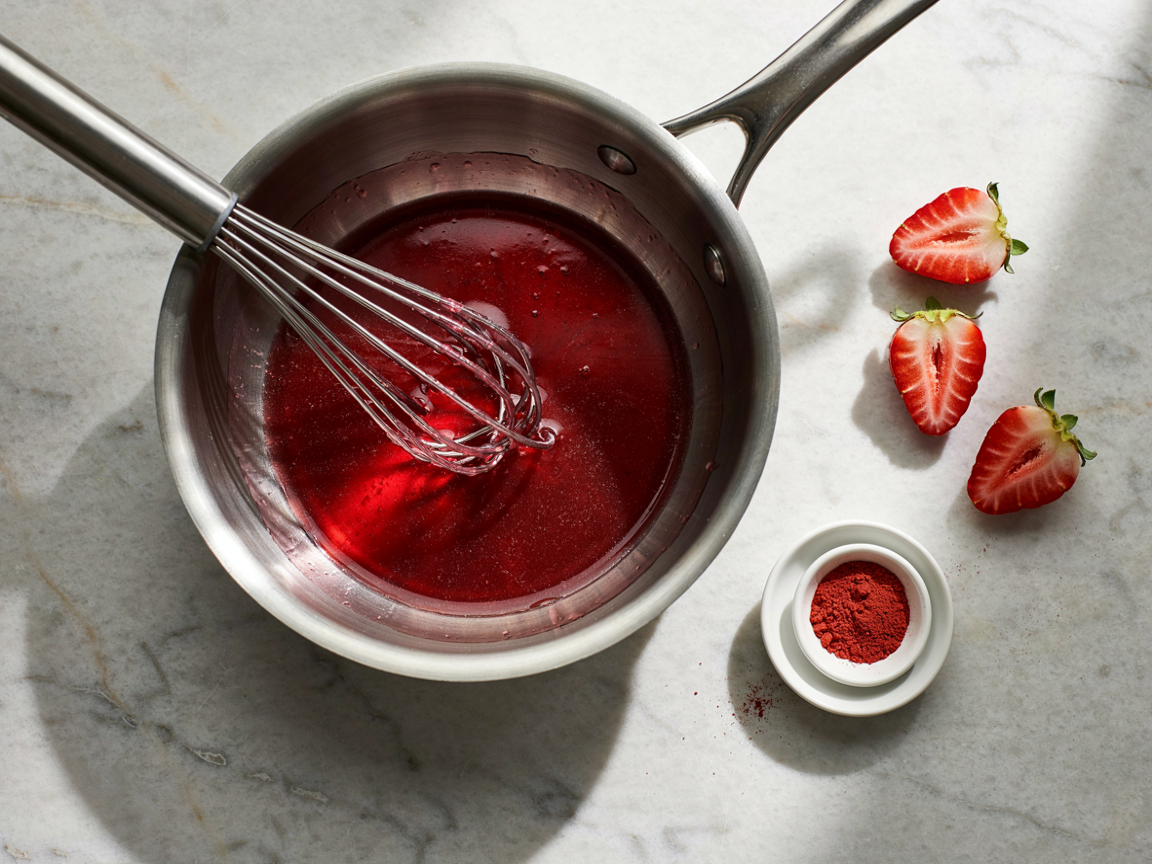
Glossy and see-through. Milky means it is not done.
Two different things are setting this pie, and knowing which does what is the difference between diagnosing a failure and guessing at it.
Cornstarch does the thickening
It is the body of the glaze. Starch granules absorb water as they heat, swell and burst, and that is what turns thin liquid into something that clings to a berry.
Gelatin does the setting
It is what makes a slice hold its shape instead of slumping. It also carries the colour and the strawberry flavour, which is why the packet version is so convenient.
Both need the right temperature
Cornstarch needs a real boil to work. Gelatin needs to go in off the heat, because sustained boiling can break it down and cost you the set entirely.
The berries need it lukewarm
Glaze poured on hot lightly cooks the fruit, dulling the colour and softening the texture. Ten minutes of cooling is the difference between a bright pie and a tired one.
The clarity test: raw cornstarch suspended in water scatters light, so the mixture looks cloudy and pale. Once the granules absorb water and burst, they stop scattering light and the liquid turns translucent. That visible change is not a nice-to-know — it is the only reliable signal that the glaze will set, and it arrives about 2 minutes into a proper boil.
Four Crusts, Compared Honestly
Pick the one that fits what you are actually after:
Traditional baked pastry
A single blind-baked shortcrust shell, cooled completely. It is the classic pairing and the flakiest option, but it contains flour and usually a little sugar, so it is the least suitable if you are making this pie specifically to cut sugar. Brush the inside with melted chocolate once cooled to keep it crisp.
Almond flour crust, no bake
Mix 2 cups of almond flour with 6 tablespoons of melted butter, 2 tablespoons of granulated sweetener and a pinch of salt, press firmly into the dish and refrigerate for an hour. This is the genuinely low-sugar option, it never needs the oven, and the high fat content makes it the most resistant to a wet filling.
Graham cracker crust
1½ cups of crumbs with 6 tablespoons of melted butter and 2 tablespoons of sweetener, pressed in and either chilled for an hour or baked at 350°F for 8 minutes. Sweeter and more familiar than almond flour, and it holds up well under the glaze.
Pecan and date crust
1½ cups of pecans and 8 pitted dates blitzed to a coarse paste with a pinch of salt, pressed in and chilled. No added sweetener at all, since the dates do that work, though it does bring their sugars with them. Nuttier and darker than the others.
Whichever you choose, waterproof it. Brush the inside of the cooled shell with about an ounce of melted chocolate and let it set before the berries go in. It takes two minutes, it is invisible once the pie is assembled, and it is the single most effective thing you can do about a soggy base.
Sugar Free Fresh Strawberry Pie with Jello Recipe
Sugar Free Fresh Strawberry Pie
Whole fresh berries set in a clear cornstarch and strawberry gelatin glaze, in a completely cooled crust.
What size?
Ingredients
- one 9-inchone 10-inchone 8-inch6 small jars, no crust baked and completely cooled pie crust
- 5 cups (about 2 lb)6½ cups4 cups5 cups fresh strawberries, hulled and dried
- 1½ cups2 cups1¼ cups1½ cups cold water
- 3 tbsp¼ cup2½ tbsp3 tbsp cornstarch
- 1 small box (0.3 oz)1½ boxes1 small box1 small box sugar-free strawberry gelatin, dry
- 2–3 tbsp¼ cup2 tbsp2–3 tbsp granulated sweetener, to taste
- a pincha pincha pincha pinch fine salt
- optionaloptionaloptionaloptional whipped cream, to serve
Instructions
Bake the crust and cool it completely
Blind bake your pie shell and let it cool to room temperature, which takes about an hour. A warm crust steams under the glaze and goes soft within minutes, and there is no recovering it once that has happened. This is the step worth planning around rather than rushing.
Hull the strawberries and dry them properly
Wash the strawberries, hull them, and lay them on a clean towel until the surfaces are genuinely dry. Water clinging to the berries thins the glaze exactly where it needs to cling, and it is the most common reason a pie looks watery in the dish an hour after it was made.
Whisk the cornstarch into cold water
Whisk the cornstarch into the cold water in a saucepan until there are no lumps at all, before any heat is applied. Cornstarch added to hot liquid seizes into lumps that never dissolve, and the glaze is not thick enough to hide them.
Boil until it turns thick and clear
Bring it to a boil over medium heat, whisking constantly, and let it bubble for 2 to 3 minutes. Watch for the moment it stops looking milky and turns glossy and translucent — that clarity is the signal that the starch has fully gelatinised. Pulling it off while it is still cloudy gives you a glaze that never sets and tastes faintly of raw flour.
Take it off the heat and whisk in the dry gelatin
Off the heat, whisk in the sugar-free strawberry gelatin powder straight from the packet until it is completely dissolved. Adding it while the pan is still on the burner can break down the gelatin and cost you the set.
Sweeten to taste and cool to lukewarm
Stir in the granulated sweetener and a pinch of salt, taste, and adjust. Then let the glaze stand for about 10 minutes until it is warm rather than hot. Hot glaze poured over fresh berries cooks them slightly and turns them dull and soft, which is the difference between a pie that looks bright and one that looks tired.
Arrange the berries in the shell
Set the strawberries into the cooled crust point-side up, largest first, packing them closely with the gaps filled by smaller berries. Packing them tightly is structural as well as decorative — it is what lets the glaze hold the whole thing together when you cut it.
Spoon the glaze over and chill for 4 hours
Spoon the glaze slowly over the berries so it runs down and coats every one, then work it into the gaps with the back of the spoon. Refrigerate uncovered for at least 4 hours, and preferably 6. It is not sliceable before then no matter how set the surface looks.
Roughly, per slice
With the almond flour crust and no whipped cream. The sugars are almost entirely from the strawberries themselves; a pastry crust adds carbohydrate but little sugar.
This is an estimate, not a lab analysis. The crust you choose moves it far more than anything in the filling.
Gelatin Options, Including Plant Based
Sugar-free strawberry gelatin is the shortcut this recipe is built around, but it is not the only way to set the glaze, and the alternatives are worth knowing.
| Setting agent | How much | What to know |
|---|---|---|
| Setting agentSugar-free strawberry gelatin | How much1 small box (0.3 oz) for 1½ cups liquid | What to knowThe standard version. Brings colour and flavour as well as the set; most supermarket gelatin is animal derived |
| Setting agentHalal-certified or beef gelatin | How much1 tbsp powder, plus 2 tbsp freeze-dried strawberry powder | What to knowA direct one-for-one swap. Identical texture, and the flavour is cleaner because it comes from real fruit |
| Setting agentAgar-agar | How much1 tsp powder per cup of liquid | What to knowPlant based. Whisk in cold with the cornstarch and boil a full 2 minutes; sets firmer and holds at room temperature |
| Setting agentCornstarch alone | How much4 tbsp instead of 3 | What to knowWorks, but softer and cloudier. You will want the extra freeze-dried strawberry powder for colour and flavour |
If you are using agar: it behaves differently enough to be worth saying twice. It must reach a full boil and stay there for two minutes, it sets as it cools rather than in the refrigerator, and it sets noticeably firmer — closer to a fruit jelly than to a glaze. Use a slightly generous teaspoon per cup and it is excellent.
Choosing and Preparing the Berries
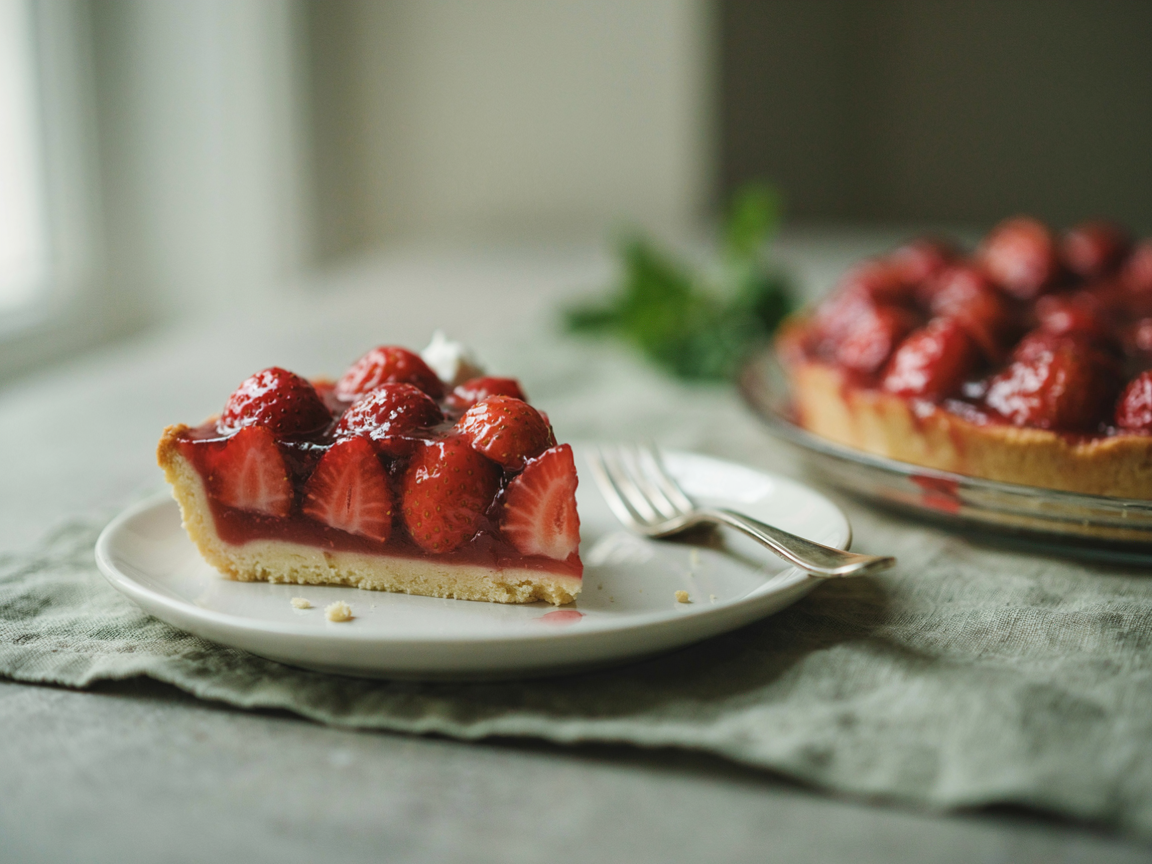
A clean slice is the proof: set glaze, tightly packed fruit, crisp base.
Medium, not giant
Medium berries pack far more tightly than large ones and leave fewer gaps for loose glaze. Buy two sizes if you can and use the small ones to fill the spaces between the others.
Firm and fully red
Soft berries collapse under the glaze and release water into it. White shoulders mean under-ripe fruit, which will taste sour against a filling that has no sugar to balance it.
Wash, then dry properly
Lay them on a towel until the surfaces are genuinely dry, not just patted. Surface water is the most common cause of a pie that looks watery an hour after it was made.
Hull with a straw
Push a drinking straw up through the point and out through the stem end. It takes the core with it and wastes far less fruit than cutting the top off with a knife.
Substitutions That Actually Work
| Instead of | Use | What changes |
|---|---|---|
| Instead ofSugar-free strawberry gelatin | UseHalal-certified or beef gelatin plus 2 tbsp freeze-dried strawberry powder | What changesA direct one-for-one swap with the same texture and a cleaner, more natural strawberry flavour |
| Instead ofGelatin entirely | UseAgar-agar, 1 tsp powder per cup of liquid | What changesPlant based; sets firmer and holds at room temperature. Boil for a full 2 minutes to activate it |
| Instead ofCornstarch | UseArrowroot, the same amount | What changesGlossier and clearer; do not boil it as long, since arrowroot thins if overcooked |
| Instead ofA baked pastry crust | UseA no-bake almond flour or graham crust | What changesLower in sugar, and it resists the glaze slightly better because of the higher fat content |
| Instead ofGranulated sweetener | UseAllulose, or a monk fruit blend | What changesAllulose dissolves best and does not recrystallise when cold, which erythritol sometimes does |
| Instead ofFresh strawberries | UseA mix of strawberries and raspberries | What changesSharper and more interesting; keep raspberries to no more than a third or they collapse |
| Instead ofWhipped cream on top | UseWhipped coconut cream | What changesDairy free, and the slight coconut note works better against strawberry than you might expect |
The one swap not worth making: frozen strawberries for fresh. They release water as they thaw and go soft, so you get a watery pie with collapsed fruit. This is a seasonal recipe, and out of season it is better to wait than to adapt.
Troubleshooting
Pick whatever went wrong:
The glaze never set
Pulled off the heat before the cornstarch finished cooking. The fix: tip the whole glaze back into a pan, bring it to a proper boil for 2 to 3 minutes until it turns clear and glossy, cool it to lukewarm and pour it back over. The berries will survive being lifted out once.
The crust went soggy underneath
Either the shell was still warm, or the berries were wet. The fix: nothing rescues a soggy crust after the fact. Next time, cool the crust completely, dry the berries on a towel, and brush the inside of the shell with melted chocolate and let it set before the fruit goes in.
It is watery in the dish after a few hours
Wet berries, or a glaze that was slightly under-thickened. The fix: pour off what has collected and serve it cold. For the next one, dry the fruit properly and give the glaze the full 3 minutes at a boil — there is more margin in over-cooking it than under-cooking it.
The berries look dull and cooked
Hot glaze poured straight over fresh fruit. The fix: let the glaze stand for 10 minutes off the heat before it goes anywhere near the berries. It should be warm to the touch rather than steaming; it will still flow perfectly well at that temperature.
It tastes artificial
Sugar-free gelatin carries a strong flavouring. The fix: use half the gelatin and make up the flavour with 2 tablespoons of crushed freeze-dried strawberries, plus a squeeze of lemon juice in the glaze. The lemon in particular pulls it back towards tasting like fruit.
The slices collapse when I cut them
Either under-chilled or loosely packed berries. The fix: give it the full 4 to 6 hours, and next time pack the fruit tightly, filling every gap with smaller berries. Loosely arranged fruit leaves pockets of glaze with nothing to hold on to.
Questions, Answered
Why did my sugar free fresh strawberry pie with jello not set?
Almost always the glaze came off the heat too early. Cornstarch only thickens properly once it has boiled and turned from milky to clear, and a glaze pulled while still cloudy will stay loose no matter how long you chill it. The second cause is wet berries, which thin the glaze from the inside after it has been poured.
Is this pie actually sugar free?
The filling is, as long as you use sugar-free gelatin and a granulated sweetener rather than sugar. The strawberries carry their own natural sugars, around 7g a cup, and a conventional pastry crust contains flour and sometimes sugar. For a genuinely low-sugar pie, use the almond flour crust in the crust section.
What can I use instead of gelatin?
Agar-agar is the usual substitute and it is plant based. Use 1 teaspoon of agar powder per cup of liquid, whisk it in with the cornstarch at the cold stage, and boil it for a full 2 minutes rather than pulling it early, since agar needs sustained heat to activate. It sets firmer than gelatin and holds at room temperature. Beef gelatin and halal-certified gelatin both work as direct one-for-one replacements if you would rather keep the texture identical.
Can I use frozen strawberries?
Not for the filling. Frozen berries release a great deal of water as they thaw and turn soft, so the pie ends up watery and the fruit collapses. If fresh strawberries are out of season, this is a recipe worth waiting for rather than adapting.
How far ahead can I make it?
Make it the morning of the day you want to serve it, or the night before at the outside. It needs at least 4 hours to set, and it is at its best between 4 and 12 hours. Past 24 hours the berries begin to release liquid into the glaze and the crust softens underneath.
How do I stop the crust going soggy?
Three things: cool the crust completely before anything goes into it, dry the berries properly, and brush the inside of the cooled shell with a thin layer of melted white or dark chocolate and let it set. That chocolate layer is a genuine waterproof barrier and it is what bakeries do.
Can I use a graham cracker crust?
Yes, and it suits this pie well. A no-bake graham or almond flour crust needs an hour in the refrigerator to firm up rather than a bake, and it stands up to the glaze slightly better than pastry because the butter content is higher.
How long does it keep?
Three days in the refrigerator, loosely covered. The first day is much the best; by day three the glaze has begun to weep and the crust is soft. It does not freeze — the glaze breaks and the berries turn to mush on thawing.
Cool the crust completely, dry the berries, boil the glaze until it turns clear, and let it cool to lukewarm before it touches the fruit. Four rules, and the pie is difficult to get wrong once you know them.
Pin this sugar free fresh strawberry pie with jello so the glaze ratios are there when strawberries are at their best.