
One Pan · 40 Minutes · Make-Ahead Friendly
Golden Roasted Butternut Squash & Sweet Potatoes (Caramelised Edges Every Time)
The side dish that disappears first — deeply browned at the edges, tender in the middle, and never the pale steamed version everyone ends up with.
- 20 min prep
- 425°F, one pan
- 5 flavour variations
- Holiday make-ahead
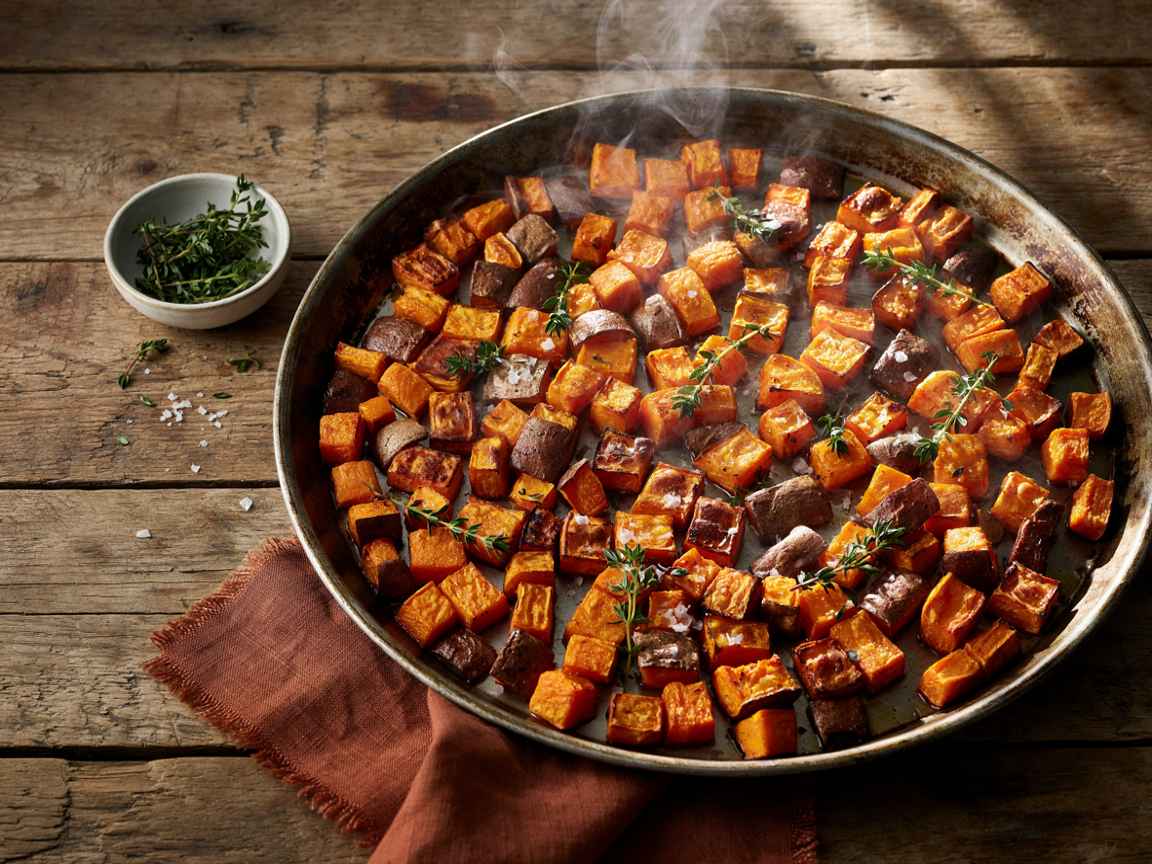
Those dark edges are the whole point — and they come from technique, not ingredients.
Golden roasted butternut squash & sweet potatoes should come out of the oven with crackling brown edges and a soft, almost custardy centre. What most people get instead is a tray of pale orange cubes sitting in their own steam, tasting fine and looking like nothing.
The gap between those two outcomes is not the recipe. It is four or five small decisions made before the pan goes in the oven — how big the cubes are, how hot the pan is when they hit it, how much space they have, and when the sweet stuff gets added. Get those right and this becomes the dish people ask you to bring.
Save the pin so it is waiting when you plan the holiday table.
Why These Two Roast So Well Together
Plenty of vegetable pairings fight each other in the oven. These two do not, and it is worth understanding why, because it tells you what to do when you swap something in.
They cook at the same rate
Cut to the same size, butternut squash and sweet potato both hit tender at roughly 35 to 40 minutes at 425°F. Nothing has to come off the pan early.
Different sugars, different browning
Sweet potato is denser and sweeter, so it caramelises harder and faster at the edges. Butternut is lighter and more savoury. You get two shades of brown on one pan.
Squash holds its shape
Butternut keeps clean square edges where sweet potato softens and rounds off. That contrast is what stops the finished tray looking like mash.
The moisture balances out
Butternut carries more water and sweet potato more starch. Together they brown more evenly than either does alone on a crowded pan.
Swapping something in? Carrots and parsnips work on the same timing. Potatoes and beetroot do not — potatoes need longer, and beetroot bleeds colour across everything. Roast those separately and combine at the end.
Golden Roasted Butternut Squash & Sweet Potatoes: The Five Rules
Every one of these fixes a specific failure. Skip any of them and you will know which one you skipped.
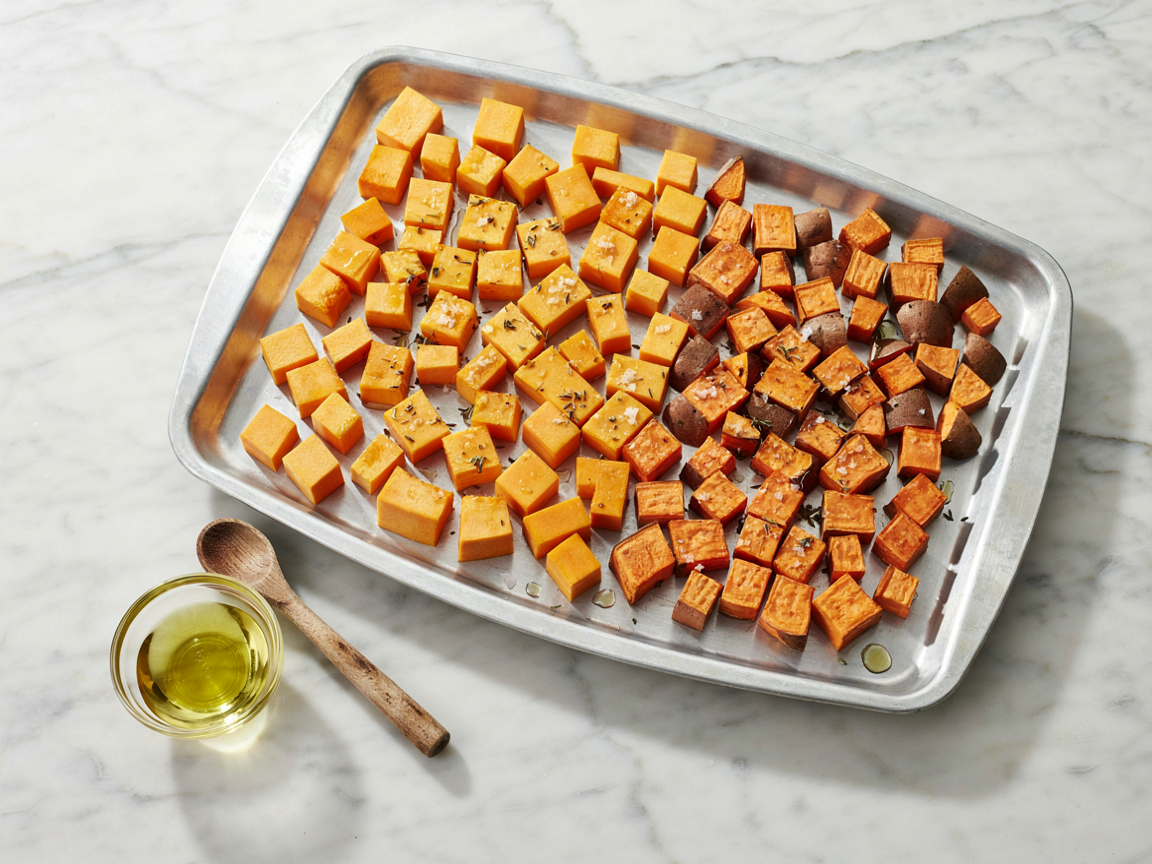
This is what the pan should look like before it goes in: single layer, visible gaps, everything glossy.
1. Preheat the pan, not just the oven
Put the empty sheet pan in while the oven comes up to temperature, and tip the vegetables onto it hot. The undersides start browning on contact instead of slowly sweating up to temperature. This one change does more than any other on this list.
2. One inch, and mean it
Cubes smaller than an inch dry out before they colour. Cubes larger than an inch go soft in the middle while the outside is still pale. More importantly, they must all be the same size — uneven cubes are why one tray contains both burnt bits and raw bits.
3. Give everything space
Vegetables release steam. If they are touching, that steam has nowhere to go and it braises them instead of roasting them. You want visible pan between the pieces. Two pans is not a failure — it is the correct answer whenever one pan looks full.
4. High heat, and leave it alone
425°F (220°C, or 200°C fan) is the sweet spot: hot enough to brown, not so hot that the sugars burn before the centres soften. Then do not touch it for the first 20 minutes. Every early stir breaks the crust that is forming.
5. Sugar goes on last
Maple syrup, honey and brown sugar all burn long before 40 minutes are up. Add them in the final 10 minutes and they glaze. Add them at the start and they scorch to bitter black patches on the pan.
Cutting butternut squash without a fight
This is the step that puts people off the whole recipe, and there is a shortcut. Microwave the whole squash for 2 to 3 minutes before you touch it with a knife. It does not cook it — it just softens the skin enough that the peeler glides instead of skidding.
Then: cut off both ends so it sits flat, slice it in half at the point where the neck meets the bulb, stand each piece on its cut end, and peel downward in strips. Scoop the seeds from the bulb with a spoon. Cube the neck first, it is all solid flesh and the fastest part.
The Recipe
Golden Roasted Butternut Squash & Sweet Potatoes
One-pan roasted autumn vegetables with garlic and thyme, finished with an optional maple glaze in the last ten minutes.
How many are you feeding?
Ingredients
The vegetables- 1 small (about 1½ lb / 680g)1 medium (about 2 lb / 900g)1 large (about 2¾ lb / 1.25kg)2 medium (about 4 lb / 1.8kg) butternut squash, peeled, seeded and cut into 1-inch cubes
- 1 large (about 12 oz / 340g)2 medium (about 1¼ lb / 570g)3 medium (about 1¾ lb / 800g)4 medium (about 2½ lb / 1.1kg) sweet potatoes, peeled and cut into 1-inch cubes
- 2 tbsp3 tbsp¼ cup6 tbsp olive oil
- 1 tsp1½ tsp2 tsp1 tbsp kosher salt
- ½ tsp¾ tsp1 tsp1½ tsp freshly ground black pepper
- ¾ tsp1 tsp1½ tsp2 tsp garlic powder
- ¾ tsp1 tsp1½ tsp2 tsp dried thyme
- 1½ tbsp2 tbsp3 tbsp¼ cup maple syrup, added in the last 10 minutes only
- A handful fresh thyme leaves or chopped parsley, and flaky salt
Instructions
Preheat the oven and the pan
Heat the oven to 425°F (220°C, or 200°C fan) and slide the empty sheet pan onto the middle rack while it comes up to temperature. A hot pan is the difference between roasting and steaming.
Soften the squash skin
Microwave the whole butternut squash for 2 to 3 minutes. It will not cook, but the skin softens enough that peeling takes half the effort and far less risk.
Cut everything to one inch
Peel and seed the squash, peel the sweet potatoes, and cut both into even 1-inch cubes. Evenness matters more than precision — pieces of wildly different sizes will never finish at the same time.
Toss with oil and seasoning
In a large bowl, toss the cubes with the olive oil, salt, pepper, garlic powder and thyme until every piece is glossy. Do not add the maple syrup yet.
Spread on the hot pan
Carefully tip the vegetables onto the preheated pan and spread them into a single layer with visible gaps between the pieces. If the pan looks crowded, split across two pans rather than piling up.
Roast undisturbed, then flip once
Roast for 20 minutes without opening the oven. Flip the pieces with a stiff spatula, then roast for another 15 to 20 minutes until the edges are deeply browned and a knife slides in with no resistance.
Glaze, rest and finish
If using maple syrup, drizzle it over in the final 10 minutes and toss. Let the pan rest for 5 minutes out of the oven, then scatter with fresh herbs and flaky salt and serve hot.
Five Ways to Season It
Same vegetables, same method. Tap a flavour to swap the seasoning — quantities are for the 6-person batch.
Herb & garlic — the house version
Savoury, aromatic and the safest bet for a holiday table where not everyone wants a sweet side.
- 1 tsp garlic powder
- 1 tsp dried thyme
- ½ tsp dried rosemary, crushed between your fingers
- Fresh thyme and flaky salt to finish
Maple cinnamon — the crowd-pleaser
The version children eat without negotiation. Warm, glossy and unmistakably autumn.
- 2 tbsp pure maple syrup
- ¾ tsp ground cinnamon
- A pinch of grated nutmeg
- ½ tsp salt, extra, to keep it from turning dessert-sweet
Smoky paprika — savoury and grown-up
Deep, slightly smoky and the best match for roast chicken or anything off a grill.
- 2 tsp smoked paprika
- ½ tsp ground cumin
- ¼ tsp cayenne, optional
- 1 tsp garlic powder
Honey harissa — sweet heat
Sticky, spicy and the one people ask about. Excellent over couscous or a yogurt base.
- 1 tbsp harissa paste, thinned with 1 tbsp of the oil
- 1 tbsp runny honey
- ½ tsp ground cumin
- Fresh coriander and a squeeze of lemon to finish
Brown butter sage — the restaurant one
Nutty, rich and the most impressive of the five for almost no extra work. No pan sauce, no thickening, nothing to go wrong.
- 3 tbsp butter
- 8 to 10 fresh sage leaves
- A squeeze of lemon
- Flaky salt
Make It Ahead for the Holiday Table
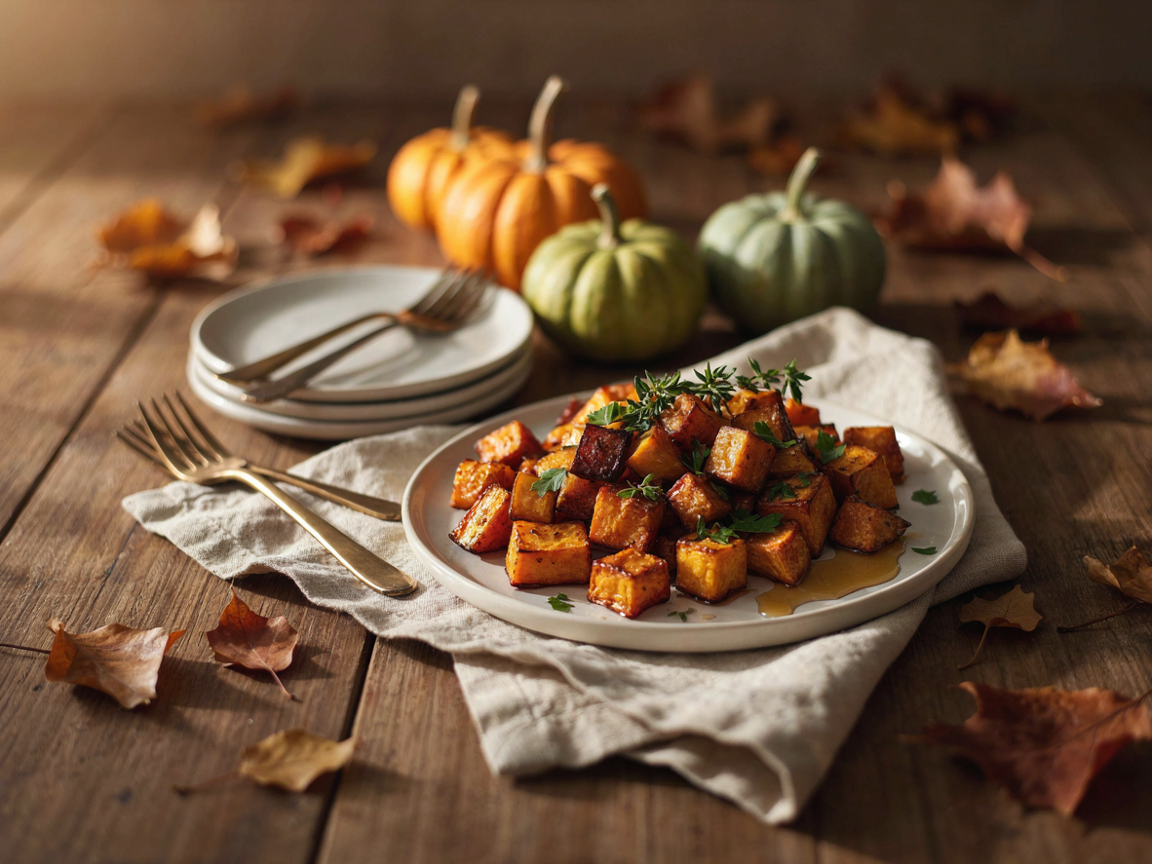
Reheated properly, nobody can tell it was not roasted twenty minutes ago.
Pick your timeline:
Prep ahead — up to 3 days
Peel and cube both vegetables, then store them in an airtight container in the refrigerator for up to 3 days. Do not store them submerged in water — that is potato advice, and here it waterlogs the squash so it will never brown. Pat them dry before oiling if any condensation has collected. Seasoning can be mixed and left in a jar.
Roast ahead and reheat — the best option
Roast completely up to 2 days ahead, cool fully on the pan, then refrigerate in a shallow container. To reheat, spread on a preheated pan at 425°F for 10 to 12 minutes — the high heat re-crisps the edges rather than just warming them through. Never microwave them; they go limp and wet. Add any maple or honey glaze during the reheat instead of the first roast.
Freezing — up to 3 months
Freeze them roasted, not raw. Cool completely, spread on a tray to freeze individually so they do not clump, then bag. Reheat straight from frozen on a preheated pan at 425°F for 15 to 20 minutes. The texture comes back about 90 per cent of the way — perfectly good for a table with five other dishes on it, slightly softer if it is the only side.
Oven-space plan for the big day
The oven is the bottleneck, not the recipe. Two options that both work: roast these fully the day before and reheat for 10 minutes while the roast rests, or cube everything the day before and roast fresh in the 40-minute window when the main dish comes out and needs to sit. Resting time is your oven window — most roasts need 20 to 30 minutes out of the oven anyway, and this dish fits neatly inside it.
What to Serve It With
On the holiday table
It sits beside roast turkey or chicken without competing, and its sweetness balances a salty gravy. Serve in a wide shallow dish rather than a deep bowl so the browned edges stay visible instead of steaming each other soft.
As a weeknight main
Pile it over couscous, warm grains or a bed of thick yogurt, add toasted seeds and a squeeze of lemon, and it stands up on its own. The honey harissa version is the one to use here.
Into next-day lunches
Cold from the fridge it works folded into a grain bowl or a green salad with feta and pumpkin seeds. It is one of the few roasted vegetables that tastes good without reheating.
Blitzed into soup
Leftovers plus hot stock, blended smooth, makes an immediate soup with far more depth than one started from raw — everything in it has already been caramelised.
Troubleshooting
Pick whatever went wrong:
Soggy, with no browning
Almost always overcrowding, a cold pan, or both. Steam released by the vegetables cannot escape when the pieces touch, so they braise. The fix: split across two pans, preheat the pan before the vegetables go on, and resist stirring for the first 20 minutes. If a tray is already soggy, spread it across two pans and give it another 10 minutes at 425°F.
Burnt outside, raw inside
The oven is too hot, or something sugary went on at the start. The fix: stay at 425°F rather than pushing to 450°F, and hold maple syrup, honey or brown sugar until the last 10 minutes. If your oven runs hot, an oven thermometer is worth more here than any technique — most ovens are 15 to 25 degrees off their dial.
Stuck to the pan
Not enough oil, or the sugars caught and welded on. The fix: make sure every cube is properly glossy before it goes on the pan, and use a thin stiff metal spatula rather than a plastic one to lift them — get under the crust and it releases in one piece. Parchment prevents sticking entirely but costs you some browning on the underside, so it is a trade.
Squash won’t peel
Raw butternut skin is tough and the peeler skates over it. The fix: microwave the whole squash for 2 to 3 minutes first, then cut off both ends so it sits flat, halve it where the neck meets the bulb, stand each piece upright and peel downward. A sharp Y-shaped peeler handles it far better than a straight swivel peeler.
Uneven doneness across the pan
Two causes: cubes of different sizes, or oven hot spots. The fix: cut to a consistent inch, and rotate the pan 180 degrees when you flip at the 20-minute mark. If you are running two pans on two racks, swap them top to bottom at the same time.
Questions, Answered
Do you have to peel butternut squash before roasting?
For cubed roasted squash, yes. Butternut skin is edible and softens when roasted, but on 1-inch cubes at high heat it stays noticeably chewy and gets in the way of the caramelised edges you are after. If you are roasting the squash in halves or thick wedges, leaving the skin on is fine and it holds the shape together.
Why is my roasted squash mushy instead of crispy?
The pan was too crowded, too cold, or both. Vegetables release steam as they roast, and if the pieces are touching, that steam has nowhere to go and it braises them instead. Spread everything in a single layer with visible gaps between pieces, preheat the empty pan with the oven, and use two pans rather than crowding one.
Can you roast butternut squash and sweet potatoes together?
Yes, and they are one of the better pairings. Cut to the same 1-inch size, both are tender in 35 to 40 minutes at 425°F, so nothing needs to come off the pan early. Sweet potato caramelises a little harder at the edges and butternut holds its shape better, which is what gives the finished tray its contrast.
What temperature is best for roasting butternut squash and sweet potatoes?
425°F, which is 220°C conventional or 200°C fan. That is hot enough to brown the edges properly but not so hot that the natural sugars scorch before the centres go tender. Lower than 400°F and they dry out before they colour; higher than 450°F and the outsides burn while the middles stay firm.
Can I make roasted butternut squash and sweet potatoes ahead for Thanksgiving?
Yes, and roasting them fully ahead works better than prepping them raw. Roast up to 2 days in advance, cool completely, refrigerate in a shallow container, then reheat on a preheated pan at 425°F for 10 to 12 minutes. The high-heat reheat re-crisps the edges. Do not use the microwave, and add any maple or honey glaze during the reheat rather than the first roast.
Do I need to boil or microwave the vegetables first?
No. Par-boiling adds water, which is the enemy of browning, and these cook through perfectly well from raw in 35 to 40 minutes. The only microwaving worth doing is 2 to 3 minutes on the whole butternut squash before you peel it, which softens the skin and makes it far easier and safer to cut.
How do I cut butternut squash safely?
Microwave it whole for 2 to 3 minutes to soften the skin, then cut off both ends so it has a flat base. Slice it in half where the narrow neck meets the round bulb, stand each piece on its cut end, and peel downward in strips. Scoop the seeds out of the bulb with a spoon, then cube the neck first since it is all solid flesh.
How long do leftovers keep?
Four days in an airtight container in the refrigerator, or up to 3 months frozen. Freeze them already roasted rather than raw, spread on a tray first so they freeze individually instead of clumping. Reheat straight from frozen on a preheated pan at 425°F for 15 to 20 minutes.
Keep Reading
One inch, one layer, a hot pan and no stirring for the first twenty minutes. That is the entire difference between a tray that gets eaten first and one that gets pushed around the plate.
Pin these golden roasted butternut squash & sweet potatoes so the method and all five flavour variations are waiting when you plan the holiday menu — then come back and tell us which seasoning you went with.