
Coconut Protein Balls: Keto and Low Carb, Just 3 Ingredients
Unsweetened shredded coconut, vanilla protein powder and almond butter, stirred together and rolled in about five minutes, with roughly 7 grams of protein and under 2 grams of net carbs a ball.
- No oven
- Gluten-free
- Nut-free option
- Freezer-friendly
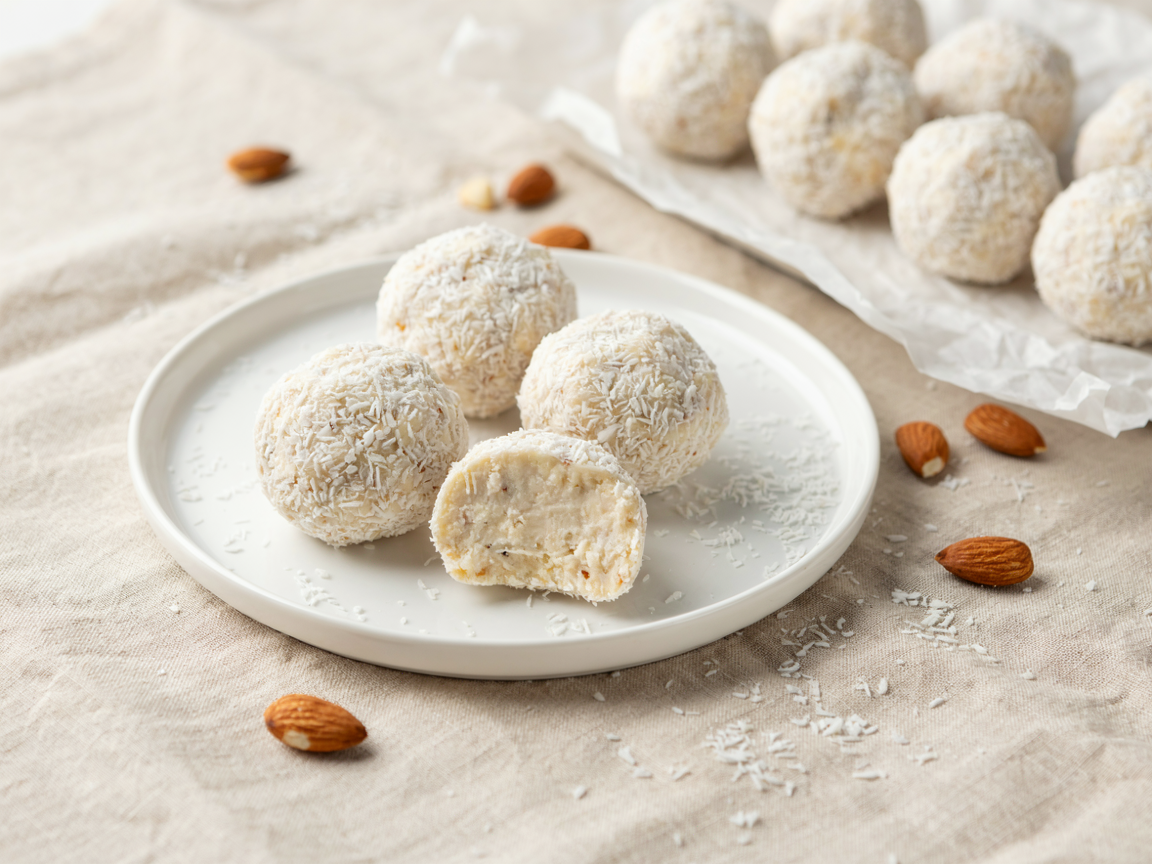
The balls from the pin: snow-white with shredded coconut, one bitten to show the creamy center, whole almonds alongside.
Coconut protein balls need three ingredients and about five minutes: unsweetened shredded coconut, vanilla protein powder and almond butter, stirred together and rolled. About 7 g protein and 1.5 g net carbs a ball, no oven, and they keep a week in the fridge. The card scales from 6 balls to 36.
In this post:
- Why these coconut protein balls work
- The recipe, from 6 balls to 36
- Four rules for balls that hold together
- What each ingredient does
- Keto macros, ball by ball
- Which protein powder, and how much milk
- Six flavors, from lemon to chocolate-dipped
- Fixes, storage, snack ideas and 14 FAQs
Why These Coconut Protein Balls Work
Three ingredients, one bowl
Coconut, vanilla protein powder and almond butter. Five minutes from bag to plate, with no oven, blender or food processor, and only a bowl and a spatula to wash.
About 7 g protein, under 2 g net carbs
Each ball as written has roughly 7 g protein, 11 g fat and 1.5 g net carbs, because most of the carbs in coconut and almonds are fiber. The macro table below has the numbers.
Coconut inside and out
Shredded coconut gives the dough its chew, and a second roll through coconut gives the snow-white finish on the pin. Coconut butter as the binder keeps the center creamy white too.
Low sugar and gluten-free
About 1 g of sugar a ball, all from the coconut and almonds, with no honey or syrup. Naturally gluten-free; check that the protein powder label says so too.
Coconut Protein Balls Recipe
The card makes 12 balls. Tap 6 for a taste, or 24 and 36 for a week of snacks and a freezer stash; every amount updates.
Coconut Protein Balls
The balls from the pin: snow-white, rolled in coconut, soft and creamy inside, with about 7 g protein and 1.5 g net carbs each. Mixing and rolling take about five minutes; the 15-minute chill is optional and extra. Tap a size and every amount updates.
How many balls?
Ingredients
- ½ cup (40 g)1 cup (80 g)2 cups (160 g)3 cups (240 g) unsweetened shredded coconut, fine or medium shred
- ⅓ cup (30 g, 1 scoop)⅔ cup (60 g, 2 scoops)1⅓ cups (120 g, 4 scoops)2 cups (180 g, 6 scoops) vanilla protein powder, whey isolate or plant blend
- ¼ cup (62 g)½ cup (125 g)1 cup (250 g)1½ cups (375 g) almond butter or coconut butter, smooth and stirred
- 1 to 2 tbsp2 to 4 tbsp¼ to ½ cup⅓ to ¾ cup unsweetened almond milk, to adjust
- a pincha pinch⅛ tsp¼ tsp fine sea salt, optional
- 1½ tsp to 1 tbsp1 to 2 tbsp2 to 4 tbsp3 to 6 tbsp powdered keto sweetener, only if the powder is unsweetened
- ¼ tsp½ tsp1 tsp1½ tsp alcohol-free vanilla, optional
- 2 tbsp (10 g)¼ cup (20 g)½ cup (40 g)¾ cup (60 g) extra shredded coconut, for coating
Protein powder: the amounts assume vanilla whey isolate; casein and plant powders need more milk (table below). Choose halal-certified whey if that matters at your table. Coconut butter instead of almond butter makes them nut-free with a whiter center; warm it until pourable.
Instructions
Mix the dry
Stir the shredded coconut, protein powder, salt and sweetener, if using, in a medium bowl until no streaks of powder remain. Powder mixed in now will not clump later.
Add the binder
Add the almond butter (or warm, pourable coconut butter) and the vanilla. Mix with a sturdy spatula, then press the mixture with your fingers. It will look crumbly at this point.
Adjust with milk
Add almond milk a tablespoon at a time, mixing after each, until a squeezed handful holds together without crumbling or sticking to your palm. Wait a minute before the last spoonful; the powder keeps absorbing.
Roll
Scoop with a 1½-tablespoon cookie scoop or a heaped tablespoon, about 25 g each. Squeeze each portion firmly in your fist, then roll it between your palms into a smooth ball.
Coat
Tip the extra coconut into a shallow dish. Roll each ball through it straight away, pressing lightly so the shreds stick, and set it on parchment.
Eat now or chill
Eat them straight away, soft and fudgy, or chill 15 minutes for the firmer, cleaner bite on the pin. Store airtight in the fridge for up to a week.
Four Rules for Protein Balls That Hold Together
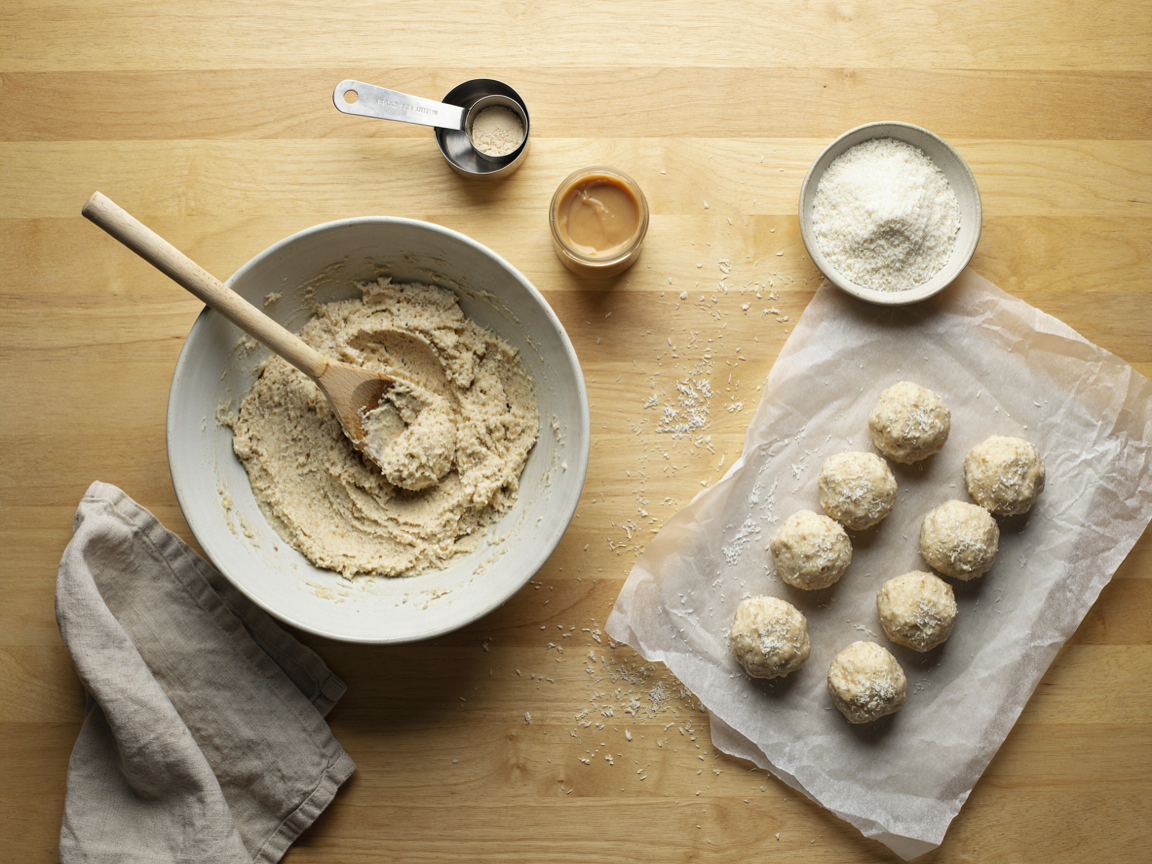
Mixing and rolling: the coconut, protein powder and almond butter dough, a dish of coconut for coating and the first balls on parchment.
Powder into the coconut first
Stir the protein powder through the dry coconut before the binder goes in. Powder that meets nut butter first forms chalky lumps that never mix out.
Milk by the tablespoon
Powders absorb very differently. Add milk slowly, squeeze a handful after each spoonful, and stop as soon as it holds. Too much turns the dough to paste.
Squeeze, then roll
Press each portion hard in your fist before rolling. Compacted balls hold together and do not crack; loosely rolled ones crumble in a lunchbox.
Coat while tacky
Roll the balls in coconut as soon as they are shaped. Once they sit or chill, the surface dries and the shreds slide off.
The Three Ingredients, and the Small Extras
Coconut for chew and fat, powder for protein, a nut or coconut butter to bind. Everything else is optional and only adjusts flavor or texture.
Unsweetened shredded coconut
Fine or medium shred, unsweetened. Desiccated coconut makes a slightly denser ball; large flakes do not bind, so pulse them a few times first. Sweetened coconut adds sugar and is not keto.
Vanilla protein powder
Whey isolate gives the lightest texture and the fewest carbs. Casein makes them fudgy, plant blends work with extra milk. Pick halal-certified whey or casein if that matters at your table.
Almond butter or coconut butter
Smooth, unsalted almond butter stirred well binds best. Coconut butter is pureed coconut meat, not coconut oil: warm it until pourable for a whiter, nut-free ball.
Unsweetened almond milk
Only to adjust the texture, a tablespoon at a time. Any milk works; coconut milk beverage or water keeps a nut-free batch nut-free.
Salt and sweetener
A pinch of salt sharpens the coconut. Add a powdered keto sweetener only when the protein powder is unsweetened; most flavored powders are sweet enough.
Alcohol-free vanilla
Optional. Half a teaspoon rounds out a lightly flavored or unflavored powder. Ordinary vanilla extract contains alcohol, so use an alcohol-free one or vanilla bean paste.
Coconut Protein Balls Macros: Are They Keto?
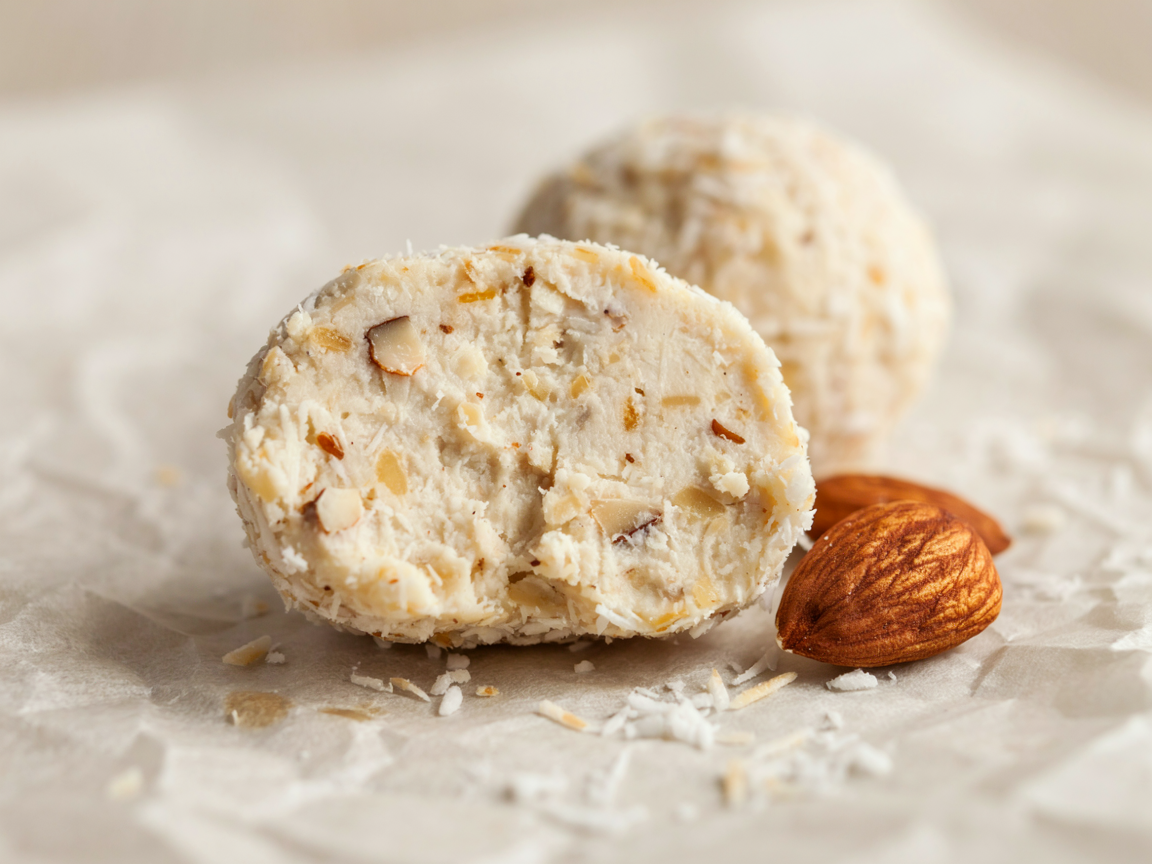
Up close: a dense, creamy center inside the coconut coating, with a whole almond beside it.
Coconut and almond butter bring the fat, the powder brings the protein, and most of the carbs in coconut and almonds are fiber. That is why a ball lands at about 1.5 g net carbs. Figures are approximate and shift with the powder you use, so check its label.
| Per serving | One ball, as written | One ball, coconut butter binder | Two balls, as written |
|---|---|---|---|
| Per servingCalories | One ball, as written~140 | One ball, coconut butter binder~145 | Two balls, as written~280 |
| Per servingFat | One ball, as written~11 g | One ball, coconut butter binder~12 g | Two balls, as written~22 g |
| Per servingProtein | One ball, as written~7 g | One ball, coconut butter binder~5.5 g | Two balls, as written~14 g |
| Per servingTotal carbs | One ball, as written~4 g | One ball, coconut butter binder~4.5 g | Two balls, as written~8 g |
| Per servingFiber | One ball, as written~2.5 g | One ball, coconut butter binder~3 g | Two balls, as written~5 g |
| Per servingNet carbs | One ball, as written~1.5 g | One ball, coconut butter binder~1.5 g | Two balls, as written~3 g |
| Per servingCalories from fat / protein / net carbs | One ball, as written75 / 20 / 5% | One ball, coconut butter binder80 / 16 / 4% | Two balls, as written75 / 20 / 5% |
Nutrition (approximate, per ball)
One of 12 balls as written, with whey isolate, almond butter and the coconut coating: about 4 g total carbs, 2.5 g fiber and 1 g sugar. Gluten-free with a gluten-free powder; halal with a halal-certified powder and alcohol-free vanilla.
Looking for more snacks with the protein up front? These low-calorie, high-protein snacks cover sweet and savory.
Which Protein Powder to Use, and How Much Milk
The recipe is built on 60 g of vanilla whey isolate for 12 balls. Swap in another powder and the texture and the milk change; the protein per ball stays close.
| Powder | Texture in the ball | Milk for 12 balls | Notes |
|---|---|---|---|
| PowderWhey isolate (as written) | Texture in the ballLight, smooth, slightly chewy | Milk for 12 balls2 to 3 tbsp | NotesFewest carbs, about 25 g protein a scoop; halal-certified |
| PowderWhey concentrate | Texture in the ballSofter and creamier | Milk for 12 balls1 to 2 tbsp | NotesA gram or two more carbs per scoop |
| PowderCasein | Texture in the ballThick and fudgy, like cookie dough | Milk for 12 balls4 to 5 tbsp, slowly | NotesKeeps absorbing; rest the dough 5 minutes before the last spoonful; halal-certified |
| PowderWhey and casein blend | Texture in the ballBetween the two, holds its shape well | Milk for 12 balls3 to 4 tbsp | NotesA good all-rounder |
| PowderPlant blend (pea, rice, pumpkin seed) | Texture in the ballDenser and earthier, can be slightly gritty | Milk for 12 balls4 to 6 tbsp | NotesRest 5 minutes; about 6 g protein a ball; dairy-free |
| PowderEgg white protein | Texture in the ballDrier, a little springy | Milk for 12 balls3 to 4 tbsp | NotesDairy-free; add the vanilla, or it can taste of egg |
| PowderCollagen peptides | Texture in the ballNo structure: sticky and slack | Milk for 12 ballsLittle or none | NotesReplace no more than a third of the powder; halal bovine or marine only |
Sweetener Options
Taste the dough before adding any. A sweetened vanilla powder usually needs nothing else.
| Sweetener | For 12 balls | Notes |
|---|---|---|
| SweetenerNone | For 12 balls— | NotesMost flavored powders are sweet enough; taste the dough first |
| SweetenerPowdered erythritol or monk fruit blend | For 12 balls1 to 2 tbsp | NotesPowdered, not granulated, or it stays gritty; a slight cooling taste |
| SweetenerPowdered allulose | For 12 balls1½ to 2½ tbsp | NotesSofter flavor with no cooling; makes the dough a little stickier |
| SweetenerLiquid stevia or monk fruit drops | For 12 balls5 to 10 drops | NotesThe strongest; add a drop at a time |
| SweetenerSugar-free flavored syrup | For 12 balls1 to 2 tbsp, in place of the same milk | NotesSweetens and loosens at once; the salted caramel tab uses it |
| SweetenerHoney or maple syrup | For 12 balls1 to 2 tbsp | NotesNot keto: adds about 1.5 to 3 g carbs a ball |
Six Coconut Protein Ball Flavors
Same coconut, powder and binder; one small change each. Amounts are for 12 balls. Tap a flavor:
Classic Coconut Almond (as Written)
The card above: coconut, vanilla whey and almond butter with ½ tsp alcohol-free vanilla. Press a whole almond into the center of each ball before coating, like the ones on the pin; it adds about 7 calories a ball.
Chocolate Coconut Protein Balls
Use chocolate protein powder, or stir 2 tbsp unsweetened cocoa into the dry mix with an extra tablespoon of almond milk and a little sweetener. The cocoa adds about 0.2 g net carbs a ball. Roll half in coconut and half in cocoa.
Lemon Coconut Protein Balls
Coconut butter as the binder for a white center, the zest of 1 lemon in the dry mix and 1 tbsp lemon juice in place of a tablespoon of milk. Bright, like a bite of lemon coconut cake, with no change to the macros worth counting.
Raspberry Coconut Protein Balls
Crush 2 tbsp (about 5 g) freeze-dried raspberries and stir them in with the coconut for pink flecks and a tart edge, about 0.2 g more net carbs a ball. Fresh raspberries make the dough wet; keep them for the plate.
Salted Caramel Coconut Protein Balls
Replace 2 tbsp of the almond milk with sugar-free caramel-flavored syrup, checking the label for alcohol-free flavoring. Press a few flakes of sea salt onto each ball after the coconut. A zero-sugar syrup adds no net carbs.
Chocolate-Dipped Coconut Bites
The candy-bar version. Use coconut butter for a snow-white center, chill the balls 30 minutes, then dip each halfway in 60 g melted 85% dark or sugar-free chocolate loosened with 1 tsp coconut oil. Set on parchment in the fridge. About 30 calories and 0.4 g net carbs more a ball.
Troubleshooting: Too Dry, Too Sticky or Gritty
Nearly every problem comes down to liquid, temperature or the powder. Find the symptom:
| Problem | Likely cause | Fix |
|---|---|---|
| ProblemToo dry, crumbly | Likely causeNot enough liquid for your powder, or stiff almond butter | FixAlmond milk 1 tsp at a time; warm the almond butter 10 seconds |
| ProblemToo sticky to roll | Likely causeToo much milk, or a runny nut butter | FixA spoonful of coconut or powder; chill 10 minutes; roll with lightly damp hands |
| ProblemGritty | Likely causeA grainy plant powder, granulated sweetener or large flakes | FixRest the dough 5 minutes; powdered sweetener; fine shred |
| ProblemChalky, tastes of powder | Likely causePowder clumped, or no salt or vanilla | FixStir the powder into the coconut first; a pinch of salt; alcohol-free vanilla |
| ProblemCoating will not stick | Likely causeBalls already dry or chilled | FixCoat straight after rolling; dampen your palms and re-roll |
| ProblemOily surface | Likely causeThe almond butter oil separated, or a warm kitchen | FixStir the jar well before measuring; chill 15 minutes |
| ProblemCracks while rolling | Likely causeDough slightly dry, or rolled without pressing | FixSqueeze each portion first; a teaspoon more milk |
| ProblemToo hard from the fridge | Likely causeCoconut butter sets firm when cold | Fix5 minutes at room temperature |
Storage, Meal Prep and Snack Ideas
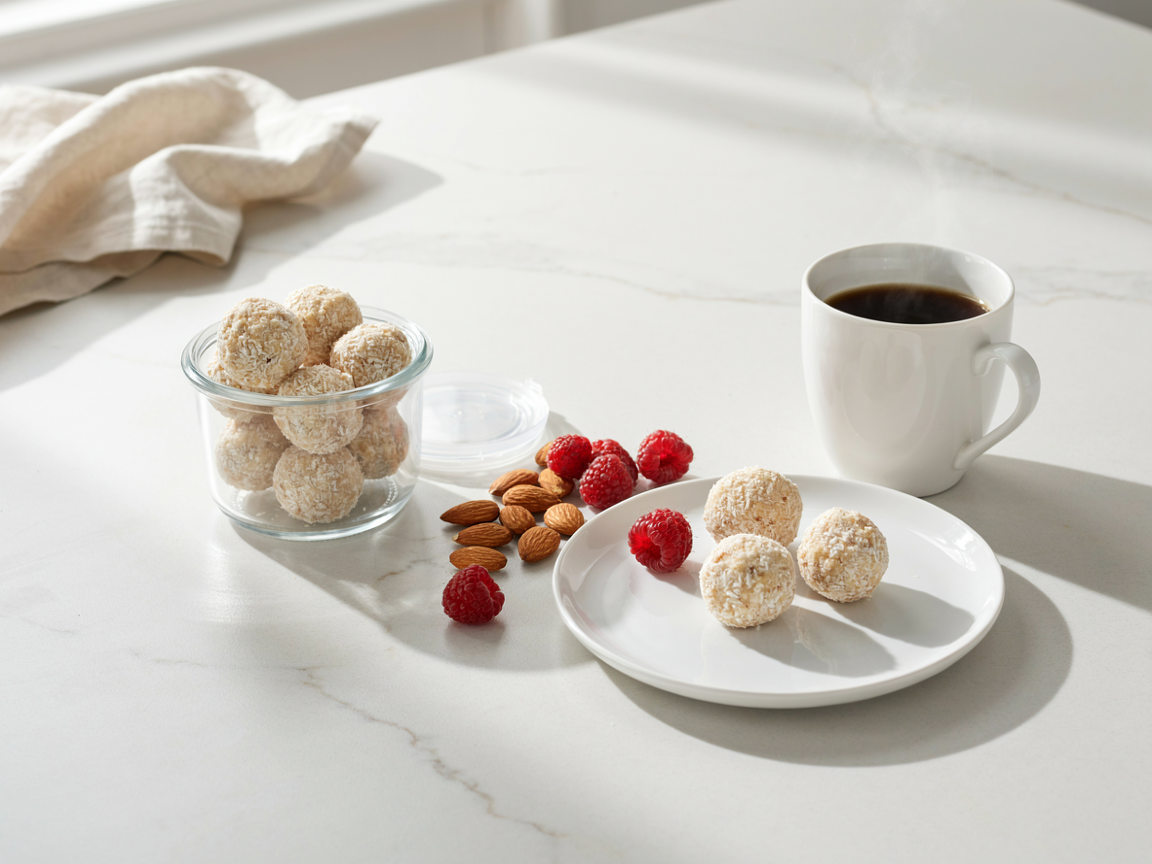
A week of snacks: coconut protein balls in a glass container, three on a plate with black coffee, almonds and raspberries.
| How | How long | |
|---|---|---|
| Fridge | HowAirtight, with parchment between layers | How longUp to 1 week |
| Freezer | HowFrozen on a tray until firm, then bagged | How longUp to 3 months |
| Thaw | How10 minutes on the counter, or eat them frozen | How longThey stay soft enough to bite |
| Room temperature | HowLunchbox or bag; an ice pack in warm weather | How longA few hours |
| Dough, unrolled | HowCovered in the fridge; a splash of milk before rolling | How long2 days |
Meal-Prep Plan
| Plan | Batch | How to split it |
|---|---|---|
| PlanOne a day | Batch12 | How to split itOne container in the fridge for the week |
| PlanTwo a day | Batch24 | How to split it12 in the fridge, 12 frozen for the following week |
| PlanFamily or office | Batch36 | How to split itHalf in the fridge, half frozen on a tray |
| PlanMixed flavors | Batch24 | How to split itSplit the dough in half: one classic, one chocolate |
Snack Ideas
Ways to eat them through the week:
- Two with a mug of black coffee or tea, as on the pin
- In a snack box with cheese cubes, cucumber and a few raspberries
- Beside a jar of chia seed pudding made with coconut milk for a coconut-on-coconut breakfast
- After the gym with one of these smoothies with coconut milk
- On a lunch plate with something from these healthy cottage cheese recipes
- For the non-keto eaters in the house: brownie blended overnight oats
Coconut Protein Balls: FAQs
How do you make coconut protein balls?
Stir 1 cup unsweetened shredded coconut with ⅔ cup (60 g) vanilla protein powder, mix in ½ cup almond butter, then add almond milk a tablespoon at a time until a squeezed handful holds. Roll 12 balls, coat them in more coconut and eat them now or chill 15 minutes.
Are coconut protein balls keto?
As written, yes by the numbers: about 1.5 g net carbs, 11 g fat and 7 g protein a ball, with roughly 75% of the calories from fat. That depends on unsweetened coconut, a low-carb powder and no honey or maple syrup, so check your powder’s label.
How many net carbs are in coconut protein balls?
About 1.5 g a ball: roughly 4 g total carbs minus 2.5 g fiber, with whey isolate and almond butter. Two balls are about 3 g net carbs. Erythritol, allulose and monk fruit are usually left out of the net carb count.
Can you make coconut protein balls without protein powder?
Yes, but they become coconut almond bites. Replace the powder with the same weight of almond flour (60 g, about ½ cup), skip most of the milk and add sweetener and vanilla to taste. Expect about 4 g protein and 2 g net carbs a ball.
What is the best protein powder for protein balls?
A vanilla whey isolate gives the lightest, smoothest ball with the fewest carbs. Casein makes them fudgy, and a pea and rice blend works for dairy-free with extra milk. Choose halal-certified whey or casein if that matters to you; the powder table above compares seven.
How do you make coconut protein balls nut-free?
Use coconut butter instead of almond butter, a nut-free protein powder, and coconut milk beverage or water instead of almond milk. If you are cooking for someone with a nut allergy, check that coconut is safe for them too.
Why are my protein balls crumbly?
There is too little liquid or binder for your powder. Add almond milk a teaspoon at a time, or another tablespoon of almond butter, and squeeze each portion before rolling. Casein and plant powders need noticeably more liquid than whey isolate.
Why do my protein balls taste gritty or chalky?
Usually the powder. Plant blends and some casein are grainy, and powder added straight to nut butter clumps. Stir the powder into the coconut first, rest the dough 5 minutes, use fine coconut and a powdered sweetener, and add a pinch of salt.
Can you freeze coconut protein balls?
Yes, for up to 3 months. Freeze them on a tray until firm, then move them to a freezer bag. Thaw 10 minutes at room temperature or eat them straight from the freezer; they stay soft enough to bite.
How long do coconut protein balls last?
Up to a week in an airtight container in the fridge, and a few hours at room temperature in a lunchbox. Batches made with coconut butter firm up more in the fridge, so let them sit 5 minutes before eating.
What sweetener can I use in protein balls?
Only add one if your powder is unsweetened: 1 to 2 tbsp powdered erythritol or monk fruit blend, a little more powdered allulose, or a few drops of liquid stevia for 12 balls. Use powdered, not granulated, or they taste gritty. Honey and maple syrup work but are not keto.
How many protein balls is a serving?
One or two. Each ball is about 140 calories with 7 g protein and 11 g fat, so two make a filling snack of about 280 calories. Portion them to your own needs.
Do you have to chill protein balls?
No. They hold together as soon as they are rolled and taste soft and fudgy. Fifteen minutes in the fridge firms them for the clean bite on the pin and makes them easier to pack.
Are coconut protein balls gluten-free?
Coconut, almond butter and almond milk are naturally gluten-free. Some protein powders contain gluten-based additives or are made alongside gluten, so look for a gluten-free label on the powder if it matters.
Save the pin so the recipe, the macro table and the six flavors are one tap away on meal-prep day.
More Protein Balls and Snacks
Two more protein balls, a no-bake treat, grab-and-go snacks, a coconut cake and a week of meal prep.
Herbalife Protein Balls
Oats, peanut butter and a scoop of shake mix. See the recipe → Five IngredientsProtein Balls With Flax Seed
Oats, flax and peanut butter, no oven. See the recipe → No-Bake TreatNo-Bake Pecan Pie Balls
Pecan pie, rolled into a bite. See the recipe → Grab and GoHigh-Protein Snacks on the Go
For the bag, the car and the desk. See the list → More CoconutSugar-Free Coconut Cake
Coconut, baked into a whole cake. See the recipe → Meal PrepHigh-Protein, Low-Carb Meal Prep
The rest of the week, planned. See the plan →Coconut, powder, almond butter, a splash of milk and a roll through more coconut. Five minutes, twelve snacks, a week in the fridge.
Pin these coconut protein balls for your next meal-prep day.
