
No Bake · 4 Ingredients · Nut-Free and No-Powder Versions
Banana Protein Balls: No-Bake, 4 Ingredients, and 6 Ways to Make Them
One banana, oats, nut butter and protein powder — plus the versions people actually search for: without peanut butter, with peanut butter powder, with no protein powder at all, and double chocolate.
- 5 minutes, no oven
- ~9g protein a ball
- 6 variations
- Printable card
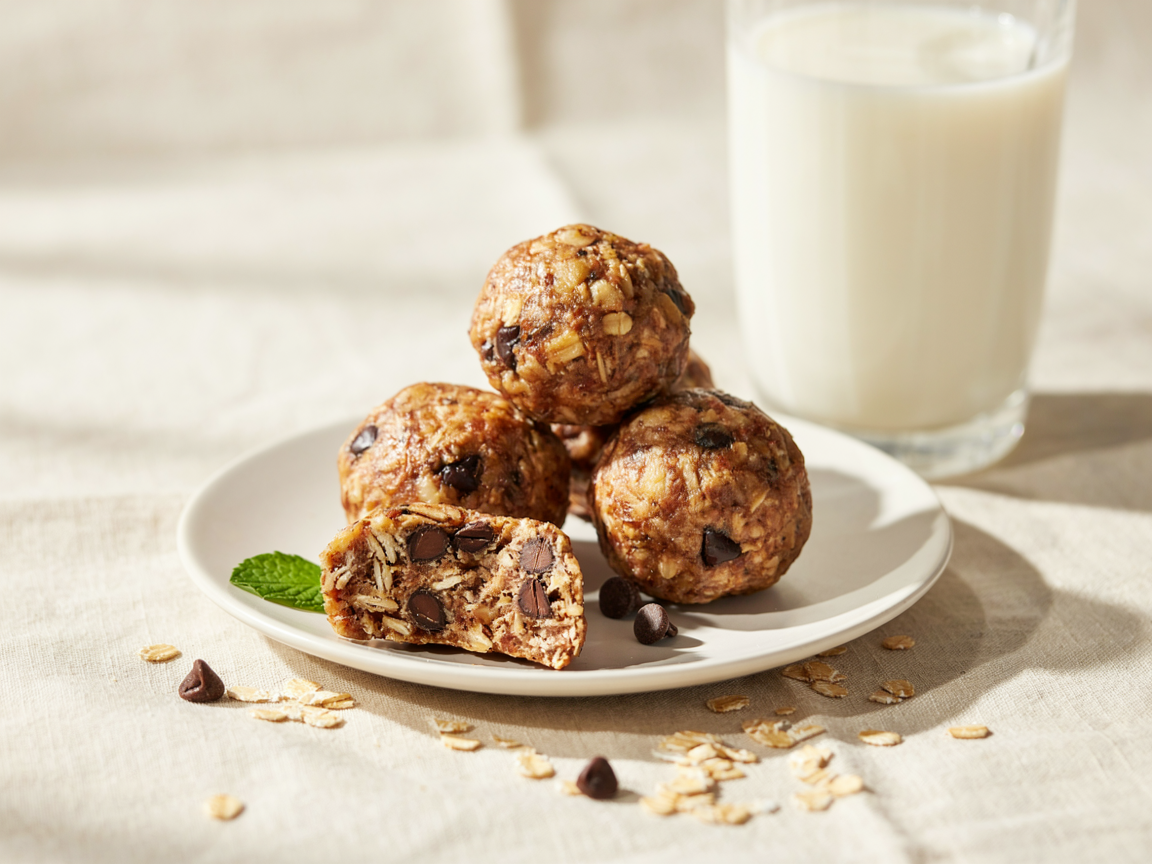
A tablespoon of mixture each, rolled with damp hands, chilled on a lined tray.
Banana protein balls are the easiest no-bake snack there is and also the one most likely to end up as a bowl of sticky mixture you cannot roll. There is one reason for that, and it has nothing to do with the recipe you followed.
A banana is about three quarters water. Most protein ball recipes are built on dates, which are sticky and dry. Swap in banana and the balance changes completely — which is why the chilling step below is not optional advice, it is the recipe.
The Four Ingredients, and What Each One Does
Everything else on this page is a substitution for one of these four. Knowing what each is doing is what lets you swap any of them without the batch falling apart.
The banana — sweetness and moisture
One large, well-spotted banana per batch. It is the only sweetener the recipe needs and it is also the reason the mixture behaves the way it does. Under-ripe bananas taste of nothing and add water without adding sugar.
The oats — structure
Rolled oats, one cup per banana. They are not filler; they are the thing absorbing all that water and turning a wet mixture into something rollable. Quick oats work and make a smoother ball; steel-cut oats do not work at all.
The nut butter — the glue
Half a cup per banana. It binds, it adds fat, and fat is what makes a snack satisfying rather than just sweet. Any nut or seed butter works, and peanut butter powder works with an adjustment.
The protein powder — the point
A third of a cup per banana, which puts each ball at around 9g. It also absorbs liquid, and different powders absorb wildly different amounts — which is covered in its own table below.
1 banana + 1 cup oats + ½ cup nut butter + ⅓ cup protein
Twelve balls. If you change one of the four, change the oats to match — they are the part doing the absorbing.
Banana Protein Balls Recipe
No-Bake Banana Protein Balls
Mashed banana, oats, nut butter and protein powder, chilled before rolling so they actually hold their shape.
How many balls?
Ingredients
- 1 large2 large3 large4 large ripe banana, well mashed
- 1 cup2 cups3 cups4 cups rolled oats
- ½ cup1 cup1½ cups2 cups peanut butter, or any nut or seed butter
- ⅓ cup⅔ cup1 cup1⅓ cups vanilla protein powder
- 1 tbsp2 tbsp3 tbsp¼ cup honey or maple syrup
- ¼ tsp½ tsp¾ tsp1 tsp ground cinnamon
- pinch⅛ tsp¼ tsp¼ tsp fine salt
- 2 tbsp¼ cup6 tbsp½ cup mini chocolate chips
Instructions
Mash the banana until it is almost liquid
Use a banana with brown spots on it and mash it with a fork until only tiny lumps remain. Lumps of banana are soft pockets in a finished ball — they never firm up, and they are why a batch sometimes falls apart in one spot and holds everywhere else. One large banana gives you about half a cup mashed.
Stir the wet ingredients together first
Beat the mashed banana, the nut or seed butter and the honey together until completely smooth before anything dry goes in. If the nut butter is stiff from the refrigerator, warm it for 15 seconds so it blends properly — cold nut butter stays in ribbons and you end up overworking the mixture trying to break it up.
Add the oats and protein powder and stop mixing early
Tip in the oats, the protein powder, the cinnamon and the salt and fold until you no longer see dry powder. It will look far too wet at this stage and that is correct. Do not add more oats now, however tempting it is — the oats have not had time to absorb anything yet.
Chill the mixture for 20 minutes before you roll anything
This is the step that makes or breaks the batch. Twenty minutes in the refrigerator lets the oats drink up the banana’s water and lets the nut butter firm up, and a mixture that was unrollable comes out scoopable. Rolling straight away is the single most common reason banana protein balls do not hold together.
Roll with slightly damp hands
A tablespoon of mixture per ball, rolled between palms rinsed under cold water and shaken dry. Damp hands stop the mixture sticking to you instead of to itself. Re-wet your hands every five or six balls.
Firm them up properly before anyone eats one
Thirty minutes in the refrigerator on a lined tray, or ten in the freezer if you are impatient. They hold their shape from the moment they are cold and they keep getting firmer over the first few hours.
Roughly, per ball
Made with peanut butter powder instead of peanut butter, the same ball comes to roughly 60 calories with about 7g of protein.
This is an estimate, not a lab analysis. Which protein powder you use moves it more than anything else.
Why Banana Protein Balls Won’t Hold Together
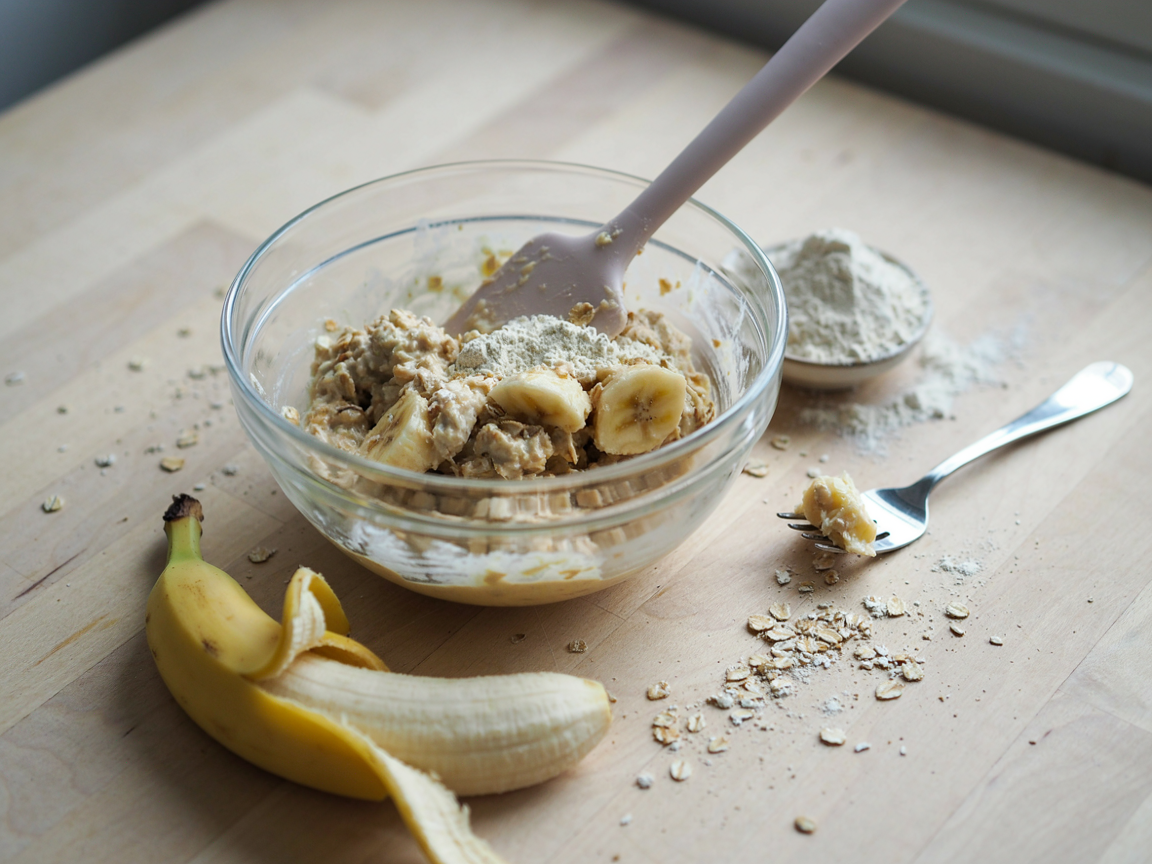
It is supposed to look too wet at this stage. Chill it before you judge it.
This is the question behind almost every complaint about this recipe, and the answer is the same every time.
A banana is about three quarters water
That is the whole problem in one sentence. Dates, which most protein ball recipes are built on, are sticky and dry; banana is wet and slippery. Any recipe that treats them as interchangeable produces a mixture that will not hold.
Chill before rolling, not after
Twenty minutes in the refrigerator lets the oats absorb that water. Rolling immediately means the oats absorb it later, in your hand, on the tray, which is when balls slump and flatten.
The ratio to hold on to
Two parts oats to one part nut butter by volume, per banana. If you change one, change the other. Most failed batches are short on oats because the mixture looked wet and the cook added more banana instead.
Fix it wet, fix it dry
Too wet after chilling: oats, 2 tablespoons at a time, then chill 10 more minutes. Too dry and cracking: milk or water, 1 teaspoon at a time. Never fix wetness with more protein powder — it makes them chalky long before it makes them firm.
The test for whether the mixture is ready: squeeze a tablespoon of it in your fist. If it holds its shape when you open your hand, roll. If it slumps, give it another ten minutes in the refrigerator before you add anything to it at all.
Six Ways to Make Them
Same method every time — pick your version:
Nut-free, no peanut butter
Swap the peanut butter for sunflower seed butter or tahini, measure for measure. Both behave almost identically in the mixture; tahini is looser, so add 2 extra tablespoons of oats. If you are avoiding seed butters as well, see the section below — you can make these with no butter of any kind.
Peanut butter powder instead
Use ⅓ cup of peanut butter powder whisked to a paste with 3 tablespoons of water, in place of the ½ cup of peanut butter. It cuts roughly 700 calories and 75g of fat from a 12-ball batch and keeps the peanut flavour. The mixture comes out drier, so add liquid a teaspoon at a time until it holds.
Extra oats, higher fibre
Take the oats to 1½ cups per banana and blend half of them into a rough flour first. The blended half binds the mixture and the whole half keeps the texture, so you get a firmer ball without it tasting like a bowl of porridge.
No protein powder at all
Replace the ⅓ cup of protein powder with ½ cup of oat flour plus 2 tablespoons of ground flaxseed. You lose the protein claim but these hold together better than any version on this page, and the flax adds a genuinely useful amount of fibre.
Double chocolate
Chocolate protein powder, 2 tablespoons of cocoa powder and a generous ¼ cup of mini chocolate chips per banana. Cocoa is very drying, so add 1 extra tablespoon of liquid or the mixture will crack rather than roll.
Strawberry banana
3 tablespoons of freeze-dried strawberry powder per banana, blitzed from freeze-dried berries. Do not use fresh or frozen strawberries — they carry far too much water and the mixture will never firm up.
Making Them Without Peanut Butter or Nuts
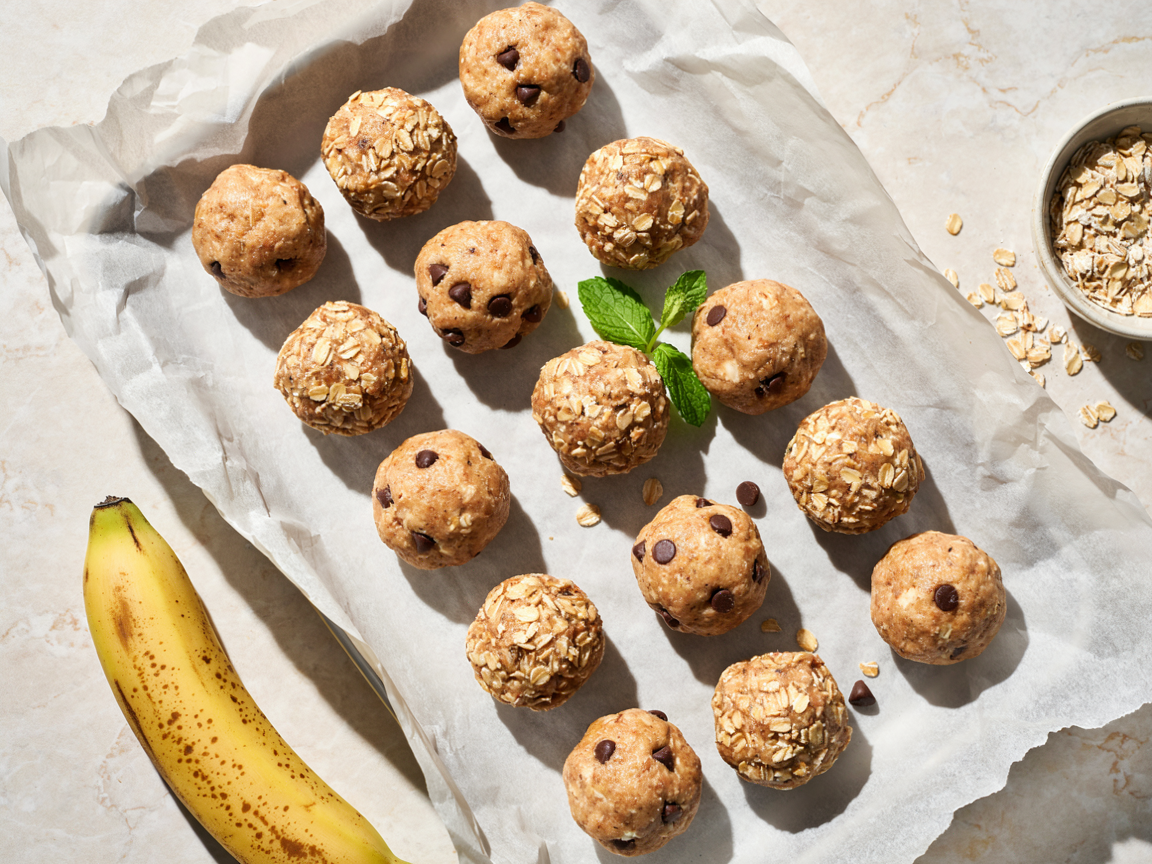
Broken open, the texture should be close and slightly chewy rather than crumbly.
This is the most-asked version and it deserves more than a line in a substitution list, because there are two different questions hiding inside it.
If you just want no peanuts
Almond, cashew or sunflower seed butter, measure for measure. Sunflower seed butter is the closest match in both texture and price, and it is the one that works in a nut-free school lunchbox. Tahini works too but is looser, so add 2 extra tablespoons of oats.
If you want no butter at all
Use 1 banana to 1¼ cups oats and ⅓ cup protein powder, with 2 to 3 tablespoons of milk or water to bring it together. Chill 30 minutes rather than 20. The result is lighter and more fragile, and needs to stay refrigerated.
What you lose, and how to get it back
Nut butter is fat, and fat is what makes a protein ball satisfying rather than merely filling. Without it, add 2 tablespoons of ground flaxseed or chia per banana — not the same thing, but it restores some richness and a lot of fibre.
The one-banana batch
A single banana makes twelve balls, which is a week of one-a-day or two days of snacking. Use the 12-ball column in the card above. There is no minimum batch size here — the mixture scales down perfectly.
Protein Powder, PB Powder, or None
The powder you use changes how much liquid the mixture needs, and it is the difference between a batch that rolls and a batch that cracks.
| What you use | Per banana | What changes |
|---|---|---|
| What you useWhey, vanilla | Per banana⅓ cup | What changesThe softest result. Whey absorbs the least liquid of any powder, so chill the mixture the full 20 minutes |
| What you useCasein, or a whey-casein blend | Per banana⅓ cup | What changesThickens the mixture noticeably. Add 1 to 2 tbsp of milk or water |
| What you usePlant protein — pea, rice, hemp | Per banana⅓ cup | What changesVery absorbent and drying. Add 2 to 3 tbsp liquid and expect a slightly grainier ball |
| What you usePeanut butter powder | Per banana⅓ cup + 3 tbsp water | What changesAbout 7g of protein and a fraction of the fat. Mix it to a paste with the water first |
| What you useCollagen peptides | Per banana⅓ cup | What changesDissolves completely and adds no structure at all, so add 2 extra tbsp of oats to compensate |
| What you useNone — oat flour and flax | Per banana½ cup oat flour + 2 tbsp ground flax | What changesNot a high-protein ball, but it holds together better than any of the above |
If you are buying a powder specifically for these: a vanilla whey or whey blend is the most forgiving, because it absorbs the least and is hardest to make chalky. Plant proteins work perfectly well but need the extra liquid, and nobody tells you that on the tub.
Storing Them
Pick where they are going:
In the refrigerator
Up to 5 days in a sealed container, and they firm up over the first few hours rather than drying out. Layer them with parchment if you are stacking, because banana makes the surface slightly tacky.
In the freezer
Up to 3 months. Freeze them uncovered on a tray until solid, then bag them so they do not fuse into a block. They thaw in about 20 minutes and are very good eaten half-frozen.
In a lunchbox or a gym bag
They are fine out of the refrigerator for about 4 hours, longer if the day is cool. Beyond that the banana softens them. An ice pack in the bag buys the whole day.
As mixture, not balls
The mixture itself keeps 3 days covered in the refrigerator and rolls better on day two than on day one. Useful if you would rather roll a few fresh each morning than commit to a whole tray.
Questions, Answered
Can you make banana protein balls with no peanuts or nuts at all?
Yes, two ways. The simple swap is sunflower seed butter or tahini in place of the peanut butter, measure for measure. If you want no butter of any kind, use 1 banana to 1¼ cups of oats and ⅓ cup of protein powder, with 2 to 3 tablespoons of milk or water to bring it together. They are lighter and slightly more fragile than the nut butter version, so chill them for a full 30 minutes before rolling and keep them refrigerated.
Can I make protein balls without protein powder?
Yes. Replace the ⅓ cup of protein powder with ½ cup of oat flour plus 2 tablespoons of ground flaxseed and change nothing else. They will not be high in protein — you are down to whatever the oats and nut butter provide, roughly 4g a ball — but they hold together better than any powdered version. Peanut butter powder is the middle road if you want some protein back without buying a tub.
Why are my banana protein balls too sticky to roll?
Because the oats have not absorbed the banana’s water yet. Chill the mixture 20 minutes before you touch it, and roll with hands rinsed under cold water. If it is still sticky after chilling, work in oats two tablespoons at a time and give it another ten minutes in the refrigerator. Adding more protein powder makes them chalky long before it makes them firm.
Can I use peanut butter powder instead of peanut butter?
Yes, and it is the single biggest calorie saving available here. Use ⅓ cup of peanut butter powder mixed to a paste with 3 tablespoons of water in place of ½ cup of peanut butter — that is roughly 700 calories and 75g of fat out of a 12-ball batch. The mixture will be drier, so add liquid a teaspoon at a time until it just holds when squeezed.
Do banana protein balls need oats?
In this version, yes — the oats are what absorb the banana’s water and give the ball its structure. If you cannot eat oats, quinoa flakes behave almost identically, and unsweetened desiccated coconut works at about three quarters of the volume. Oat flour alone makes a denser, more cake-like ball that still holds.
How long do they keep?
Five days in the refrigerator, three months in the freezer, and about four hours in a bag at room temperature before the banana starts to soften them. They are noticeably better on day two than on the day you make them, because the oats finish absorbing and the cinnamon settles in.
Can I put fresh strawberries or other fresh fruit in them?
No, and this is the most common way a batch is ruined. Fresh and frozen fruit carry a lot of water, and the mixture will never firm up no matter how long you chill it. Freeze-dried fruit crushed to a powder gives you the same flavour with none of the water — 3 tablespoons per banana is about right.
Mash the banana properly, keep the oats to nut butter ratio, and chill the mixture before you roll rather than after. Nothing else about this recipe is difficult.
Pin these banana protein balls so the six variations and the powder chart are there the next time you have one sad banana on the counter.