
Ceramic vs Nonstick Pans: Which One Should You Buy?
Ceramic vs nonstick pans compared on coating, heat, oven limits, weight and how long the slick surface lasts, with three picks of each.
Best ceramic: GreenPan Valencia Pro. Best traditional nonstick: All-Clad HA1. Best budget nonstick: T-fal Ultimate. Best-looking: Caraway.
Both release a fried egg easily when new. Ceramic is made without PTFE and takes more oven heat; traditional nonstick usually stays slick for longer.
Choose ceramic, such as the GreenPan Valencia Pro, for a PTFE-free, lighter pan that goes into a hotter oven, and keep the heat at low to medium. Choose traditional nonstick, such as the All-Clad HA1, for the longest-lasting slick surface for eggs and fish.
The chart, the heat facts and six picks are below.
Product links go to Amazon. As an Amazon Associate, Kitchen Guide 101 earns from qualifying purchases.
Ceramic and Nonstick Pans Compared
All 6 side by side. Tap any name to see it on Amazon.
| Pan | Coating | Body | Oven-safe to | Best for | Price |
|---|---|---|---|---|---|
| GreenPan Valencia Pro 10″ Ceramic Nonstick Frying Pan | Ceramic | Hard-anodized, induction base | 600°F (lids 425°F) | Ceramic for most kitchens | $$ |
| OXO Enhanced 10″ Ceramic Nonstick Frying Pan | Ceramic | Hard-anodized | 430°F | Gas and electric stoves | $$ |
| Caraway Non-Stick Ceramic Frying Pan, 10.5″ | Ceramic | Induction-ready | 550°F | A pan that stays out on the stove | $$$ |
| All-Clad HA1 Hard Anodized Nonstick Fry Pan | PTFE nonstick | Hard-anodized, stainless base | 500°F | Nonstick that lasts for years | $$$ |
| T-fal Ultimate Hard Anodized Nonstick Fry Pan | PTFE nonstick | Hard-anodized | 400°F | Everyday eggs | $ |
| Calphalon Classic Nonstick Fry Pan | PTFE nonstick | Hard-anodized aluminum | 450°F | Families cooking every day | $$ |
Details are as stated on each Amazon listing at time of writing and can change. Price tiers: $ lowest in this group · $$ middle · $$$ highest.
3 Ceramic Pans and 3 Nonstick Pans, Reviewed
Details come from each listing, with America’s Test Kitchen results where noted.
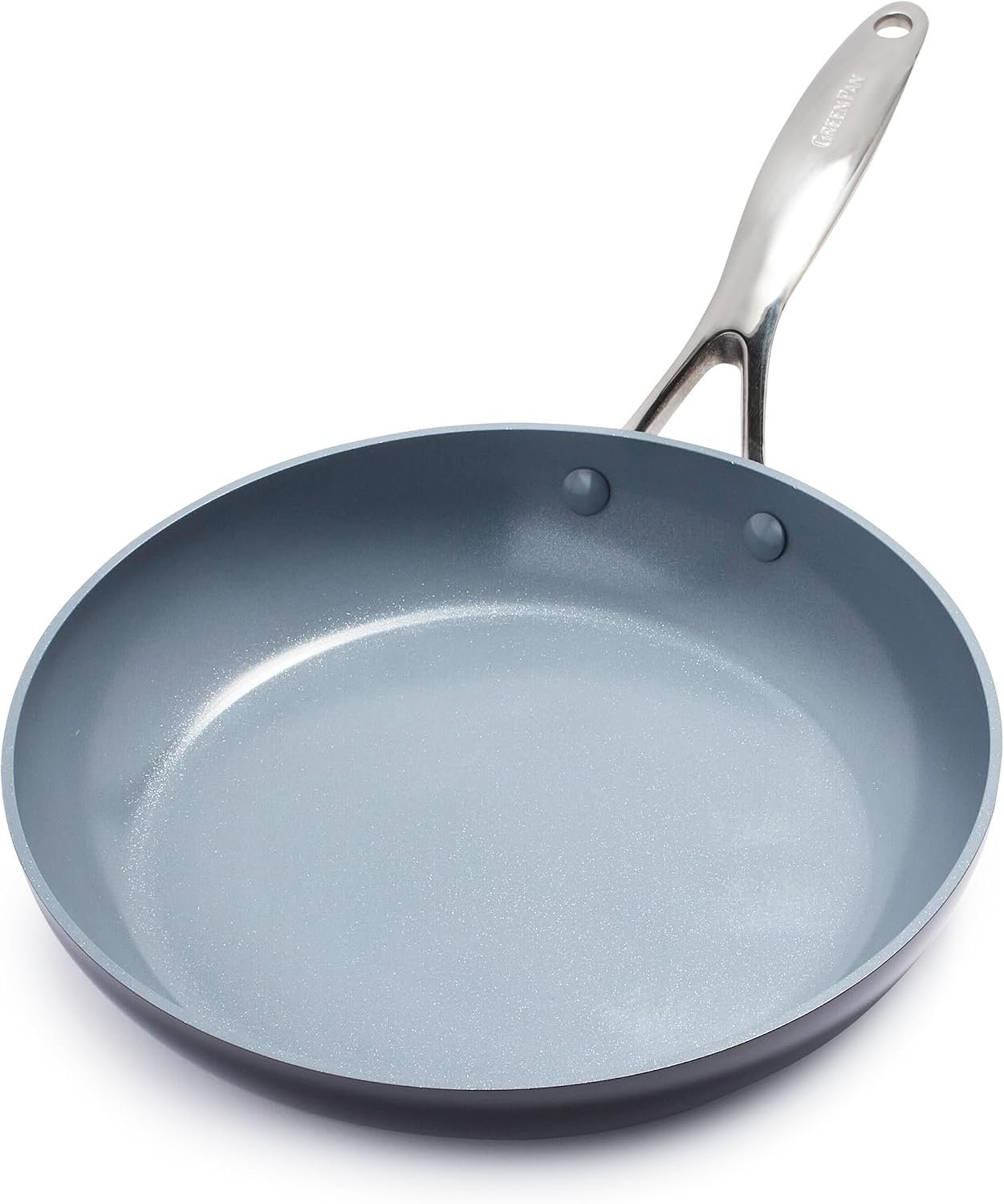
GreenPan Valencia Pro 10″ Ceramic Nonstick Frying Pan
America’s Test Kitchen named the 12-inch Valencia Pro its top ceramic skillet in August 2026 and highly recommends this 10-inch size. It was one of only three pans to pass ATK’s coating-durability test.
The coating is made without PFAS, PFOA, lead or cadmium, the base works on induction, and it is oven-safe to 600°F (lids to 425°F). ATK notes it runs hotter than traditional nonstick, so turn the heat down a notch.
- Passed ATK’s durability test
- Works on induction
- Highest oven limit here
- Runs hot, so lower the heat
- Middle price tier
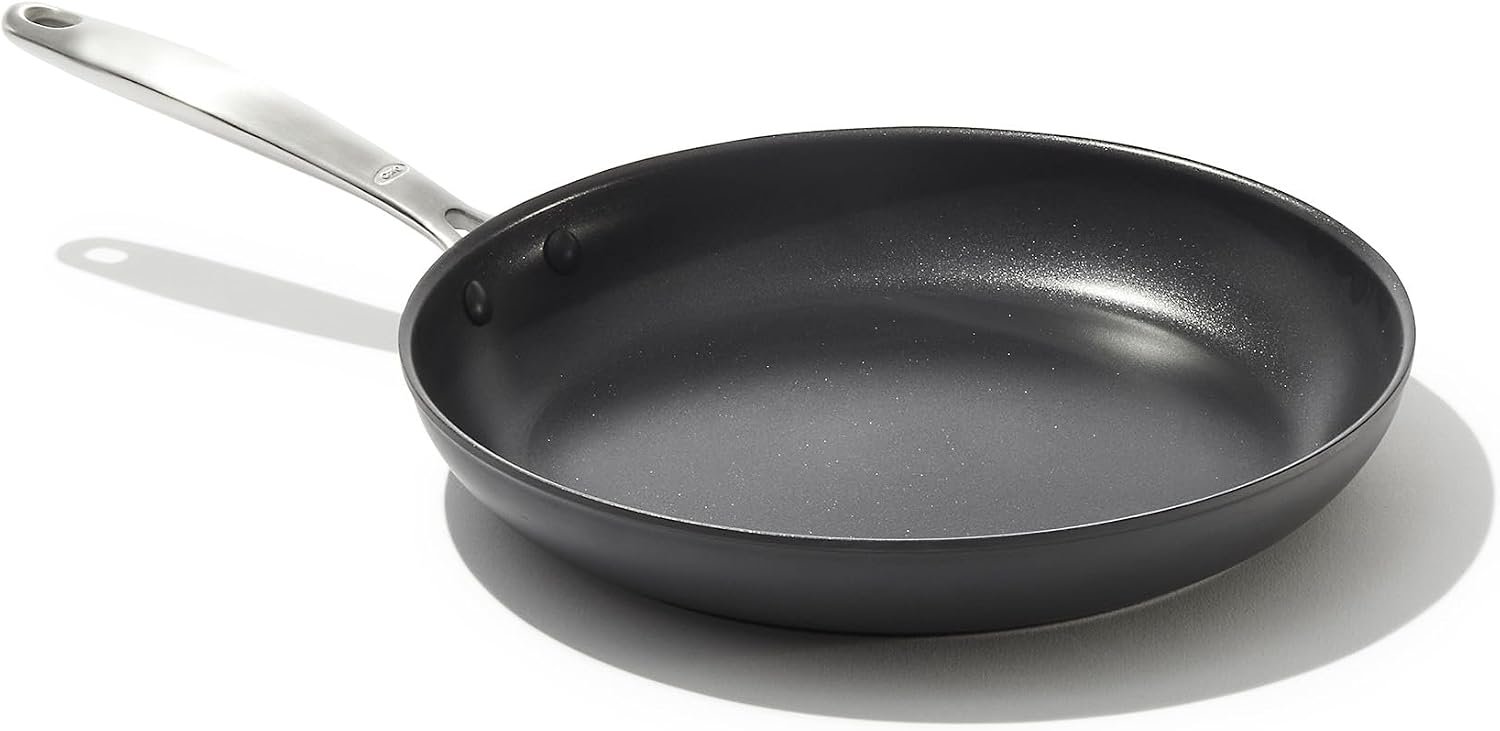
OXO Enhanced 10″ Ceramic Nonstick Frying Pan
America’s Test Kitchen recommends the Enhanced line as lightweight and durable. The diamond-reinforced ceramic coating is free of PFAS, PFOA, lead and cadmium.
It is dishwasher-safe and oven-safe to 430°F, but ATK notes it does not work on induction.
- Recommended by ATK
- Light to lift
- Dishwasher-safe
- Not for induction
- Lower oven limit
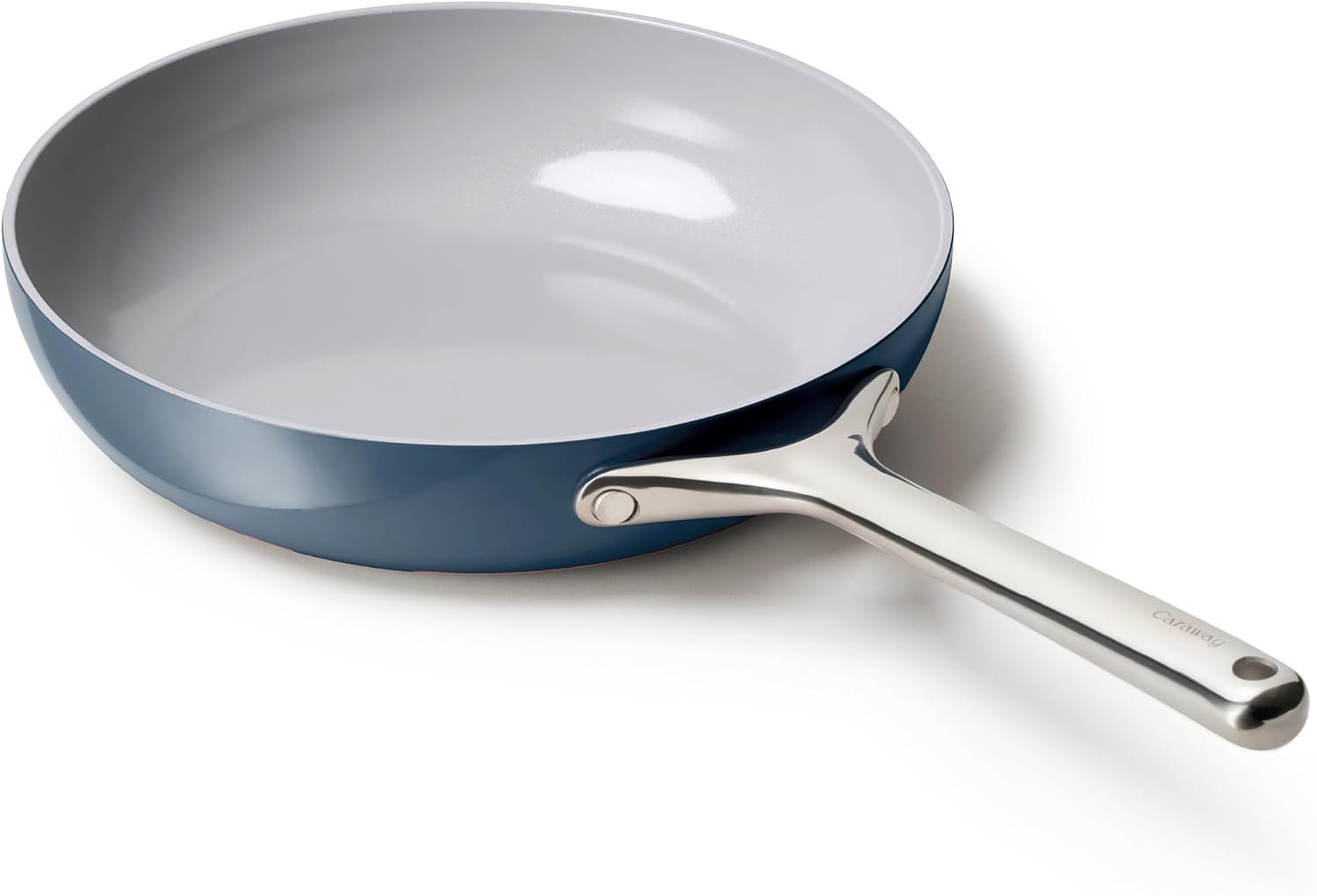
Caraway Non-Stick Ceramic Frying Pan, 10.5″
The pan that made ceramic cookware look good, in eight colors from navy to marigold. Its coating is free of PTFE, PFOA, PFAS, lead and cadmium, and it works on gas, electric and induction.
Caraway recommends low to medium heat with a little oil or butter. It is oven-safe to 550°F.
- Eight colors
- Works on induction
- Oven-safe to 550°F
- Top price tier
- Best kept to low and medium heat
All-Clad HA1 Hard Anodized Nonstick Fry Pan
A heavy, even-heating pan in 8, 10 and 12 inch sizes. It handles a sear as well as eggs and crepes, and it is oven-safe to 500°F.
It is labeled dishwasher-safe, but hand washing keeps the coating slick for longer.
- Solid, even heat
- Three sizes
- Highest oven limit of the three
- Top price tier
- Hand washing recommended
T-fal Ultimate Hard Anodized Nonstick Fry Pan
A long-time favorite in 8, 10 and 12 inch sizes. The Thermo-Spot heat indicator takes the guesswork out of preheating.
The coating resists scratches better than most pans at this price tier. It is dishwasher-safe and oven-safe to 400°F.
- Lowest price tier here
- Preheat indicator
- Scratch-resistant coating
- Lowest oven limit here
- Not for metal utensils
Calphalon Classic Nonstick Fry Pan
A hard-anodized pan in 8, 10 and 12 inch sizes. Its long stainless handles stay cool on the stove, and it is oven-safe to 450°F.
It balances durability and comfort for daily cooking.
- Stay-cool handles
- Oven-safe to 450°F
- Three sizes
- Not for metal utensils
- Coating wears with years of use
Ceramic vs Nonstick: Side by Side
| Ceramic nonstick | Traditional nonstick | |
|---|---|---|
| The coating | A sand-derived (silica) coating, made without PTFE | PTFE (polytetrafluoroethylene), the coating behind Teflon |
| On the stove | Heats fast and stays hot, so use low to medium heat | Heats more slowly; low to medium heat |
| Heat limit | High heat wears the coating faster | Can break down above 500°F; ATK says never go past 450°F |
| Oven-safe | Usually 400 to 600°F | Usually 400 to 500°F |
| Skillet weight | About 1.5 to 2.5 lb | About 2.5 to 3.5 lb |
| How the slick surface fades | More brittle; tiny cracks start to grab food | Wears away slowly with use |
| Care | Hand wash, no cooking spray, soft tools | Hand wash, soft tools |
| Best for | PTFE-free cooking, oven finishing, a lighter pan | Eggs, fish and crepes, with the longest slick life |
Coating, heat, oven and weight ranges from America’s Test Kitchen. Check each listing for your pan’s own limits.
Which Lasts Longer, Ceramic or Nonstick?
Traditional nonstick usually keeps its slick surface longer. America’s Test Kitchen describes ceramic as more brittle: over time, tiny cracks form and food starts to grab. A PTFE coating wears away more slowly and cannot be replaced either.
Coatings differ a lot by brand. The GreenPan Valencia Pro was one of only three pans to pass ATK’s coating-durability test, and a good traditional nonstick pan often lasts 3 to 5 years with care.
Keep the heat down
Low to medium heat is the biggest single help for both coatings.
Skip cooking spray
Spray leaves a film that builds up and makes ceramic sticky.
Use soft tools
Wood, silicone or nylon protect either surface.
Let it cool first
Cold water on a hot pan stresses the coating.
Hand wash
Even pans labeled dishwasher-safe last longer washed by hand.
Stack with a protector
A cloth or pad between pans stops rim scratches.
Step-by-step care is in how to clean ceramic pans.
Who Should Buy Which?
Buy ceramic to avoid PTFE
Ceramic coatings are made without PTFE.
Buy ceramic to finish in the oven
Several ceramic pans go to 550 or 600°F.
Buy ceramic for a lighter pan
Ceramic skillets often weigh about a pound less.
Buy nonstick for the longest slick life
A traditional coating usually stays slick longer.
Buy nonstick for delicate food
Eggs, fish and crepes release easily.
Buy either for low and medium heat
Neither coating is made for very high heat.
Want a full set? See the best ceramic cookware sets and the cookware set deals.
What to Check Before You Buy
Five things to check.
Ceramic or PTFE
Ceramic is made without PTFE.
Induction base
Not every pan has one, so check the listing.
Oven-safe temperature
From 400 to 600°F, depending on the pan.
How it feels to lift
Ceramic skillets are often lighter.
Dishwasher label
Hand washing keeps any coating going longer.
More cookware guides: ceramic vs carbon steel cookware, induction-safe cookware sets, pan protectors for stacking and the best spatulas.
Ceramic vs Nonstick FAQs
Is ceramic better than nonstick?▼
It depends on what matters most to you. Ceramic is made without PTFE, weighs less and takes more oven heat. Traditional nonstick usually stays slick for longer.
Is ceramic cookware nonstick?▼
Yes. Ceramic is a nonstick coating made without PTFE. “Nonstick” on its own usually means a PTFE-coated pan.
Which lasts longer, ceramic or nonstick?▼
Traditional nonstick, as a rule. America’s Test Kitchen describes ceramic as more brittle, though the GreenPan Valencia Pro passed its coating-durability test.
How hot can a nonstick pan get?▼
ATK says never go past 450°F. PTFE can break down and give off fumes above 500°F, so keep the burner at low to medium.
Can ceramic pans go in the oven?▼
Most can, usually to 400 to 600°F. The OXO Enhanced goes to 430°F, the Caraway to 550°F and the GreenPan Valencia Pro to 600°F.
Do ceramic pans work on induction?▼
Only with a magnetic base. The GreenPan Valencia Pro and Caraway do; ATK notes the OXO Enhanced does not.
Why does food stick to my ceramic pan?▼
Usually a film from cooking spray, or heat set too high. A baking soda clean removes the film. Cook with a little oil or butter instead of spray.
Can I use metal utensils?▼
Use wood, silicone or nylon on both. GreenPan says the Valencia Pro is metal-utensil safe, but softer tools still help any coating last.
The Bottom Line
- Ceramic for most kitchens: the GreenPan Valencia Pro.
- Light ceramic for gas or electric: the OXO Enhanced.
- Ceramic that looks good on the stove: the Caraway.
- Nonstick for years: the All-Clad HA1; on a budget: the T-fal Ultimate.
- Everyday family pan: the Calphalon Classic.
Ceramic to avoid PTFE and finish in the oven; traditional nonstick for the longest-lasting slick surface.