
No Bake · 8 Flavours · 15 Minutes
Cottage Cheese Protein Balls: 8 Flavours, and the One Step Nobody Skips Twice
Blend the cottage cheese completely smooth and nobody can tell it is in there. Leave a single curd and everybody can.
- ~6g protein a ball
- 4 batch sizes
- No baking
- Freezes 3 months
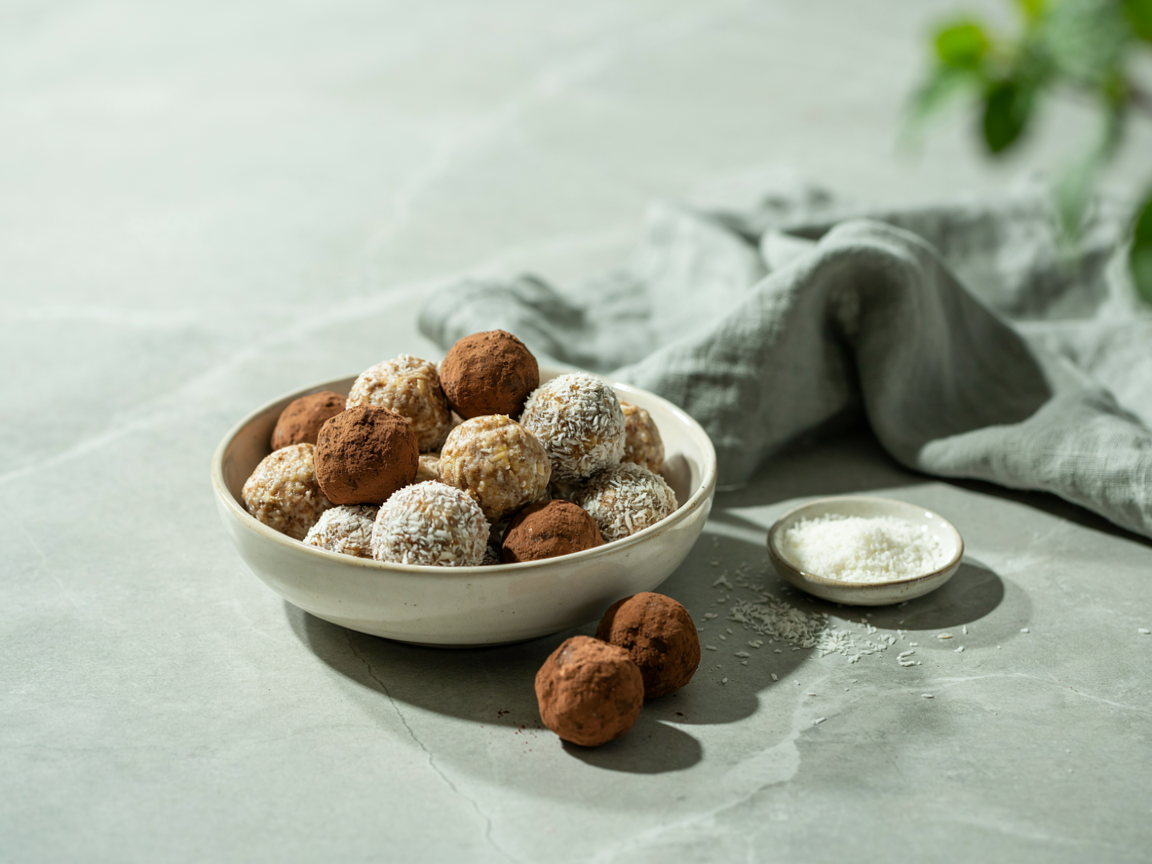
Fifteen minutes of work, most of which is waiting for the dough to chill.
Cottage cheese protein balls are the cheapest high-protein snack you can make at home, and the reason people give up on them is always the same: they can taste the cottage cheese. That is not a flavour problem, it is a texture one, and it is solved in sixty seconds with a blender.
What follows is the base dough, the ratio that makes it work with any protein powder, eight flavours built on the same recipe, and the fixes for sticky, dry and chalky — the three ways this goes wrong.
Why Cottage Cheese Makes a Better Protein Ball
Most no-bake protein balls are oats, nut butter and syrup held together with a scoop of powder. Cottage cheese changes the arithmetic, because it brings protein and moisture at the same time.
Protein without dryness
A scoop of powder adds protein and takes moisture out. Cottage cheese adds roughly 24g of protein a cup while putting moisture back in, which is why these stay soft rather than turning into chalk.
Slow-digesting casein
Most of the protein in cottage cheese is casein, which digests slowly and keeps you full for longer than the same amount of whey. That is the practical reason it works well as an afternoon snack.
It costs very little
A tub of cottage cheese is among the cheapest protein in the shop by a wide margin. A full batch of twelve works out at a fraction of the cost of any bought protein snack.
It carries flavour well
Blended cottage cheese is mild and faintly tangy, which is close to a cheesecake base. That neutrality is why the same dough works for lemon, chocolate, cinnamon and coffee without fighting any of them.
The honest trade-off: these must live in the refrigerator. A cottage cheese ball is not a lunchbox snack that sits out all morning the way an oat-and-date ball is. In exchange you get a softer, creamier texture and noticeably more protein for the same calories, which for most people is the better deal.
The Blending Step, and Why It Decides Everything
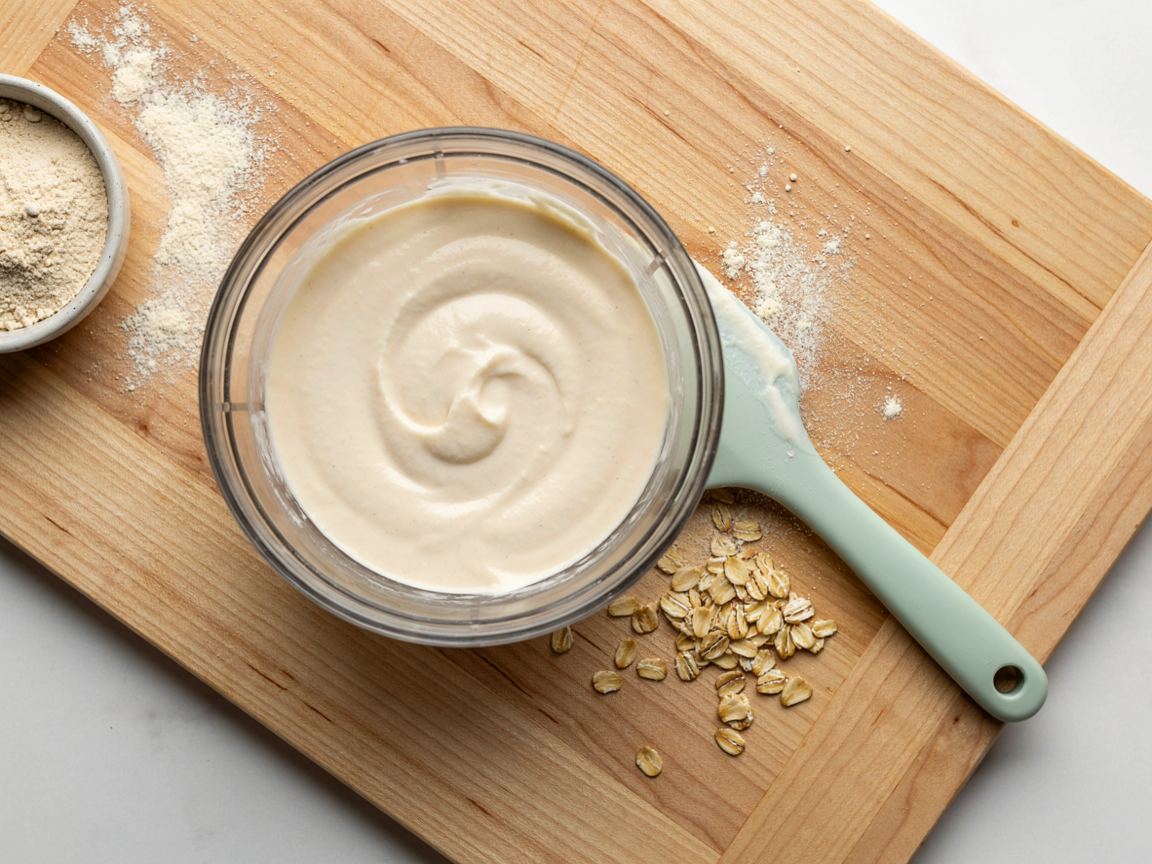
This is the target. If you can still see curds, it is not done.
Cottage cheese is curds suspended in cream. The curds are what people taste and feel, and they do not break down during mixing — stirring simply moves them around, which is why a dough that looked fine in the bowl produces balls that are unmistakably cottage cheese.
Blend it alone, first
Cottage cheese on its own, nothing else in the bowl. Adding oats or powder at the same time thickens the mixture so much that the blades stop catching the curds.
A full 60 seconds
Most people stop at twenty and call it smooth. Run it for a minute, scrape down halfway, and run it again. It should look like thick Greek yogurt with no texture at all.
Small bowl, big difference
A one-cup food processor or a bullet blender works far better than a full-size jug, where a single cup sits below the blades and never circulates properly.
No blender? Use a sieve
Press the cottage cheese through a fine mesh sieve with a spatula. It takes about four minutes and your arm will know about it, but the result is just as smooth.
Cottage Cheese Protein Balls Recipe
No-Bake Cottage Cheese Protein Balls
Cottage cheese blended completely smooth, bound with oat flour and nut butter, chilled twice and rolled.
How many balls?
Ingredients
- 1 cup1½ cups2 cups3 cups cottage cheese, blended completely smooth (2% or 4%)
- 1 scoop (30g)1½ scoops2 scoops (60g)3 scoops vanilla or unflavoured whey protein powder
- ¾ cup1⅛ cups1½ cups2¼ cups rolled oats, pulsed to a coarse flour
- 3 tbsp¼ cup + 1 tbsp6 tbsp½ cup + 1 tbsp smooth nut butter (almond, peanut or cashew)
- 2 tbsp3 tbsp¼ cup6 tbsp honey or maple syrup
- 1 tsp1½ tsp2 tsp1 tbsp vanilla extract
- a pincha pinch¼ tsp½ tsp fine salt
- 3 tbsp¼ cup6 tbsp½ cup + 1 tbsp mini chocolate chips or add-ins, optional
Instructions
Blend the cottage cheese until it is completely smooth
Put the cottage cheese alone into a small blender or food processor and run it for a full 60 seconds, scraping down once. It should look like thick Greek yogurt with no visible curds at all. This is the only step that genuinely cannot be skipped — every complaint about grainy protein balls that taste of cottage cheese traces back to curds that were never broken down.
Blitz the oats into a coarse flour
Pulse the rolled oats 10 to 15 times until they look like coarse flour with a few larger pieces left for texture. Whole rolled oats stay chewy and make the mixture hard to roll; oat flour bought ready-made works but gives a slightly pasty result, so pulsing your own is worth the extra 20 seconds.
Stir the wet ingredients together
Combine the blended cottage cheese, nut butter, honey and vanilla in a bowl and stir until completely uniform. If your nut butter is stiff, warm it for 15 seconds first — cold nut butter never fully incorporates and leaves dense pockets through the finished balls.
Add the protein powder, oats and salt
Add the dry ingredients and mix until a thick, slightly sticky dough forms and no dry powder remains at the bottom of the bowl. Mix firmly rather than gently here; unlike a cake batter there is no gluten to overdevelop and under-mixed dough is what gives you a chalky mouthful of protein powder later.
Chill the dough for 20 minutes
Cover and refrigerate for 20 minutes. Freshly mixed dough is too soft to roll cleanly and will stick to everything, but after 20 minutes the oats have absorbed moisture and the fat has firmed up. Skipping this step is the second most common reason people end up with sticky lumps rather than balls.
Roll into balls and coat them
Scoop tablespoon-sized portions and roll between your palms into balls about 1¼ inches across. Damp hands stop the dough sticking. Roll in cocoa, desiccated coconut, crushed freeze-dried fruit or chopped nuts if you want the coating, which also stops them sticking to each other in the box.
Chill again, then store
Set the finished balls on a lined tray and refrigerate for another 30 minutes to firm up properly before transferring to an airtight container. They are edible straight away, but the texture at the half-hour mark is noticeably better than at zero.
Roughly, per ball
The base recipe without chocolate chips or a coating. Two balls come to roughly 165 calories and 12g of protein.
This is an estimate, not a lab analysis. Protein powders vary by 5g a scoop between brands, which moves the figure more than anything else here.
Eight Flavours from One Base
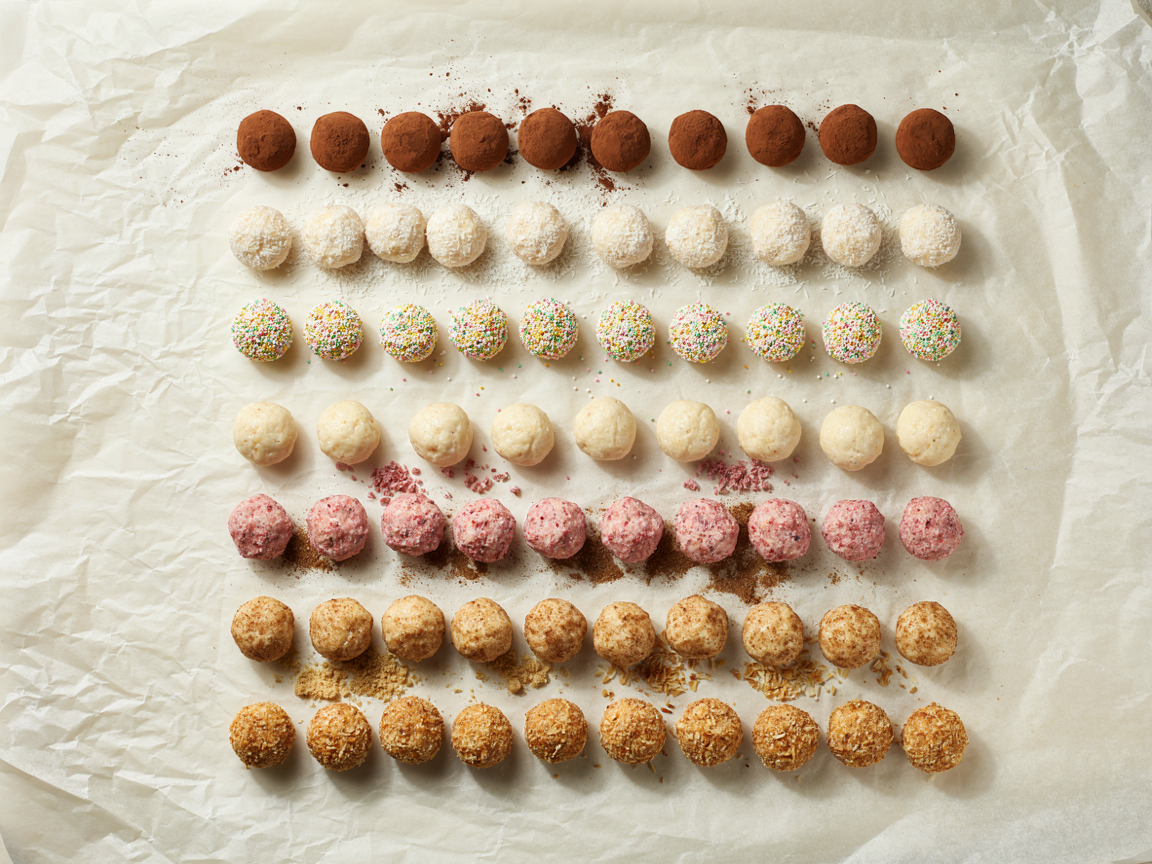
Same dough, eight directions. The coating does most of the visual work.
Every one of these is the base recipe with something added or swapped. Nothing below changes the method or the chilling times.
Vanilla birthday cake
Vanilla protein powder, an extra teaspoon of vanilla and 2 tablespoons of sprinkles folded in at the end. Roll in more sprinkles. The one that children actually eat without asking what is in it.
Chocolate peanut butter
Chocolate protein powder, peanut butter as the nut butter, and 2 tablespoons of cocoa added with the oats. Roll in cocoa. The most forgiving flavour if your protein powder is one of the chalkier ones.
Lemon blueberry
The zest of a whole lemon plus ⅓ cup of crushed freeze-dried blueberries. Use freeze-dried rather than fresh — fresh berries release water and the dough will not hold.
Cinnamon roll
1½ teaspoons of cinnamon in the dough and a coating of cinnamon sugar. A tablespoon of cream cheese in place of a tablespoon of the nut butter takes it much closer to the real thing.
Cookie dough
Brown sugar in place of the honey, mini chocolate chips, and an extra half teaspoon of vanilla. Heat-treat the oats at 350°F for 5 minutes first if you want it to taste properly like raw cookie dough.
Strawberry shortcake
⅓ cup of crushed freeze-dried strawberries and a coating of crushed shortbread or graham crumbs. Freeze-dried only, for the same water reason as the blueberries.
Coffee mocha
2 teaspoons of instant espresso powder dissolved in 1 teaspoon of hot water, plus 2 tablespoons of cocoa. Adds almost no calories and completely changes the flavour.
Coconut almond
Almond butter, ⅓ cup of desiccated coconut folded in, and a coating of toasted coconut. Toast the coating coconut in a dry pan for 2 minutes — untoasted it tastes of very little.
The freeze-dried rule: any fruit flavour has to use freeze-dried fruit, not fresh and not frozen. Fresh fruit is mostly water, and water turns this dough into a paste that will not hold a shape no matter how much oat flour you add to rescue it.
The Ratio, So You Can Stop Measuring
Once you have made these twice you will not need the recipe, because the whole thing is four components in a fixed relationship. Work in parts and you can build a batch from whatever is in the cupboard.
| Component | Proportion | What it does |
|---|---|---|
| ComponentBlended cottage cheese | Proportion4 parts | What it doesProtein and moisture. The base everything else is measured against |
| ComponentOat flour | Proportion3 parts | What it doesStructure. More makes them firmer and drier, less makes them sticky |
| ComponentProtein powder | Proportion1 part | What it doesProtein and thickening. Past 1 part the chalkiness starts to show |
| ComponentNut butter and syrup | Proportion1 part each | What it doesBinding and flavour. These are structural, not optional extras |
Adjusting for your powder: casein and plant proteins absorb far more liquid than whey. Mix the dough, then judge it by feel rather than by the recipe — it should hold together when squeezed but not stick to a dry finger. Add cottage cheese a tablespoon at a time if it is dry, oat flour a tablespoon at a time if it is wet.
Substitutions That Actually Work
| Instead of | Use | What changes |
|---|---|---|
| Instead ofCottage cheese | UseThick Greek yogurt, strained | What changesTangier and slightly looser; add 2 tbsp extra oat flour to compensate |
| Instead ofRolled oats | UseAlmond flour, the same volume | What changesLower carb and richer; the dough is softer, so chill it for 30 minutes rather than 20 |
| Instead ofHoney or maple syrup | UseDate paste, or a sugar-free syrup | What changesDate paste makes them denser and fudgier; sugar-free syrup needs an extra tablespoon of cottage cheese |
| Instead ofWhey protein powder | UseCasein, or a plant blend | What changesBoth absorb more liquid — add cottage cheese a tablespoon at a time until the dough holds |
| Instead ofNut butter | UseSunflower seed butter or tahini | What changesSchool-safe; tahini is noticeably more savoury, so add an extra teaspoon of sweetener |
| Instead ofProtein powder entirely | Use3 tbsp extra oat flour plus 2 tbsp extra cottage cheese | What changesMilder and more oaty, roughly 4g protein a ball instead of 6g |
| Instead ofA blender | UseA fine mesh sieve and a spatula | What changesWorks but takes about four minutes of pressing; a small food processor is far easier |
The one swap not worth making: low-fat cottage cheese to save calories. The fat is what carries the flavour and keeps the texture creamy, and you are saving around 20 calories across a batch of twelve. Use 2% or 4% and change something else if you need to.
Troubleshooting
Pick whatever went wrong:
They taste grainy and of cottage cheese
The curds were never broken down. The fix: there is no rescue once it is mixed, so tip the whole lot back into the blender with an extra tablespoon of cottage cheese and blitz it smooth, then re-chill. Next time, blend the cottage cheese alone for a full 60 seconds before anything else goes near it.
The dough is too sticky to roll
Under-chilled, or a wet brand of cottage cheese. The fix: chill for a further 20 minutes and roll with damp hands. If it is still sticking after that, work in oat flour one tablespoon at a time — but do the chilling first, because most sticky dough is simply warm dough.
They are dry and crumbly
Too much protein powder for the liquid, which happens easily with casein and plant proteins. The fix: add blended cottage cheese a tablespoon at a time until the dough holds together when squeezed. Different powders absorb wildly different amounts, so the recipe is a starting point rather than a rule.
There is a chalky protein powder aftertaste
Either under-mixing or the powder itself. The fix: mix more firmly so the powder is fully hydrated, and lean on cocoa, espresso powder or cinnamon, which mask it far better than vanilla does. A day in the refrigerator also softens the aftertaste noticeably.
They fell apart in the container
Not enough binder, usually from cutting the nut butter or the honey. The fix: both are structural rather than just flavour, so keep them at full quantity. Rolling the balls firmly rather than gently, and the second chill on the tray, both help them hold.
They went hard after a few days
Normal. The explanation: the oats keep drawing moisture out of the cottage cheese for several days. They are still good, just firmer. If you are making them for the week ahead, freeze half on day one and move them to the refrigerator the night before you want them.
Questions, Answered
Can you taste the cottage cheese in cottage cheese protein balls?
Not if you blend it properly. Blended until completely smooth, cottage cheese tastes mildly creamy and slightly tangy, closer to Greek yogurt than to anything recognisable as cottage cheese, and the vanilla, nut butter and sweetener cover what is left. Leave any curds in and you will taste them in every bite.
Do I really have to blend the cottage cheese?
Yes, and it is the one step worth being strict about. Curds do not break down during mixing, so they stay as small pale lumps with a distinct texture and flavour running through the finished balls. Sixty seconds in a small blender or food processor is all it takes and it changes the result completely.
What protein powder works best?
Whey or a whey-casein blend gives the cleanest flavour and binds well. Pure casein absorbs far more liquid and will need an extra tablespoon or two of cottage cheese, and most plant proteins are drier and chalkier still, so add liquid gradually rather than all at once. Vanilla is the most flexible flavour to keep on hand.
Can I make these without protein powder?
Yes. Leave it out and add 3 extra tablespoons of oat flour and 2 extra tablespoons of cottage cheese to keep the dough together. They still carry a useful amount of protein from the cottage cheese and nut butter, roughly 4g a ball rather than 6g, and the flavour is milder and more oaty.
How long do cottage cheese protein balls last?
Five days in an airtight container in the refrigerator. They are best from day one to day three; after that the oats keep absorbing moisture and the texture turns firmer and drier, though they are still perfectly good. They should always be kept cold rather than at room temperature.
Can I freeze them?
Yes, and they freeze very well. Freeze them in a single layer on a tray first so they hold their shape, then transfer to a bag for up to 3 months. Take one out 10 to 15 minutes before you want it, or eat it straight from frozen, which is genuinely good in summer.
Why is my mixture too sticky to roll?
Usually skipped chilling, and occasionally a wetter brand of cottage cheese. Refrigerate the dough for 20 minutes before rolling and wet your hands lightly. If it is still sticky after chilling, work in oat flour a tablespoon at a time until it just holds its shape.
How much protein is in each ball?
About 6g a ball for the base recipe made as 12, so a two-ball snack is around 12g of protein for roughly 165 calories. Using a higher-protein powder or dropping the oats to half a cup pushes it a little higher; adding chocolate chips and a coating brings the calories up without moving the protein.
Blend the cottage cheese alone for a full minute, chill the dough before you roll it, and judge the texture by feel rather than by the measurements, because every protein powder behaves differently. Everything else here is a flavour decision.
Pin these cottage cheese protein balls so the ratio and the eight flavours are there on the next meal-prep afternoon.