
3 Ingredients · No Added Pectin · The Exact Ratio
Lemon Marmalade Recipe: Three Ingredients, No Pectin, a Perfect Set
Lemons, sugar and water — nothing else. The seed trick that sets it without a pectin packet, the lemon-to-sugar-to-water ratio written out so you can scale it, and the cold-plate test that tells you when to stop boiling.
- 3 ingredients
- No pectin packet
- About 3 jars
- Printable card
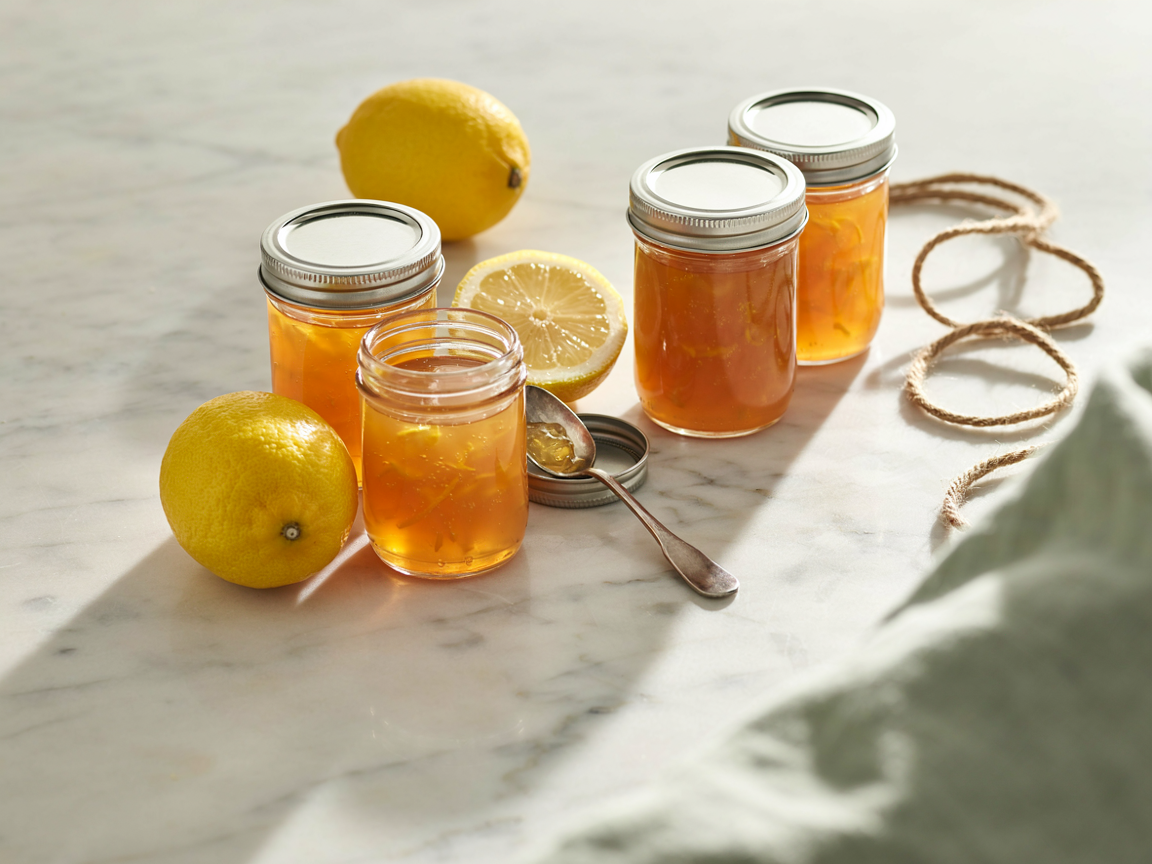
Three 8-ounce jars from one pound of lemons. The shreds should sit suspended, not floating on top.
This lemon marmalade recipe uses three ingredients and one of them is water. There is no pectin packet, no preserving sugar and no special equipment beyond a wide pot and a couple of plates in the freezer.
The part that does the work is the part most people throw away. Lemon seeds and white pith are among the richest natural sources of pectin there are — tie the seeds into a scrap of cheesecloth, simmer them with the fruit, and the marmalade sets itself.
The Lemon, Water and Sugar Ratio
Every marmalade question that begins “how many lemons” or “can I make it with three lemons” comes down to one proportion. Here it is, and it is the only number you need to remember.
1 lb lemons : 2 cups water : 2 cups sugar
That is roughly four large lemons, and it makes about three 8-ounce jars. Take the sugar to 2½ cups for a sweeter, firmer marmalade.
| Lemons | Water | Sugar | Makes | Simmer |
|---|---|---|---|---|
| Lemons8 oz (225 g) | Water1 cup | Sugar1–1¼ cups | MakesAbout 1½ jars | Simmer30–35 min |
| Lemons1 lb (450 g) — the base recipe | Water2 cups | Sugar2–2½ cups | Makes3 jars | Simmer40–45 min |
| Lemons2 lb (900 g) | Water4 cups | Sugar4–5 cups | Makes6 jars | Simmer50–60 min |
| Lemons3 lb (1.35 kg) | Water6 cups | Sugar6–7½ cups | Makes9 jars | Simmer60–70 min |
The one caveat about scaling up: the ratio scales cleanly but the time does not. A double batch needs more than double the boiling to reach setting point, because a deeper pot evaporates more slowly. Above about three pounds of fruit, marmalade becomes genuinely hard to set — two smaller batches will beat one large one every time.
Why Lemon Marmalade Sets Without Pectin
A set needs three things in the pot at once: pectin, acid and sugar. Most jam recipes have to buy the first one in a box. Lemons arrive carrying all three.
Pectin lives in the seeds and the pith
Not in the juice and not really in the flesh. Citrus concentrates its pectin in exactly the parts we normally discard, which is why a recipe that keeps them needs nothing from a packet.
Lemons bring their own acid
Pectin will not form a gel without acid, which is why apple and berry jams so often call for added lemon juice. A lemon marmalade has that requirement built in.
Sugar pulls the water out
Pectin can only set once enough water has left the mixture. Sugar draws it out and the hard boil evaporates the rest, which is what the 220°F target is really measuring.
Water is the third ingredient, and it is not filler
It gives the peel time to soften and the pectin time to migrate out of the seeds and into the pot. Too little water and the peel stays chewy however long you cook it.
Do not throw away the seeds. They look like nothing and they are the single most important thing in this recipe. Tie them in cheesecloth, simmer them with the fruit, and when you squeeze the bundle before adding the sugar you will see a clear, gluey liquid come out of it. That is pectin, and it is what gives the marmalade its wobble.
Lemon Marmalade Recipe
Three Ingredient Lemon Marmalade
Lemons, sugar and water, set by the pectin in the seeds and pith. No pectin packet, no preserving sugar, no canning experience needed.
How many jars?
Ingredients
- 3 large (⅔ lb)4 large (1 lb)8 large (2 lb)12 large (3 lb) lemons, unwaxed if you can get them
- 1⅓ cups2 cups4 cups6 cups water
- 1⅓–1⅔ cups2–2½ cups4–5 cups6–7½ cups granulated sugar — the lower figure for tart
- 1 square1 square1 square2 squares cheesecloth or muslin, plus kitchen string
- 2223 small plates, chilled in the freezer
- 2369 sterilised 8-ounce jars with lids
Instructions
Scrub the lemons and slice them thinly
Scrub the fruit under warm water, trim both ends, then halve each lemon from top to bottom, lay the halves flat side down and slice as thinly as you can manage — about the thickness of a coin. The thickness of your slices is the texture of your marmalade, so this is the one step worth slowing down for. Pick out the seeds as you go and drop them into a small bowl.
Tie the seeds into a bundle
Pile the reserved seeds, and any loose scraps of pith, into the middle of a small square of cheesecloth and tie it shut with kitchen string. This is where almost all of your setting power lives. Lemon seeds are one of the richest natural sources of pectin in any fruit, which is why this recipe needs no pectin packet at all.
Soak overnight — optional, but it is the better version
Put the sliced lemons, the water and the seed bundle in the pot, cover it, and leave it on the counter overnight, or up to 12 hours. The peel softens before it ever meets heat, the water draws pectin out of the seeds and pith in advance, and the next day’s simmer is shorter and gentler. Skip it if you are in a hurry — the recipe works without it — but an overnight soak is the difference between a good marmalade and a noticeably better one.
Simmer until the peel is completely soft
Bring the pot to a boil, then turn it down and simmer uncovered for 40 to 45 minutes, or 25 to 30 if you soaked overnight. Test a strand of peel by pressing it against the side of the pot — it should squash with no resistance and no chew. Peel that is still firm now will still be firm in the jar, because sugar sets the texture in place and nothing softens after this point.
Squeeze the bundle, then dissolve the sugar slowly
Lift the seed bundle out with tongs, let it cool for a moment, then hold it over the pot and squeeze hard. What comes out is thick, clear and gluey — that is the pectin, and you want all of it. Now add the sugar over low heat and stir until you cannot feel a single grain against the bottom of the pot. Rushing this is the most common cause of grainy marmalade.
Boil hard to setting point
Turn the heat up to a rolling boil that does not stop when you stir it, and let it go for 15 to 20 minutes. You are aiming for 220°F (105°C). As it approaches, the bubbles get slower and glossier and the whole surface changes character. Test on a plate you chilled in the freezer earlier: spoon a little on, wait 30 seconds, and push it with a fingertip. If it wrinkles and holds the line, it is done.
Rest five minutes, then jar it
Take the pot off the heat, skim any foam, and let it stand for five minutes before you ladle. Those five minutes are what stop all the peel floating to the top of the jar. Give it one gentle stir, fill sterilised jars leaving a little headspace, wipe the rims and seal.
Roughly, per tablespoon
Going to the full 2½ cups of sugar takes it to roughly 58 calories a tablespoon.
This is an estimate, not a lab analysis.
The Overnight Soak, and Whether to Bother
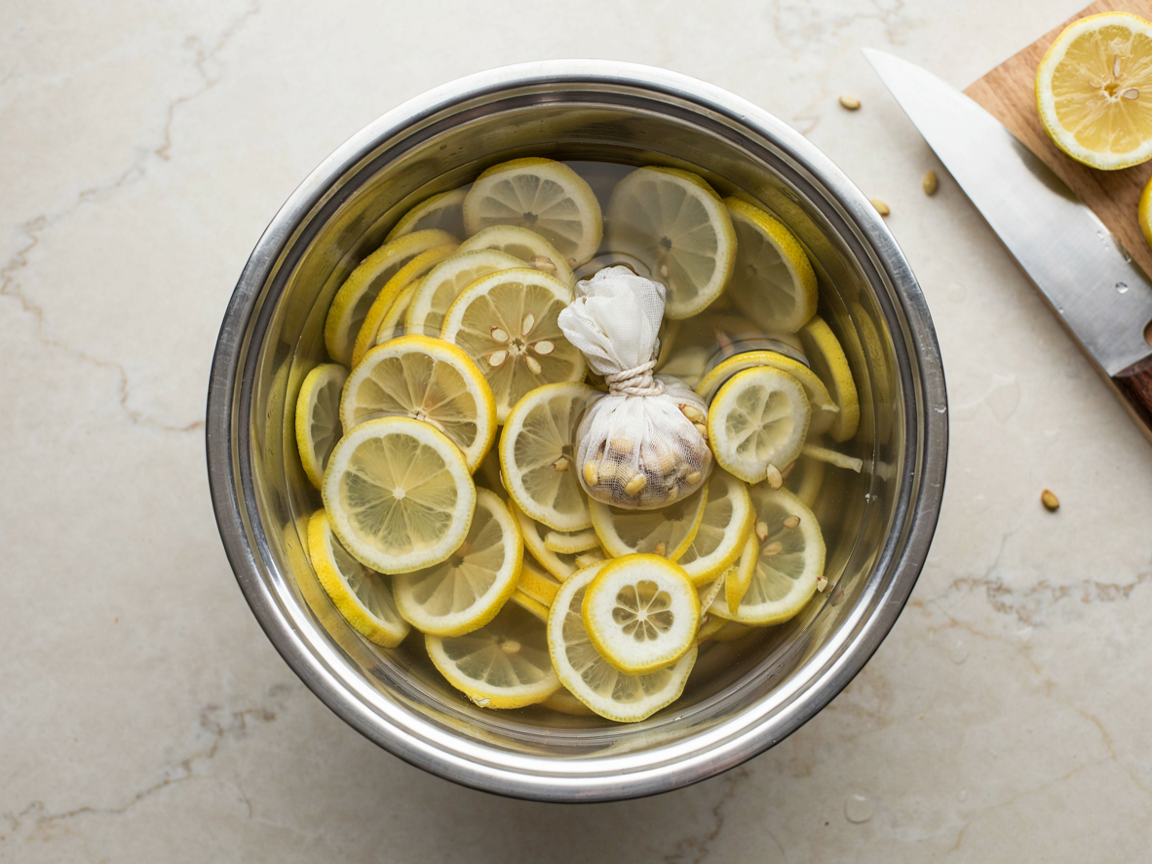
Sliced, covered with water, seed bundle in. Left overnight, the peel softens before it ever meets heat.
Most three-ingredient recipes mention the overnight soak in a parenthesis, if at all. It deserves better than that, because it changes two things.
The peel softens without heat
Twelve hours in cold water does what fifteen extra minutes of simmering does, without driving off any of the fresh lemon aroma that long cooking flattens.
More pectin is in the pot before you start
The seeds and pith leach pectin into the water overnight, so it is already dissolved and working when the heat goes on rather than being extracted during the cook.
The simmer gets shorter
25 to 30 minutes instead of 40 to 45. Less time on the heat means a brighter colour and a cleaner lemon flavour in the finished jar.
Nothing can go wrong while you sleep
Cover the pot and leave it on the counter. No refrigeration needed, no ingredients added yet, and nothing to check.
When to skip it: if you are making marmalade this afternoon, skip it. The recipe is built to work without it and the extra ten minutes of simmering makes up most of the difference. But if you can start it the night before, do — it is free, it is entirely passive, and it gives you softer peel and a more reliable set.
How to Know It Has Reached Setting Point
This is the only genuinely nervous moment in the whole recipe, and there are two ways through it. The cold-plate test is more reliable than the thermometer, and it costs nothing.
The cold-plate test
Chill two small plates in the freezer before you begin. Take the pot off the heat, spoon a little marmalade onto a cold plate and wait 30 seconds. Push it with a fingertip: if the surface wrinkles and holds the line where you pushed, it is set. If it floods straight back, boil 3 to 5 minutes more and test again.
The thermometer
220°F, or 105°C. Useful as a signal to start testing rather than as the final word — altitude, pan width and how much water was in your fruit all move the real setting point by a degree or two.
What it looks like
The bubbles change character. Early on they are fast, small and watery; at setting point they are slower, larger and glossier, and the marmalade falls off the spoon in a sheet rather than in drops.
When to stop regardless
Twenty-five minutes of hard boiling is about the limit. Past that the colour darkens toward caramel and the fresh lemon flavour goes, so take a loose set over an over-boiled one.
Wait a full day before deciding it failed. Marmalade keeps thickening for 24 hours after it goes into the jar, and a great many perfectly good batches get re-boiled the same evening by someone who checked too soon. Give it overnight on the counter first.
Peel, Pith and How Bitter It Comes Out
A gentle bitterness is what makes it marmalade rather than jam. How much of it you get is decided by two things, and one of them is not the option people reach for first.
| If you want | Do this | What changes |
|---|---|---|
| If you wantLess bitterness | Do thisSlice the peel thinner | What changesThin shreds carry less pith per spoonful, and they cook more evenly too |
| If you wantMuch less bitterness | Do thisBlanch the slices 1 minute, drain, then start | What changesRemoves a good deal of the bitter compounds and costs you very little set |
| If you wantA softer, sweeter jar | Do thisGo to the top of the sugar range | What changes2½ cups per pound of fruit rounds the edge off without changing the method |
| If you wantMore bitterness, deliberately | Do thisSwap one lemon for a grapefruit | What changesA proper marmalade bitterness, the kind people who grew up on it are looking for |
| If you wantDelicate shreds | Do thisHalve top to bottom, then slice flat side down | What changesThe cut direction is what gives you short shreds rather than long rings |
| If you wantTo keep the set | Do thisLeave the pith on | What changesIt is one of the two pectin sources — removing it is why marmalade fails to set |
On cutting the pith away entirely: it is the first thing people try and it is the wrong lever. The pith is one of the two places your pectin lives, so removing it removes your set. Thinner slices and a one-minute blanch get you the same reduction in bitterness without costing you the thing that makes the marmalade work.
Six Variations on the Same Method
The base never changes — pick a fourth ingredient:
Lemon and ginger
A thumb of fresh ginger, peeled and sliced paper-thin, goes in with the lemons at the start so it softens alongside the peel. Warm, slightly hot at the back of the throat, and the variation most people make twice.
Lemon and sea salt
A scant half teaspoon of flaky sea salt stirred in during the last minute of the boil, for a 3-jar batch. It does not taste salty — it sharpens the lemon and takes the flat edge off the sugar, the same way salt works in caramel. This is the one to make if you find ordinary marmalade cloying.
Vanilla lemon
The seeds scraped from half a vanilla pod, or a teaspoon of extract, stirred in off the heat at the very end. Heat drives vanilla off, so adding it early wastes it. Mellow, floral, and very good on scones.
Rosemary or thyme
One small sprig simmered with the fruit and fished out before the sugar goes in. Gives a savoury, grown-up marmalade that belongs next to sharp cheddar rather than on toast.
Mixed citrus
Swap one of the four lemons for an orange, a lime or a grapefruit. Orange softens it, lime sharpens it, grapefruit adds a proper bitterness. Keep the total fruit weight the same and nothing else changes.
Less sugar, more tart
Stay at the bottom of the sugar range, 2 cups for a 1 lb batch. It sets a little softer and keeps for less time, because sugar is also the preservative — store it in the refrigerator and use it within a few weeks.
Troubleshooting
Pick whatever happened:
It did not set
The most common problem and the most fixable. The fix: wait a full 24 hours first — marmalade goes on thickening as it cools and a great many perfectly good batches get re-boiled unnecessarily. If it is still loose the next day, tip it back into the pot, boil hard for another 3 to 5 minutes and re-test on a cold plate. The juice of one more lemon adds both acid and pectin if it resists.
It came out grainy
Sugar that never fully dissolved before the boil started. The fix: nothing saves a grainy batch cleanly, but next time keep the heat low after the sugar goes in and stir until you cannot feel a single grain on the bottom of the pot. It takes five minutes and it is the only way to prevent it.
It is too bitter
Some bitterness is what makes it marmalade rather than jam, but it can go too far. The fix: slice the peel thinner next time, or blanch the slices in boiling water for one minute and drain before you start. Going to the upper end of the sugar range also softens it. Do not remove the pith entirely — that is where a large part of your set comes from.
All the peel floated to the top
Jarred too soon. The fix: let the pot stand for a full five minutes off the heat, give it one stir, and then ladle. The marmalade thickens just enough in those minutes to hold the shreds in suspension.
It went dark and stiff
Boiled well past the setting point. The fix: start testing at 15 minutes rather than waiting for a thermometer to read exactly right. Over-boiled marmalade turns caramel-coloured and hard, and while it is still edible, the fresh lemon flavour is gone.
Storing Lemon Marmalade
| How it is stored | How long | What to know |
|---|---|---|
| How it is storedOpened, in the refrigerator | How long3 to 4 weeks | What to knowOnce the seal is broken, the refrigerator is the only place for it. Use a clean spoon every time. |
| How it is storedSealed, not water-bath processed | How longUp to 3 months | What to knowLadled hot into freshly sterilised jars and sealed at once, kept somewhere cool and dark. Check the lid has no give in the centre. |
| How it is storedWater-bath processed | How longUp to 1 year | What to knowTen minutes in a boiling-water bath makes the jars properly shelf-stable. This is the route if you are making a large batch or giving jars away. |
| How it is storedFrozen | How longUp to 6 months | What to knowIt freezes well and thaws with no change in texture. Leave headspace in the jar for expansion, and use plastic or wide-mouthed glass. |
Always check the seal before you trust a jar. The centre of the lid should have no give in it at all. Anything that smells fermented, shows mould, or has a lid that clicks when pressed goes in the bin — a jar of marmalade is not worth the argument.
Ways to Use It
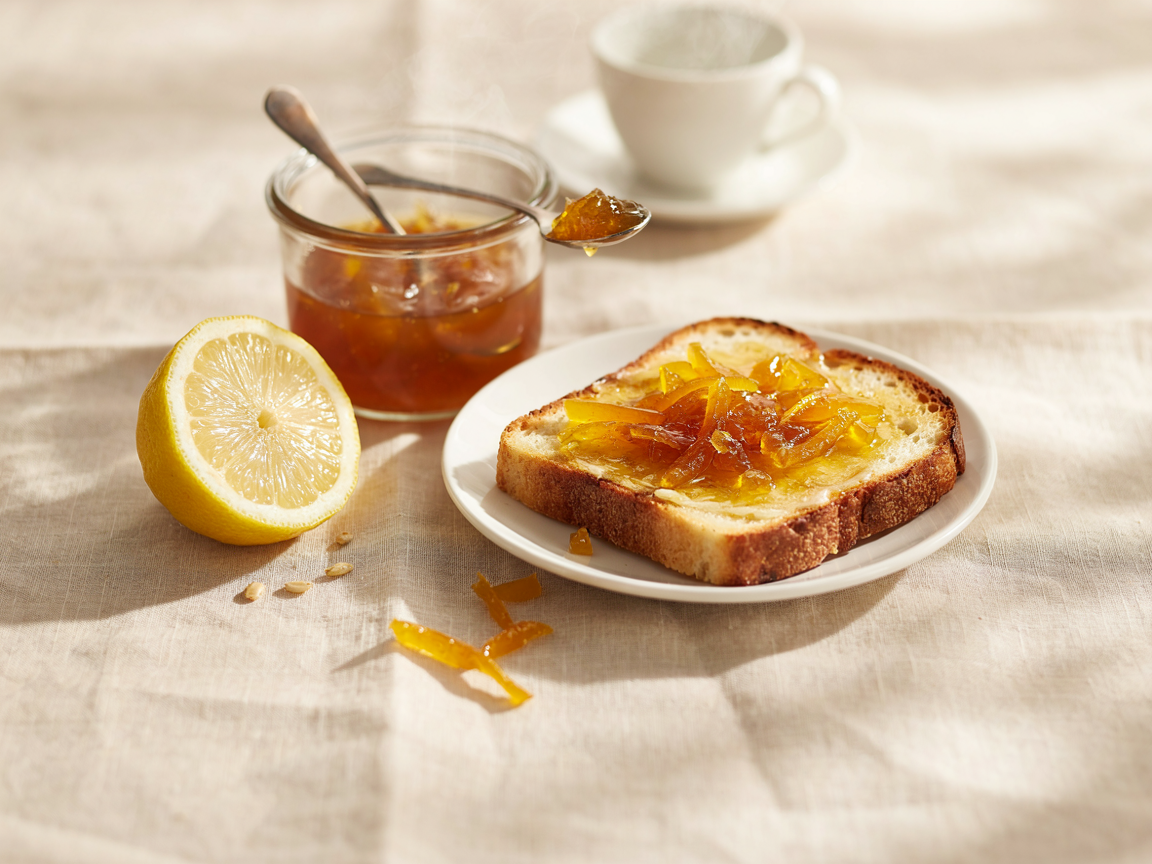
Warm toast, real butter underneath, marmalade thick enough to see the shreds.
On toast, and on everything like it
Thickly, on warm buttered toast, crumpets, scones or biscuits. The one it was invented for, and still the one it is best at.
As a glaze
A spoonful warmed and brushed over chicken, salmon or roasting carrots in the last ten minutes. The sugar caramelises and the lemon cuts the fat.
As a dipping sauce
Stirred loose with a little warm water and a pinch of chilli flakes. Three minutes, no cooking, and it turns a jar of marmalade into something for a party platter.
Swirled into breakfast
Through plain yogurt, over porridge, or folded into pancake batter just before it hits the pan so the shreds stay whole.
On a cheese board
Beside a sharp cheddar or a soft white cheese. Marmalade does what chutney does, with a brightness chutney has not got.
Baked into things
As the filling in thumbprint cookies, between layers of a sponge, or spread thinly on shortbread before the second layer goes on.
As a gift: three jars means you keep one and give two away. Write the flavour and the date on the label, and add a line saying to refrigerate it once it is opened — it is the detail people most often forget, and it is the difference between a jar that lasts a month and one that does not.
Questions, Answered
Can you make lemon marmalade with frozen lemons?
Yes, and there is an argument it works better. Freezing ruptures the cell walls in the peel and pith, so the fruit softens faster once it is cooking and releases its pectin more readily. Slice them while still part-frozen if you want neat shreds, or thaw them completely in a bowl and tip every drop of the thawing juice into the pot — that juice is full of acid and pectin. Do not freeze them already sliced with sugar on them; freeze the whole fruit.
What is the lemon to sugar to water ratio for marmalade?
One pound of lemons to two cups of water to two cups of sugar, by volume, is the working rule. That gives about three 8-ounce jars. Take the sugar up to two and a half cups for a sweeter, firmer set, or stay at two for a tarter one. The ratio scales cleanly, but the boiling time does not — a double batch needs noticeably more than double the time to reach setting point, and batches above about three pounds of fruit become hard to set at all.
Can I make lemon marmalade without the pith?
You can, but you will probably regret it. The white pith is one of the two places the pectin lives — the seeds are the other — so removing it means removing the thing that sets your marmalade. If the pith is what you object to, the answer is thinner slices and a one-minute blanch rather than cutting it away. If you are set on removing it, keep every seed and expect to boil for longer.
What is the difference between lemon marmalade and lemon jam?
Marmalade includes the peel; jam does not. That is the whole distinction. Because the peel brings both the bitterness and most of the pectin, marmalade sets on its own and tastes more complex, while a lemon jam made from flesh and juice alone usually needs added pectin and tastes simply sweet and sour.
Do I really not need pectin?
No packet pectin at all. Lemons are among the most pectin-rich fruits there are, and it is concentrated in the seeds and pith — exactly the parts most recipes throw away. Simmer the seed bundle with the fruit, squeeze it before the sugar goes in, and boil to 220°F, and the marmalade sets by itself.
Can I use bottled lemon juice?
No. The recipe is built on the whole fruit: the peel gives the texture and the flavour, the pith and seeds give the set. Bottled juice gives you none of those things, and what you would get is a thin lemon syrup that never thickens.
Do I have to sterilise the jars?
For anything beyond a few days in the refrigerator, yes. Wash them in hot soapy water and either run a hot dishwasher cycle or heat them in a 250°F oven for 10 minutes, and boil the lids separately. Fill them while both the jars and the marmalade are still hot.
Slice thinly, keep the seeds, dissolve the sugar before you boil, and test on a cold plate rather than trusting the clock. That is the entire recipe, and everything else on this page is detail around those four things.
Pin this lemon marmalade recipe so the ratio is there the next time you have a bowl of lemons and an afternoon.